


Apple reported fiscal fourth-quarter earnings on Thursday that beat Wall Street expectations on revenue and earnings per share.
However, Apple came up short versus revenue expectations in core product categories including the company’s iPhone business and services.
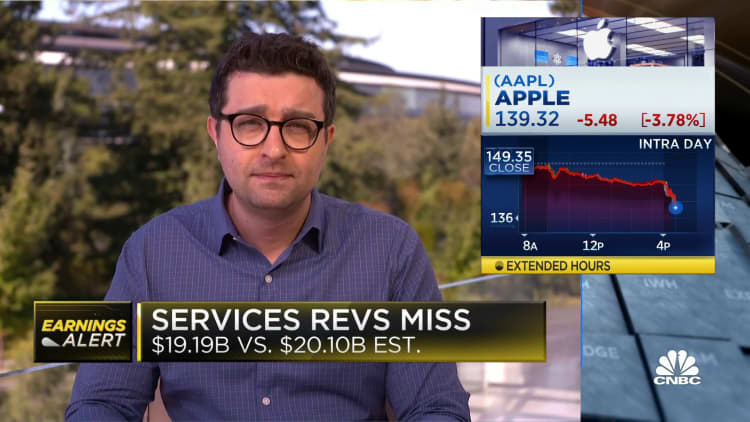
Apple shares fell over 1% in extended trading.
Here is how Apple did versus Refinitiv consensus estimates:
- EPS $1.29 vs. $1.27 est.
- Revenue. $90.15 billion vs. $88.90 billion estimated, up 8.1% year-over-year
- iPhone revenue: $42.63 billion vs. $43.21 billion estimated, up 9.67% year-over-year
- Mac revenue: $11.51 billion vs. $9.36 billion estimated, up 25.39% year-over-year
- iPad revenue: $7.17 billion vs. $7.94 billion estimated, down 13.06% year-over-year
- Other Products revenue: $9.65 billion vs. $9.17 billion estimated, up 9.85% year-over-year
- Services revenue: $19.19 billion vs. $20.10 billion estimated, up 4.98% year-over-year
- Gross margin: 42.3% vs. 42.1% estimated
Apple did not provide official guidance for its first fiscal quarter, which ends in December and contains Apple’s biggest sales season of the year. It hasn’t provided guidance since 2020, citing uncertainty.
However, Apple CFO Luca Maestri gave investors a few data points that caused the stock to dip during the company’s earnings call.
He said that total year-over-year revenue would grow in December less than the 8.1% during the September quarter. He added that Mac sales would actually decline in the December quarter on an annual basis. He also said that services would grow year-over-year during the quarter, but would be hurt by the macroeconomic environment.
“We’re not providing revenue guidance, but we are sharing some directional insight,” Maestri said.
Apple increased revenue by 8% during the quarter, and Apple CEO Tim Cook told CNBC that it would’ve grown “double-digits” if not for the strong dollar. Total sales in Apple’s fiscal 2022 were up 8% to $394.3 billion.
“The foreign exchange headwinds were over 600 basis points for the quarter,” Cook told CNBC’s Steve Kovach. “So it was significant. We would have grown in double digits without the foreign exchange headwinds.”
Cook told CNBC that Apple had slowed the pace of its hiring. Other tech companies are looking to make cuts ahead of a possible recession and as interest rates rise.
“We are hiring deliberately. And so we’ve slowed the pace of hiring,” Cook said.
Although Apple’s iPhone business increased sales by over 9% on an annual basis, it came up short versus analyst expectations. Apple’s September quarter had 8 days of iPhone 14 sales, and analysts are closely looking for details about if Apple customers are trading up for more expensive models or if the new devices are poised to sustain higher sales through Apple’s fiscal 2023.
iPhone 14 phones on display inside an Apple store in Marunouchi, Tokyo.
Stanislav Kogiku | SOPA Images | Lightrocket | Getty Images
Cook indicated that Apple’s performance in phone sales was strong despite signs that other smartphone companies are struggling with a recent decrease in demand and said the company grew “switchers,” or people who bought an Apple phone after having an Android device. He added that the company’s high-end phones, the iPhone 14 Pro, were supply constrained.
“We clearly countered the industry trends on the phone if you look at third party estimates of what the smartphone industry did,” Cook said.
Cook said that supply issues didn’t significantly affect Apple during the period, after several quarters in which supply shortages hurt Apple’s sales. Cook told CNBC said it was paying less for some memory chips.
Apple’s services business also missed estimates.
Apple’s services business reported just under 5% growth during the quarter, a significant slowdown for the investor-favorite and profitable business line versus last quarter, which was 12%.
For the fiscal year, Apple services grew just over 14% to $78.13 billion, a slower rate of growth than 2021’s 16% annual increase, and much slower than 2020’s 27% services growth.
The business includes several different lines, including Apple’s online services like Apple Music and Apple TV+, revenue from the App Store, hardware warranties, and search deals with companies like Google. Apple said it had 900 million total subscriptions, which includes subscriptions to apps through Apple’s App Store.
Apple recently increased prices for Apple Music and Apple TV+, but the increases started during the December quarter.
Cook said the price increases were “disconnected” from Apple’s services performance.
“Well, if you look at the price increases as an example, Music, the licensing cost has increased,” Cook said.
He added that Apple TV+ has more shows now, so Apple feels that the product is more valuable.
Investors generally like Apple’s move into services because the products are more profitable than Apple’s hardware and often bring in recurring revenue.
There were a few bright spots in Apple’s report. Mac sales were up over 25% to $11.51 billion, even as data points from parts suppliers, chipmakers, and competing PC firms were pointing during the quarter to a significant slowdown in laptop and desktop sales after two boom years during the pandemic.
Apple’s Other Products category, which includes Apple Watch and AirPods, also saw an annual increase and beat Wall Street expectations. Some analysts believed that Apple’s wearables were most likely to be hurt if recessionary fears slowed discretionary spending. That business increased nearly 10% year-over-year to $9.65 billion.
Apple’s iPad, which had been hampered by supply issues, decreased nearly 10% year-over-year and is Apple’s smallest individual line of business. The company recently released new models in October, which could boost sales just after the September quarter finished. Cook said that it was a difficult comparison because last year, Apple released new iPads in September.
