


Angola’s announcement on Thursday that it will stop the oil producers’ Business of the Petroleum Exporting Countries (OPEC) delivers to a head longstanding tensions within the impressive group, but market effects is probably to be limited, according to analysts.
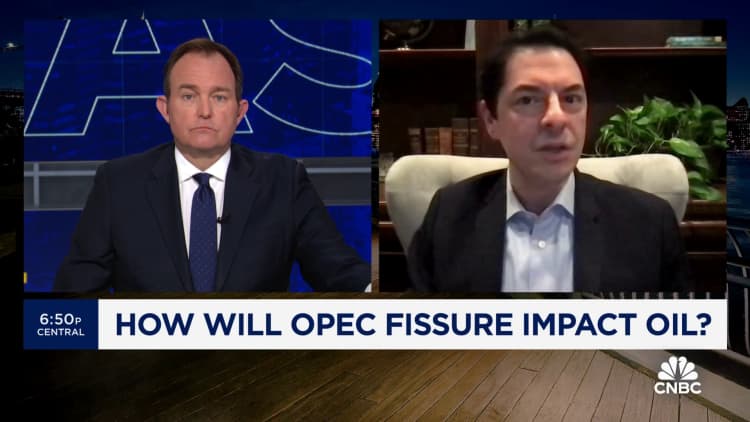
The go “did not appear as a surprise, [as] the writing was on the wall already very last month,” Clay Seigle, director of the worldwide oil services at Rapidan Power Team, advised CNBC’s “Previous Phone” Thursday.
A conference of the prolonged OPEC+ team in November was dominated by a deep disagreement on production baselines — the levels that decide quotas and compliance — with oil-reliant Angola and Nigeria both equally opposing initiatives to deepen their baselines as they find to increase their declining outputs. Angola’s oil minister said Thursday that OPEC membership no extended served the country’s pursuits.
Angola’s exit leaves OPEC with 12 customers, with crude oil production of about 27 million bpd, or all over 27% of the environment oil industry, in accordance to Reuters. Angola accounted for much less than 4% of OPEC output, Scotiabank analysts mentioned.
Angola follows on the footsteps of Ecuador and Qatar, which still left the corporation in 2020 and 2018, respectively.
“We consider it’s truly a one and completed shift between Angola and OPEC,” Seigle explained to CNBC’s Brian Sullivan.
“The sector should really not get complacent, wondering that OPEC cohesion is slipping apart and there’s likely to be some kind of domino effect.”
Giovanni Staunovo, commodities analyst at UBS, pointed out that oil selling prices had previously rebounded from a dip on Thursday.
“The clarification is that from an oil marketplace provide standpoint, the affect is negligible as oil creation in Angola was on a downward pattern in excess of the previous a long time,” he mentioned in emailed responses Friday.
“No just one expects that the departure of Angola from OPEC is very likely to consequence in much more barrels hitting the market, as bigger output would first need larger investments.”
The industry has concerns about unity, but there is no indication at present that heavyweights within the alliance intend to stick to Angola’s path, Staunovo added.
Mounting stress
Analysts at Scotiabank explained in a observe on Thursday that, although there would be no effect on worldwide oil supply owing to Angola previously maximizing its production, the latest OPEC departure was “a further instance of the climbing pressure” in the team.
“We would not be shocked if other far more marginal gamers this sort of as Congo, [Equatorial Guinea], Gabon, etc. revisit their OPEC membership,” they wrote.
The analysts consequently hope a slightly detrimental effect on energy shares in the in close proximity to-expression, since the shift “delivers a fresh new excuse for the gamers to lengthen their adverse bias in the oil market place.”
Extra considerable than Angola’s departure is the forthcoming introduction of Brazil to OPEC+ — which reunites OPEC customers and allies like Russia — and the actuality that U.S. crude output is at present at report highs, Rapidan’s Clay Seigle stated.
“[Those producers] are seriously moving the needle on world-wide provide-need balances and in a way presenting a little bit of a obstacle for the members of OPEC+ to control a pretty nicely-supplied market, relative to desire, not just in the coming yr 2024 but in the next numerous yrs.”
“That is heading to be the obstacle they experience, in trying to send the appropriate indicators to the sector that they have the functionality and the cohesion to proceed that equilibrium,” Seigle included.
Brazil has nonetheless to settle for a generation quota, and its strength minister stated in November that the nation must however evaluate the document that underpins the OPEC+ partnership.


