


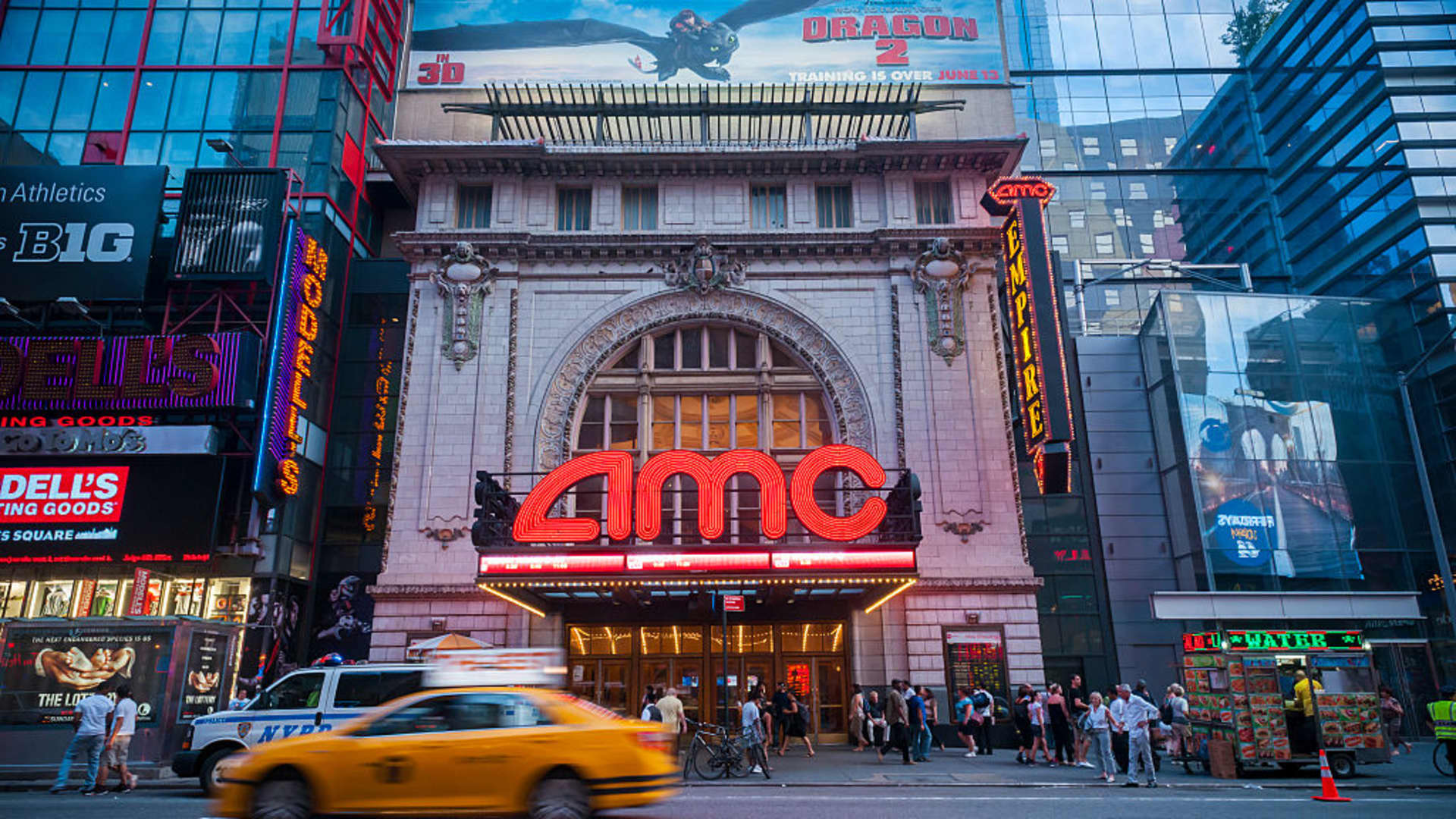
The AMC 25 Theatres in Times Square in New York is seen on Tuesday, July 8, 2014.
Richard Levine | Corbis News | Getty Images
AMC Entertainment hit a new 52-week low Wednesday as the movie theater company contends with a massive debt load, dilution of its stock and a film release schedule short on blockbusters.
Shares of the world’s largest movie theater company have fallen about 80% to under $6 so far this year, as investors question the company’s capital structure and overall business strategy.
The company came back from the brink of bankruptcy in 2021 thanks to millions of retail investors who turned its shares into a meme stock. Since then, AMC has devised several plans to raise more capital to pay down its debts and invest in acquisitions, theater upgrades, a popcorn business and even a gold mine.
In its latest effort, AMC issued a dividend to all common shareholders in the form of preferred shares called “APE,” a reference to the “Apes” moniker adopted by meme stock investors. However, analysts say the company was unable to fully capitalize on selling off these new shares before disillusioned investors pulled their support.
For now, AMC has enough cash in hand to survive and operate for the next several years, said Eric Handler, media and entertainment analyst at MKM Partners. As of June 30, AMC had availability liquidity of more than $1.17 billion. Its share slump, he added, is “purely about the capital structure.” Even at its depressed price, the stock is overvalued, according to Handler.
AMC has also struggled to post a profit in recent quarters, and its debt load is $5 billion, about $2 billion more than its market value. The company amassed the debt prior to the pandemic, when it acquired several smaller theater chains and invested in upgrading its theaters seating and screens. While AMC may have delayed its debt payments, “that doesn’t necessarily mean it’s going to be a favorable environment when they do have to refinance,” said Alicia Reese, an analyst at Wedbush.
Reese noted that initial declines in the stock came as management executives sold off shares when they were at their height in mid-2021and steadily declined in the months that followed. There was another selloff in August, when AMC announced that it was issuing a dividend to all shareholders in the form of preferred APE shares.
“AMC could have capitalized on that, if they had moved very quickly,” she said. “And if they had sold enough shares to wipe out their debt balance, they could have done that. They would have lost all of their retail shareholders pretty quickly, but then they would have been a bit more attractive, fundamentally, even though the share count would have been pretty massive.”
Representatives from AMC did not immediately respond to CNBC’s request for comment.
Rise of the APEs
In an August letter to shareholders, CEO Adam Aron said the APE shares would “deeply and fundamentally” strengthen AMC. “Given the flexibility that APEs will give us, we likely will be able to raise money if we need or so choose, which immensely lessens any survival risk as we continue to work our way through this pandemic to recovery and transformation,” he wrote.
Then, in late September, the company hired Citigroup as an underwriter to help it sell up to 425 million units of its preferred stock. Reese noted that that sale could amount to around $750 million, a “small dent” in the company’s overall debt.
“To me, it looks like a lost opportunity,” she said. “And now APE shares are priced so low that it’s not as great to position as they saw themselves in mid August.”
APE shares, which started trading in August, were down around 5% on Wednesday, falling to their lowest point yet. The shares have a 52-week high of $10.50, which was achieved in late August.
These APE shares were designed as a workaround, of sorts, to help free up AMC to sell additional units of stock as it works to revive its business after the pandemic. The company raised billions during the pandemic by selling new stock but ran out of shares to sell. Investors, including AMC’s most stalwart fans, feared dilution and rejected the company’s efforts to issue additional stock.
Reese noted that before the retail investors began buying up stock in late 2020 and early 2021, AMC had around 100 million shares outstanding. That number ballooned to 500 million over the next two years.
Now, the combination of AMC’s regular shares and its APE preferred stock equates to more than a billion outstanding shares.
“They’ve been diluted into oblivion,” Reese said.
Where have all the blockbusters gone?
Also weighing on investors is a significant lack of blockbuster content during the last few months of the year.
There are only four would-be blockbuster releases coming to theaters before the end of the year: Warner Bros.′ “Black Adam (Oct. 21), and Disney’s “Black Panther: Wakanda Forever” (Nov. 11), “Strange World” (Nov. 23) and “Avatar: The Way of Water” (Dec. 16.)
In 2019, there were nearly two-dozen blockbuster-style films slated on the calendar for the last four months of the year, including “Star Wars: The Rise of Skywalker,” which generated $177 million in domestic ticket sales during its opening weekend.
Audiences have returned to cinemas in the wake of the coronavirus pandemic and are spending more than ever on tickets and popcorn. However, the lack of steady theatrical releases will weigh heavily on the industry during the final months of the year. AMC should be able to ride out this lack of content because of its significant cash stockpile.
“You need your dry powder to guard against any type of disruptions,” Handler said. “I think they can limp along for many years with their current balance sheet.”
Hollywood production has ramped back up, and the release calendar will improve in 2023 and beyond. Currently, the 2023 box office is expected to reach around $9.5 billion in total ticket sales, according to estimates from Eric Wold, senior analyst at B. Riley Securities. For comparison, the 2019 box office reached $11.4 billion.
“I think the outlook is positive for AMC with the potential to return to pre-pandemic box office by 2024,” he said.


