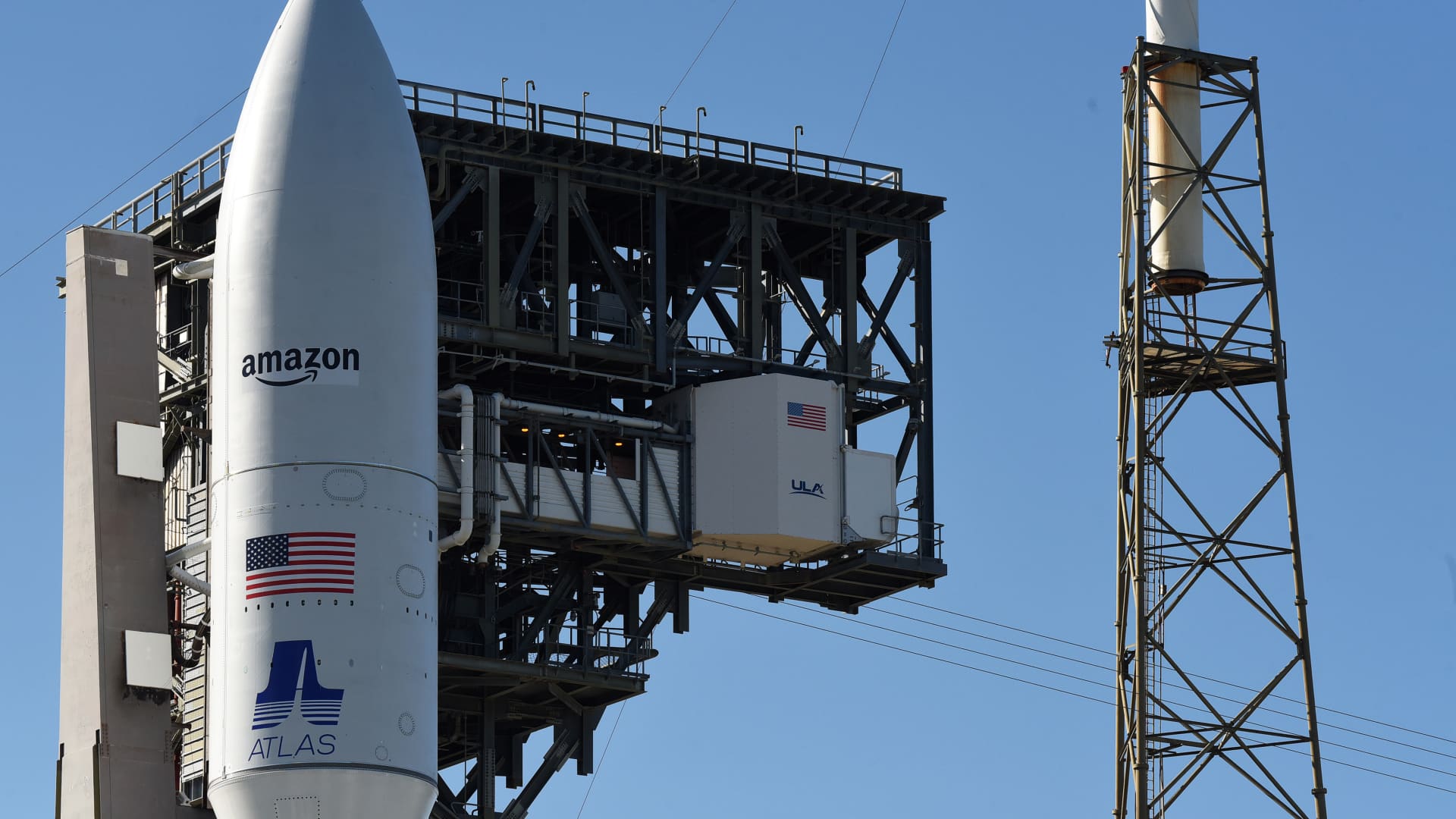
United Launch Alliance Atlas V rocket carrying the first two demonstration satellites for Amazon’s Project Kuiper broadband internet constellation stands ready for launch on pad 41 at Cape Canaveral Space Force Station on October 5, 2023 in Cape Canaveral, Florida, United States.
Paul Hennessey | Anadolu Agency | Getty Images
Your Amazon order of satellite internet is about to ship.
More than four years since the tech giant announced its ambitious plan to invest heavily in building a global satellite internet network, Amazon on Friday is set to launch the first pair of prototypes for its Project Kuiper system.
“We’ve done extensive testing here in our lab and have a high degree of confidence in our satellite design, but there’s no substitute for on-orbit testing,” Project Kuiper vice president of technology Rajeev Badyal said in a statement before the launch.
Project Kuiper is Amazon’s plan to build a network of 3,236 satellites in low Earth orbit, to provide high-speed internet access anywhere in the world. The company plans to invest upwards of $10 billion to build Kuiper, and recently broke ground on a $120 million pre-launch processing facility in Florida.
Sign up here to receive weekly editions of CNBC’s Investing in Space newsletter.
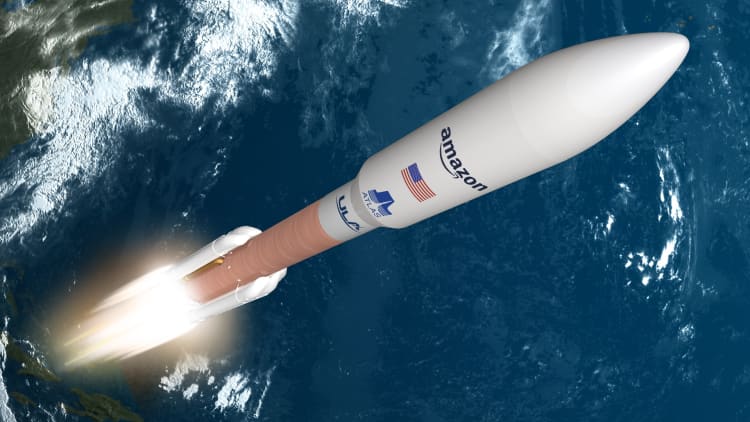
Called “Protoflight,” Friday’s mission will see United Launch Alliance’s Atlas V rocket carry two satellites – Kuipersat-1 and Kuipersat-2 – into low Earth orbit. The rocket is launching from ULA’s pad SLC-41 in Cape Canaveral, Florida, with a two hour launch window opening at 2 p.m. ET.
If the launch is postponed for weather or technical reasons, ULA has a backup window on Saturday.
United Launch Alliance Atlas V rocket carrying the first two demonstration satellites for Amazon’s Project Kuiper broadband internet constellation stands ready for launch on pad 41 at Cape Canaveral Space Force Station on October 5, 2023 in Cape Canaveral, Florida, United States.
Paul Hennessey | Anadolu Agency | Getty Images
Amazon twice switched rides for the pair of satellites before finally deciding to go with the immediately available, albeit far overpowered, Atlas V rocket for the Protoflight mission. Amazon originally planned to launch on ABL Space’s RS1 rocket, before delays in RS1’s development moved the satellites to United Launch Alliance’s Vulcan rocket, but delays to Vulcan’s debut moved the satellites to Atlas V.
Information about the size and design of the pair of Amazon’s satellites has been scarce – with the company only sharing photos of the shipping containers that delivered the spacecraft to Florida. Even ULA’s details about the launch are limited, with the info provided comparable to when the rocket company flies classified spy satellites for the U.S. government.
Last year, Amazon announced the biggest corporate rocket deal in the industry’s history to launch Kuiper satellites, signing launch contracts with ULA, Arianespace, and Jeff Bezos’ Blue Origin. As part of that deal, Amazon expects to pay about $7.4 billion for Kuiper launches over the next five years.
It has booked 77 launches – deals that include options for more launches when needed – from that trio of companies to deploy the satellites fast enough to meet regulatory requirements. That massive purchase has come under scrutiny from an Amazon shareholder lawsuit, which alleges the company snubbed SpaceX for valuable satellite launch contracts because of Jeff Bezos’ personal rivalry with Elon Musk.
Amazon is playing catch up to SpaceX, which has grown its Starlink satellite internet service to more than 2 million customers. Crucially, SpaceX says it is no longer absorbing the cost of the Starlink antennas it sells with the service, and the more than 5,000 satellites its launched so far now serve consumer, enterprise, and government customers.
Earlier this week, Amazon reiterated that its first production Kuiper satellites are on track to launch in the first half of next year – with plans to begin beta testing the network with customers by the end of 2024.
The “ultra-compact” version of the Project Kuiper
Amazon
Protoflight represents an “end-to-end” test of Kuiper. Amazon will look to verify the prototype satellites can connect to ground antennas and relay that connectivity on to its small customer terminals.
This year Amazon revealed a trio of satellite antennas that it plans to sell to Kuiper customers. The company has yet to say what it expects to charge customers for the hardware or service. Earlier field testing of Amazon’s Kuiper antennas saw download speeds of up to 400 Mbps.
The company’s main Kuiper facilities are near Seattle – in the Washington cities of Redmond and Kirkland. Amazon has other locations in San Diego, Austin, Texas, New York City and Washington, D.C.