


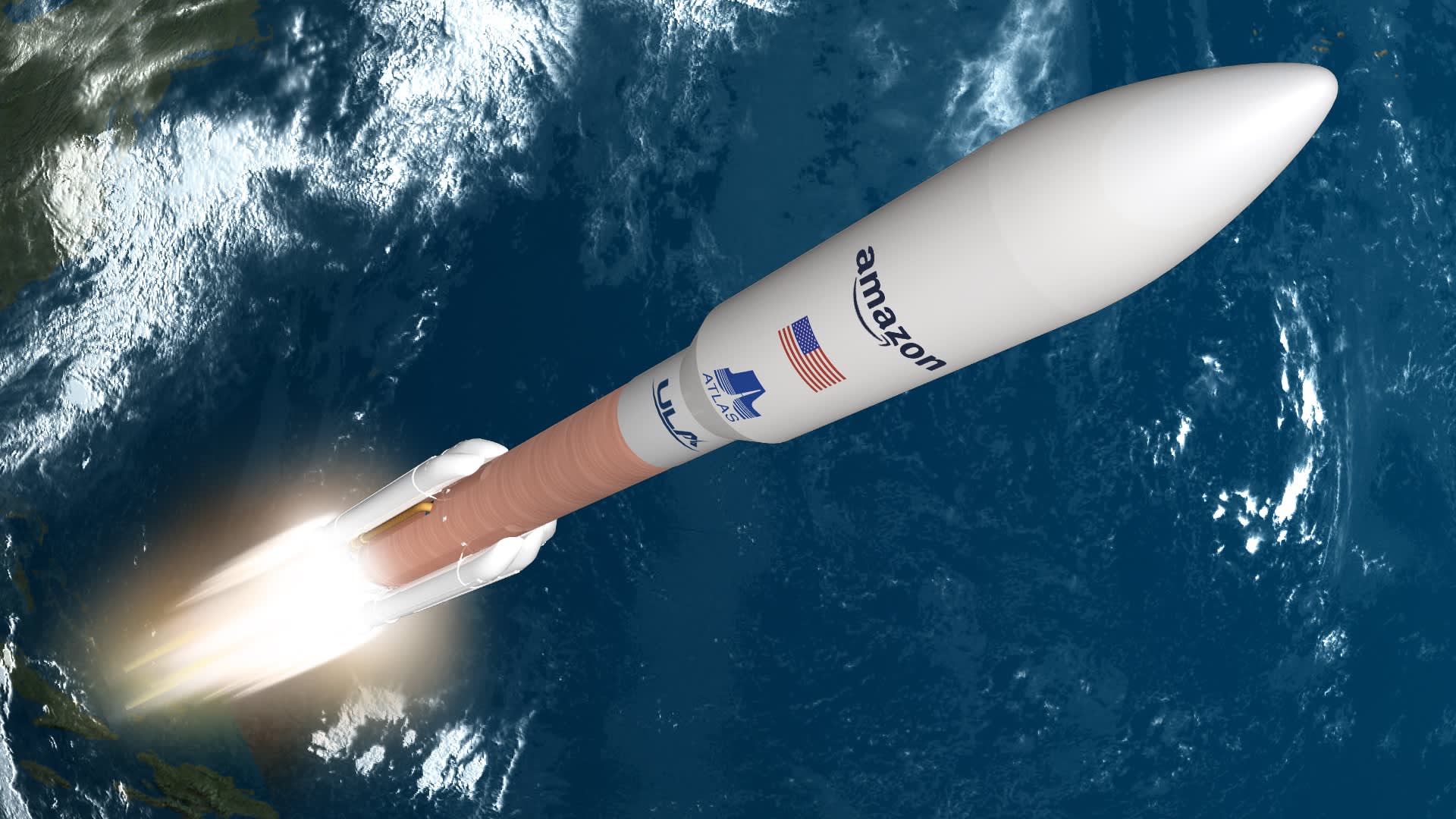
Amazon has a plan to deliver internet from space using 3,236 small satellites in low Earth orbit. It’s called Project Kuiper.
In April, the company signed a multibillion-dollar contract — the largest rocket deal in the history of the commercial space industry — for launches of its Kuiper satellites with three different entities: Jeff Bezos’s Blue Origin, United Launch Alliance (a joint venture of Boeing and Lockheed Martin) and Europe’s Arianespace.
“In many ways, it’s a response and a competition to Elon Musk and SpaceX with its Starlink network,” said CNBC space reporter Michael Sheetz. Amazon first revealed Project Kuiper in 2019, but the company’s announcement last month gave it new momentum.
SpaceX’s Starlink already has about 2,000 satellites in orbit, serving about 250,000 total subscribers. The Federal Communications Commission has approved SpaceX to launch a total of 12,000 satellites.
Amazon hasn’t yet launched a single satellite, but it could still be a big player in the game.
“The satellite communications market is one that’s valued at a few tens of billions of dollars,” said Caleb Henry, a senior analyst at Quilty Analytics. “No one in this industry believes that it’s a one-system-take-all kind of environment. We expect to see at least two and probably more constellations go forward, serving not only the residential consumer, but any type of business or organization that relies on internet connectivity.”
An estimated 37% of the world’s population has still never used the internet, with 96% of those people living in developing countries, according to data from the International Telecommunication Union, a United Nations organization. And Amazon joins a list of tech giants, along with Facebook and Google, that have invested in developing digital infrastructure to support their own core services.
“Amazon is known as the everything company, and it’s hard to have an everything company without internet,” said Henry. “Amazon’s fastest-growing segment has been its AWS cloud service. And in support of that, they’ve built out a tremendous amount of internet infrastructure, whether it’s data centers or fiber.”
Henry said space is a “very natural expansion” of Amazon’s data business and its consumer business, “providing goods and electronics and resources to people around the world.”
Watch the video above to learn how Amazon’s Project Kuiper satellite internet service will compete with SpaceX’s Starlink, and why the e-commerce giant is positioned to deliver connectivity throughout the globe in the near future.


