



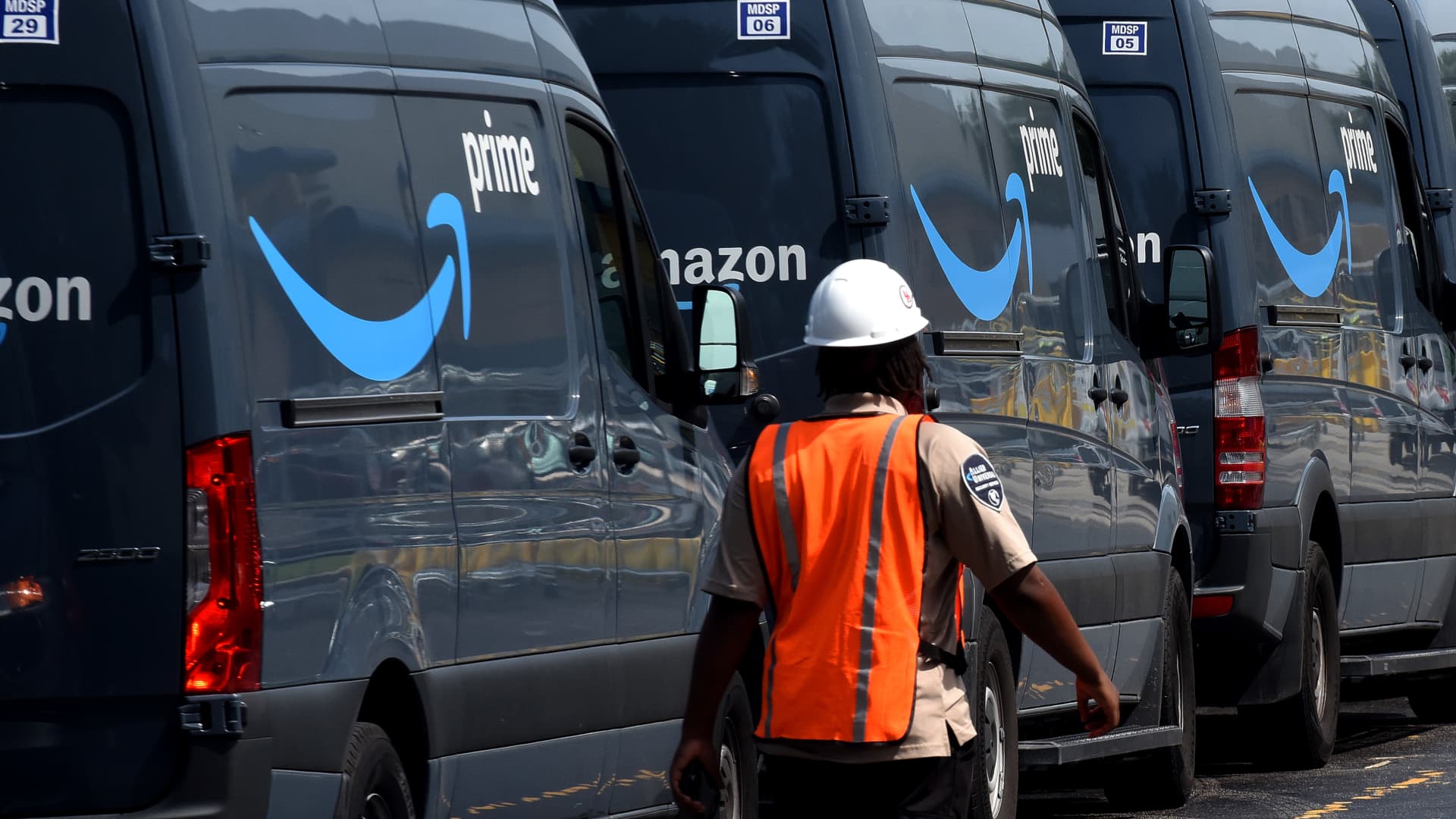
Amazon vans line up at a distribution center to pick up packages for delivery on Amazon Prime Day in Orlando, Florida.
Paul Hennessy | NurPhoto | Getty Images
Amazon’s carbon emissions jumped 18% last year, as the company reckoned with a pandemic-driven surge in e-commerce and grew its business to meet that demand.
In its annual sustainability report issued Monday, Amazon said its activities emitted the equivalent of 71.54 million metric tons of carbon dioxide in 2021. That’s up 18% from 2020, and an increase of nearly 40% from 2019, the year Amazon first began disclosing its carbon footprint.
Amazon lowered its carbon intensity, which measures emissions per dollar of sales, by 1.9% in 2021, compared with a 16% decline in 2020.
The Covid-19 pandemic led to a massive influx of orders at Amazon and other e-commerce companies. Many consumers, flush with stimulus checks, opted to do their shopping online to avoid risking exposure to the virus.
The wave of demand pushed Amazon to expand its logistics network of delivery vans, planes and trucks. It rapidly launched new warehouses to process the stream of orders. Between 2020 and the end of 2021, Amazon doubled the size of the fulfillment network it had built over the previous 25 years, the company said.
The company also added more data centers to support Amazon Web Services, as Covid-19 sped up corporations’ shift to the cloud.
Amazon unveiled its “Climate Pledge” in 2019. As part of the plan, Amazon has committed to be carbon neutral by 2040, and it purchased 100,000 electric delivery vans from Rivian Automotive that it expects to have on the road in the U.S. by 2030. It also launched a $2 billion venture capital fund to invest in new climate technologies, partly so that they may be used to further Amazon’s sustainability goals.
Amazon’s climate record, and the ways it measures its own environmental record, have faced scrutiny. A report earlier this year by Reveal from the Center for Investigative Reporting found the company, in contrast to major retailers such as Target and Walmart, only counts product carbon emissions from the use of Amazon-branded goods, and not those it buys from manufacturers and sells directly to the customer.
Representatives from Amazon didn’t immediately respond to a request for comment on the reporting discrepancies highlighted in Reveal’s investigation.
WATCH: Watch the first look at Amazon and Rivian’s electric delivery vans
