


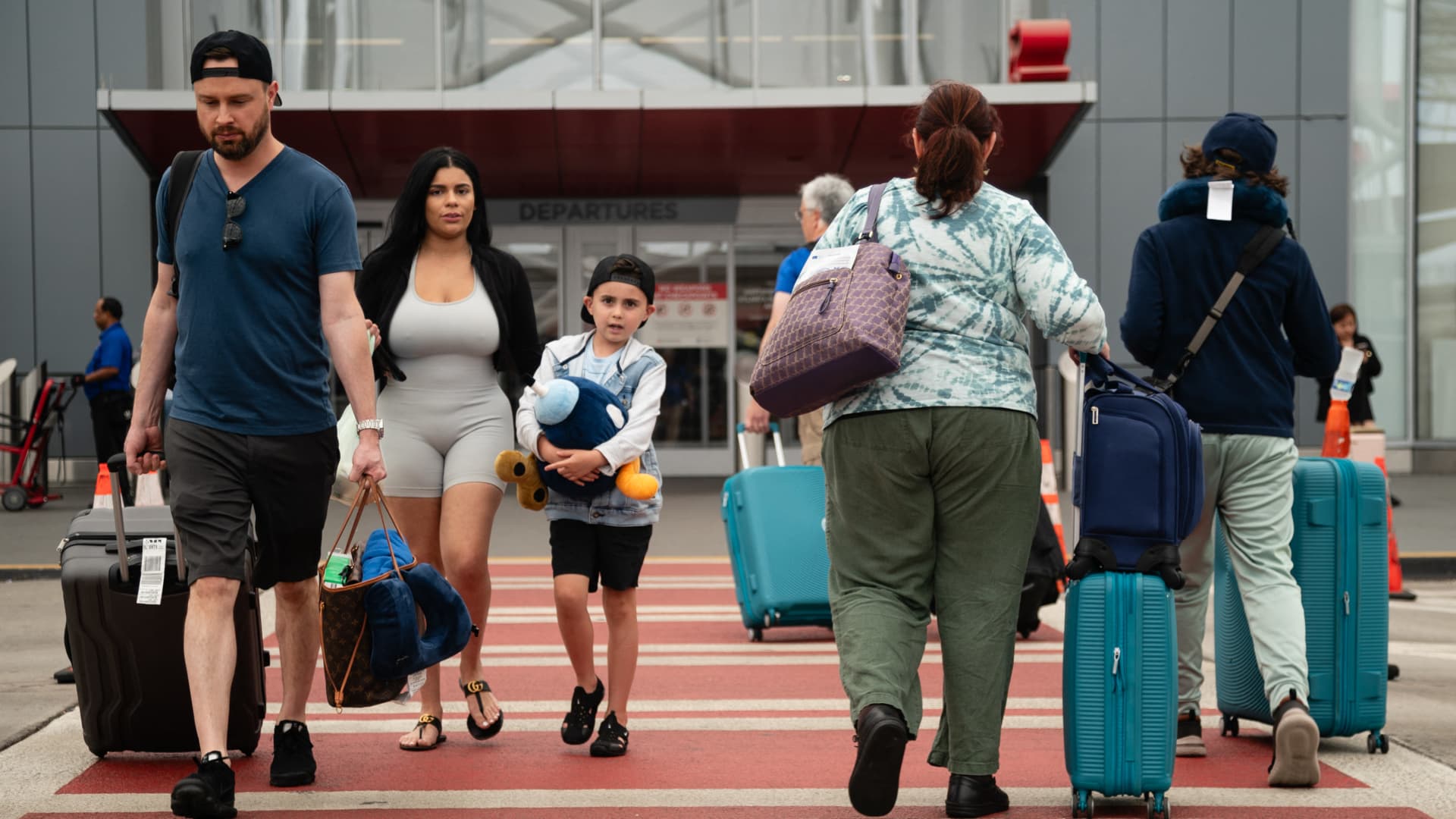
Travelers are seen ahead of the fourth of July holiday weekend at Hartsfield-Jackson Atlanta International Airport on June 30, 2023, in Atlanta, Georgia.
Elijah Nouvelage | AFP | Getty Images
Flight disruptions piled up at airports around the country ahead of the July Fourth weekend, but airline investors have largely shrugged them off.
More than 63,000 flights operated by U.S. airlines, or 30% of their schedules, were delayed between June 24 through July 2. More than 9,000, or 4.2%, were canceled. Both of those percentages are above disruption averages so far this year, according to flight-tracking site FlightAware.
The delays were driven mostly by a series of rolling thunderstorms coupled with other issues like a shortage of air traffic controllers in congested airspace around New York and other areas, derailing travel plans of thousands of customers. It upended what has been a mostly calm spring for travelers.
But sky-high travel demand continues to keep airline stocks aloft, with several reaching multi-year highs.
The Transportation Security Administration said it screened nearly 2.9 million people on Sunday, a record for a single day. It’s the clearest sign yet of unrelenting demand for air travel, as passengers book flights or cash in on rewards points and make up for lost time after the Covid pandemic halted trips.
American Airlines and Delta Air Lines have recently raised their profit outlooks thanks to strong bookings. Lower fuel prices from last year continue to be a tailwind for the industry, too.
Airlines release second-quarter results and will offer a full-summer outlook starting in mid-July, reports that will likely include the financial impact of the late June and early July disruptions.
Airline stocks rise
Major U.S. carriers’ stock gains this year are far outpacing the broader market.
United Airlines and Delta are each up 46% so far this year through Monday, while American Airlines is up 42%. For comparison, the S&P 500 has gained 16% over the same period. Delta and United recently touched their highest levels since June 2021.
Southwest Airlines, whose 2022 year-end meltdown drove it to a first-quarter loss, is up 10% this year.

The NYSE Arca Airline Index, which tracks mostly U.S. airlines, is up 51% year to date through Monday, outpacing the S&P 500’s 16% gain.
Even over the past week as travel chaos hit operations, many airline stocks topped the S&P 500. United Airlines was an exception. Its stock dropped 1.7% as the carrier struggled to stabilize its operation while storms kept rolling through its hub at Newark Liberty International Airport.
From June 24 through July 2, United had the biggest share of delays of U.S. carriers, accounting for 42% of its mainline schedule, according to FlightAware.
The Federal Aviation Administration at the start of last week slashed the departure rate at Newark, which led to pileups of delays, CEO Scott Kirby said. When planes can’t depart, arriving flights don’t have a place to park so disruptions can easily snowball.
“Airlines, including United, simply aren’t designed to have their largest hub have its capacity severely limited for four straight days and still operate successfully,” Kirby said in a note to staff this weekend.
He said the airline will have to reduce its schedule in Newark, particularly during the spring and summer thunderstorm season to avoid pileups unless there is more capacity at the airport.
Thunderstorms are difficult for airlines because they can pop up with little warning and are harder to predict than other types of weather like hurricanes or winter storms.
Often, airlines will delay flights to wait for thunderstorms to clear and airspace to open up, rather than cancel, but crews can reach federally-mandated workday limits, adding to disruptions.
David Neeleman, founder and former CEO of JetBlue Airways and CEO of Breeze Airways, said there’s not a lot an airline can do when there are such sharp cuts to airline arrival rates.
Airlines could cancel proactively only to have the weather to clear up, he said.


