


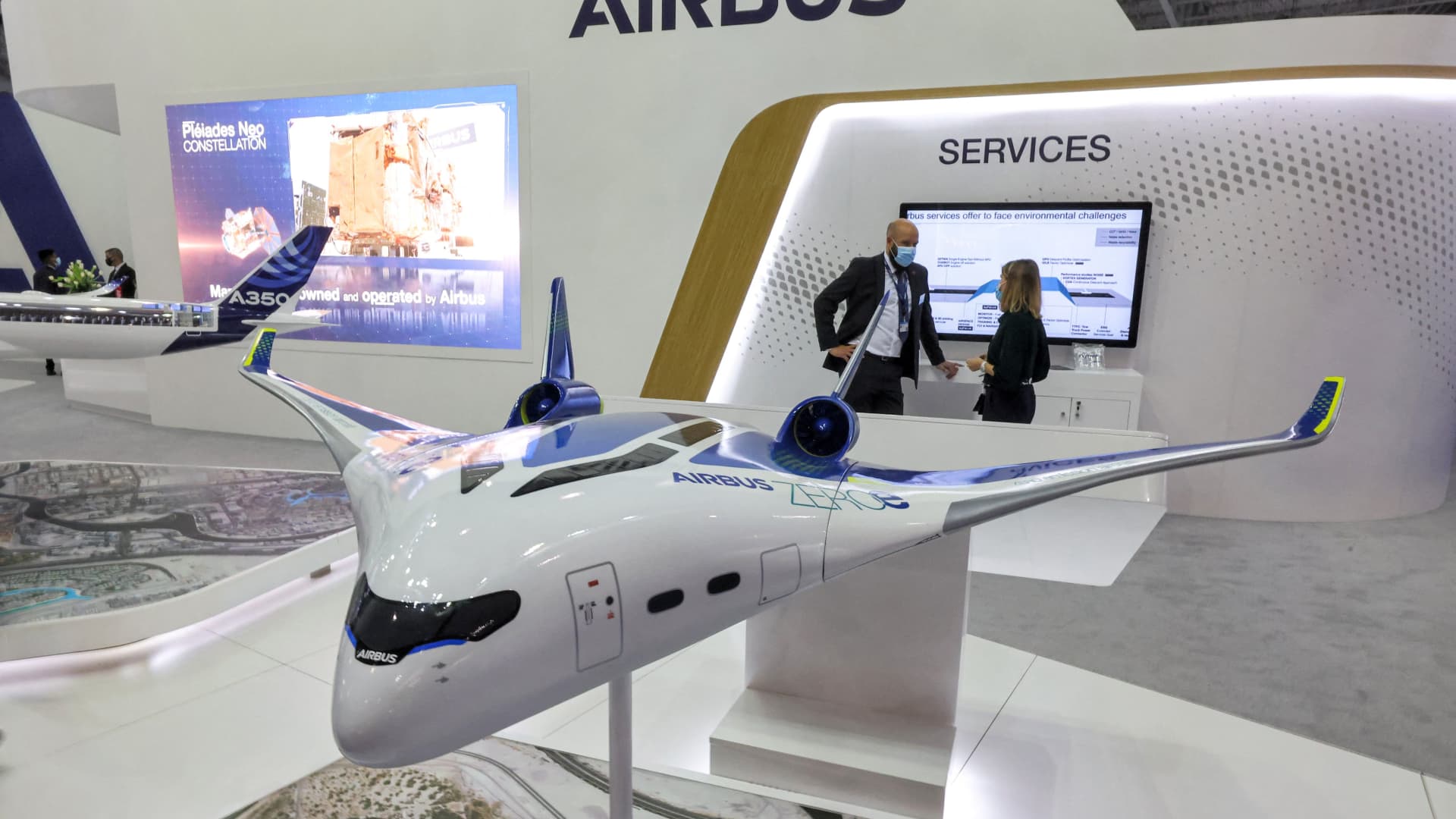
A model of one of Airbus’ ZEROe concept planes, photographed in November 2021. The firm has said it wants to develop “zero-emission commercial aircraft” by the year 2035.
Giuseppe Cacace | Afp | Getty Images
Airbus is launching a U.K.-based facility focused on hydrogen technologies, a move which represents the firm’s latest attempt to support the design of its next generation of aircraft.
In a statement Wednesday, Airbus said the Zero Emission Development Centre in Filton, Bristol, had already begun working on the development of the tech.
One of the site’s main goals will center around work on what Airbus called a “cost-competitive cryogenic fuel system” that its ZEROe aircraft will need.
Details of three zero-emission, “hybrid-hydrogen” concept planes under the ZEROe moniker were released back in Sept. 2020. Airbus has said it wants to develop “zero-emission commercial aircraft” by the year 2035.
The ZEDC in the U.K. will join other similar sites in Spain, Germany and France. “All Airbus ZEDCs are expected to be fully operational and ready for ground testing with the first fully functional cryogenic hydrogen tank during 2023, and with flight testing starting in 2026,” the company said.
The environmental footprint of aviation is significant, with the World Wildlife Fund describing it as “one of the fastest-growing sources of the greenhouse gas emissions driving global climate change.” The WWF also says air travel is “currently the most carbon intensive activity an individual can make.”
Just this week, environmental groups launched legal action against KLM, saying the Dutch aviation giant was misleading the public over the sustainability of flying.
KLM was notified of the lawsuit on the same day as the firm’s annual general meeting. A spokesperson confirmed the group had received the letter and said it would study its contents.
Hopes for hydrogen
In an interview with CNBC earlier this year, Airbus CEO Guillaume Faury said aviation would “potentially face significant hurdles if we don’t manage to decarbonize at the right pace.”
Faury, who was speaking to CNBC’s Rosanna Lockwood, laid out a number of areas his firm was focusing on. These included ensuring planes burned less fuel and emitted less carbon dioxide.
In addition, the aircraft the company was delivering now had a certified capacity for 50% sustainable aviation fuel in their tanks.
“We need to see the SAF industry moving forwards, being developed, being grown to serve airlines and to be able to use that capacity of 50% of SAF,” he said. “We’ll go to 100% by the end of the decade.”
The above represented a “very important part of what we’re doing” Faury explained. “The next one is looking at the mid-term and long-term future to bring to the market the hydrogen plane because this is really the ultimate solution,” he said, noting that a lot of engineering, research and capital commitments would be required.
Described by the International Energy Agency as a “versatile energy carrier,” hydrogen has a diverse range of applications and can be deployed in a wide range of industries.
It can be produced in a number of ways. One method includes using electrolysis, with an electric current splitting water into oxygen and hydrogen.
If the electricity used in this process comes from a renewable source such as wind or solar then some call it green or renewable hydrogen. The vast majority of hydrogen generation is currently based on fossil fuels.
Airbus is not the only company looking at using hydrogen in aviation. Last October, plans to operate commercial hydrogen-electric flights between London and Rotterdam were announced, with those behind the project hoping it will take to the skies in 2024.
At the time, aviation firm ZeroAvia said it was developing a 19-seater aircraft that would “fly entirely on hydrogen.” In September 2020, a six-seater hydrogen fuel cell plane from the company completed its maiden flight.
—CNBC’s Sam Meredith contributed to this report

