



Dubai, UNITED ARAB EMIRATES — A world wide rush for the future wave of generative artificial intelligence is expanding community scrutiny on an normally-forgotten but critically significant environmental challenge: Huge Tech’s growing water footprint.
Tech giants, together with the likes of Microsoft and Alphabet-owned Google, have not too long ago reported a sizeable upswing in their water intake and researchers say 1 of the key culprits is the race to capitalize on the next wave of AI.
Shaolei Ren, a researcher at the College of California, Riverside, revealed a research in April investigating the resources essential to operate buzzy generative AI products, these types of as OpenAI’s ChatGPT.
Ren and his colleagues observed that ChatGPT gulps 500 milliliters of h2o (around the sum of water in a normal 16-ounce bottle) for each individual 10 to 50 prompts, based on when and the place the AI product is deployed.
Hundreds of millions of monthly buyers all publishing inquiries on the well-liked chatbot rapidly illustrates just how “thirsty” AI products can be.
The study’s authors warned that if the escalating h2o footprint of AI types is not adequately addressed, the problem could come to be a important roadblock to the socially liable and sustainable use of AI in the potential.
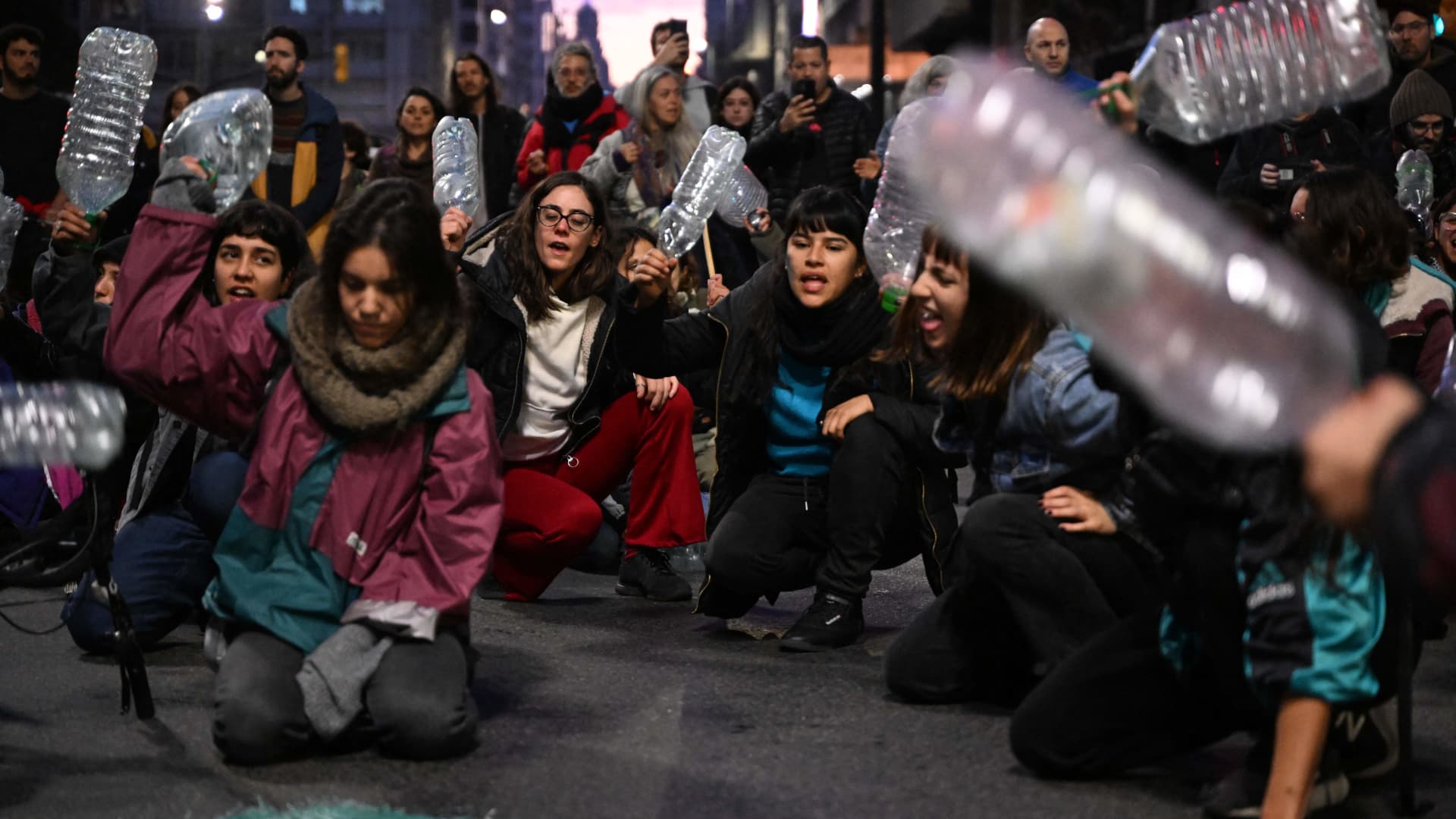
Folks consider aspect in a protest identified as by Uruguay’s Central Union (PIT-CNT) in “protection of drinking water” in opposition to the dealing with of the national authorities with respect to the administration of the shortage of consuming water reserves in Montevideo on Might 31, 2023.
Eitan Abramovich | Afp | Getty Illustrations or photos
ChatGPT creator OpenAI, section owned by Microsoft, did not reply to a ask for to remark on the study’s conclusions.
“In typical, the public is obtaining far more professional and knowledgeable of the h2o difficulty and if they discover that the Massive Tech’s are having away their drinking water sources and they are not obtaining enough water, nobody will like it,” Ren advised CNBC by using videoconference.
“I assume we are likely to see extra clashes in excess of the h2o usage in the coming many years as properly, so this form of hazard will have to be taken treatment of by the businesses,” he included.
‘A hidden cost’
Details centers are portion of the lifeblood of Huge Tech — and a good deal of water is expected to keep the ability-hungry servers amazing and working smoothly.
For Meta, its these warehouse-scale info facilities that generate not only the optimum proportion of its water use but also the lion’s share of its strength use and greenhouse fuel emissions.
In July, protesters took to the streets of Uruguay’s money to press again versus Google’s plan to construct a facts heart. The proposal sought to use huge quantities of water at a time when the South American nation was struggling its worst drought in 74 several years.
Google reportedly explained at the time the project was still at an exploratory section and pressured that sustainability remained at the heart of its mission.
With AI, we’re looking at the typical issue with technological innovation in that you have performance gains but then you have rebound effects with additional energy and far more methods remaining utilised.
Somya Joshi
Head of division: world wide agendas, local weather and programs at SEI
In Microsoft’s newest environmental sustainability report, the U.S. tech firm disclosed that its global h2o intake rose by extra than a third from 2021 to 2022, climbing to nearly 1.7 billion gallons.
It implies that Microsoft’s annual drinking water use would be adequate to fill a lot more than 2,500 Olympic-sized swimming swimming pools.
For Google, meanwhile, total h2o usage at its details facilities and offices came in at 5.6 billion gallons in 2022, a 21% increase on the calendar year in advance of.
Both of those firms are doing the job to cut down their h2o footprint and develop into “drinking water beneficial” by the conclude of the 10 years, which means that they goal to replenish far more h2o than they use.

It’s noteworthy, having said that, that their newest drinking water intake figures ended up disclosed before the launch of their possess respective ChatGPT opponents. The computing power needed to run Microsoft’s Bing Chat and Google Bard could signify appreciably higher concentrations of water use over the coming months.
“With AI, we’re looking at the basic dilemma with engineering in that you have efficiency gains but then you have rebound results with much more strength and a lot more sources becoming utilised,” mentioned Somya Joshi, head of division: world wide agendas, climate and systems at the Stockholm Setting Institute.
“And when it comes to h2o, we’re observing an exponential rise in h2o use just for providing cooling to some of the machines that are needed, like hefty computation servers, and significant-language styles using larger and more substantial quantities of data,” Joshi instructed CNBC throughout the COP28 climate summit in the United Arab Emirates.
“So, on a single hand, companies are promising to their prospects far more effective versions … but this will come with a hidden price tag when it comes to electrical power, carbon and water,” she added.
How are tech companies lowering their drinking water footprint?
A spokesperson for Microsoft told CNBC that the company is investing in research to evaluate the electrical power and drinking water use and carbon impression of AI, while doing the job on ways to make big devices much more economical.
“AI will be a powerful tool for advancing sustainability methods, but we will need a abundant thoroughly clean electrical power provide globally to ability this new technological innovation, which has greater usage demands,” a spokesperson for Microsoft told CNBC by way of e mail.
“We will keep on to observe our emissions, accelerate development although escalating our use of cleanse strength to electricity datacenters, paying for renewable power, and other initiatives to satisfy our sustainability aims of staying carbon damaging, drinking water optimistic and zero squander by 2030,” they added.
Aerial view of the proposed web page of the Meta Platforms Inc. knowledge heart outside Talavera de la Reina, Spain, on Monday, July 17, 2023. Meta is arranging to construct a 1 billion ($1.1 billion) knowledge center which it expects to use about 665 million liters (176 million gallons) of h2o a calendar year, and up to 195 liters per second all through “peak drinking water move,” in accordance to a technological report.
Paul Hanna | Bloomberg | Getty Visuals
Independently, a Google spokesperson told CNBC that exploration demonstrates that even though AI computing demand from customers has considerably amplified, the energy essential to ability this engineering is growing “at a significantly slower rate than several forecasts have predicted.”
“We are using examined methods to lessen the carbon footprint of workloads by massive margins with each other these ideas can decrease the power of teaching a design by up to 100x and emissions by up to 1000x,” the spokesperson explained.
“Google details facilities are designed, crafted and operated to improve performance – when compared with five yrs back, Google now delivers close to 5X as much computing ability with the exact sum of electrical electricity,” they ongoing.
“To help the up coming technology of fundamental advances in AI, our latest TPU v4 [supercomputer] is confirmed to be one of the fastest, most effective, and most sustainable ML [machine leanring] infrastructure hubs in the world.”


