President Joe Biden called on Congress Wednesday to temporarily suspend the federal gas tax, as he tries to quell the rapid surge in prices at the pump. While experts say a suspension could provide some immediate relief, it could also keep demand elevated, thereby exacerbating tight supply.
Consumers are getting hit with higher prices everywhere, which has become a headache for the administration ahead of the midterm elections in November.
But the rise in gas prices is perhaps the most noticeable — gas stations on every corner declare the price per gallon. The national average topped $5 per gallon for the first time ever earlier this month.
It has become an Achilles’ heel for the administration, noted Opis Global’s Tom Kloza, “even though it has nothing to do with any policies [Biden’s] had since he came into power.”
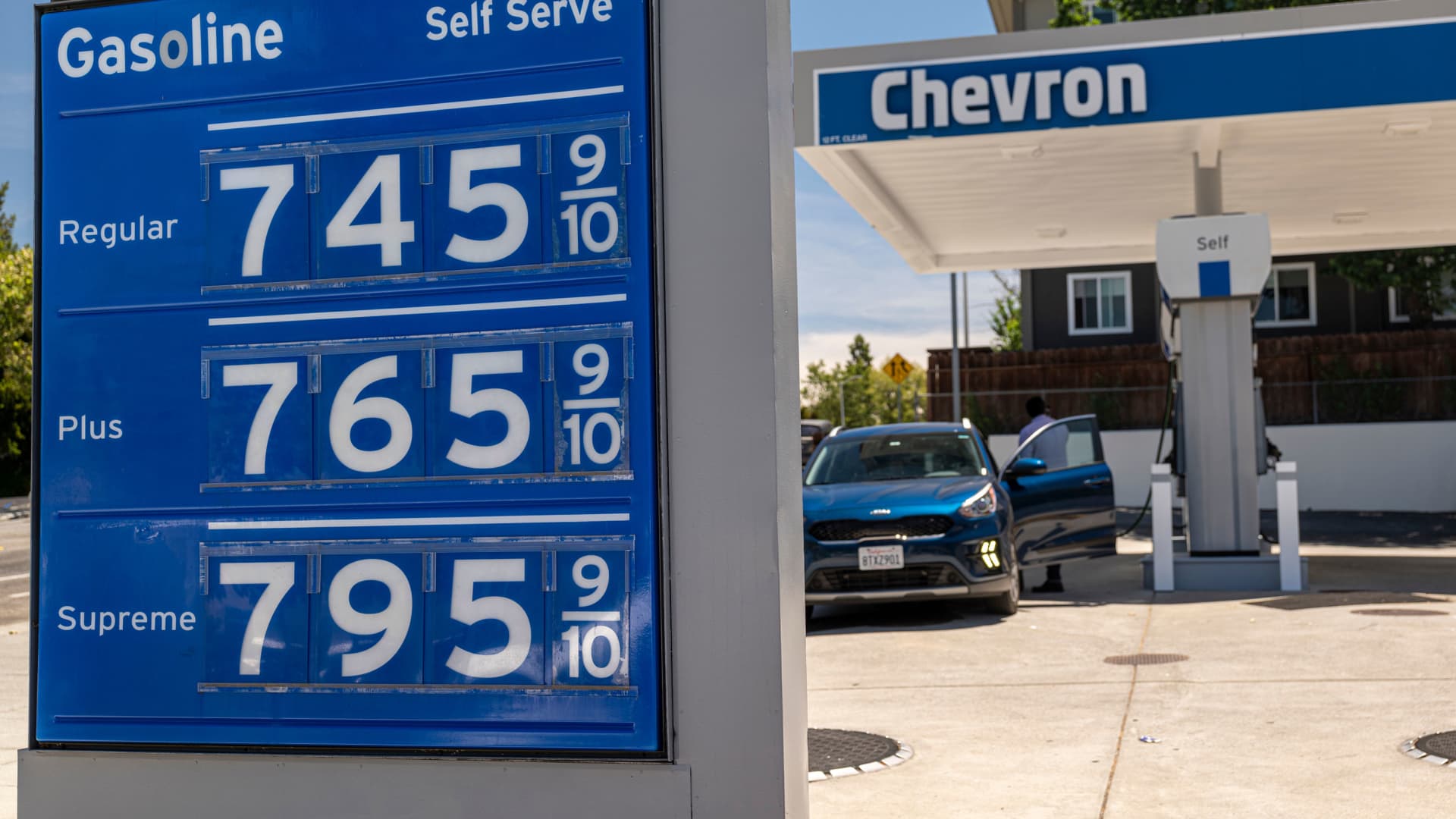
Fuel prices at a Chevron gas station in Menlo Park, California, on Thursday, June 9, 2022.
David Paul Morris | Bloomberg | Getty Images
Biden’s plan asks Congress to suspend the federal tax on gasoline and diesel fuel for three months, which coincides with the summer driving season. The federal tax is 18 cents per gallon of regular gasoline, and 24 cents per gallon of diesel.
The president is also asking states to suspend their gas taxes, or find other ways to provide relief for consumers.
A suspension would “give Americans a little extra breathing room as they deal with the effects of Putin’s war in Ukraine,” the White House said in a statement.
“If this bill is signed and enacted — becomes effective — it will help motorists,” said Patrick De Haan, head of petroleum analysis at GasBuddy. But he added that the extent to which any relief is felt will depend on wholesale prices remaining stable. The wording and timing of any potential legislation will also have an impact.
De Haan pointed to New York as an example. The state suspended its gas tax, but at a time when wholesale fuel prices were rising. Ultimately, consumers didn’t see much of an impact since the lower taxes were offset by higher wholesale prices.
Still, he said that if this were implemented today it would “greatly enhance the downside,” since gasoline futures have pulled back recently, after rising above $4.
It’s unclear whether Biden has Congress’ support for this legislation. The proposal comes at a key time in the runup to the midterm elections.
The president has repeatedly taken aim at oil and gas companies, for what he claims are policies that prioritize profits at the expense of consumers. Last week, he called on refiners to ramp up output. The industry, for its part, says the Biden administration has unfriendly policies, and they can’t boost output even if they wanted to, thanks to issues including labor shortages.
The White House does not control gas prices. More than half of the cost per gallon of gasoline is based on the underlying price of oil, which is set on a global basis and has spiked above $100.
Jason Furman, professor of economic policy at Harvard and former chair of the Coun cil of Economic Advisers under President Obama, said a suspension would have little impact on consumers while leading to billions of dollars for oil companies.
“When refineries are already stressed to capacity the additional demand that the gas tax holiday will unleash will manifest itself almost entirely in the form of higher prices for producers instead of savings for consumers,” he said, before adding: “I don’t think any expert thinks this is a remotely good idea.”
Goldman Sachs’ global head of commodities research Jeff Currie echoed this point, saying a gas tax holiday will ultimately lead to higher demand from consumers. An often-cited phenomenon for commodity markets is that the cure for high prices is high prices. Cutting prices is a temporary measure that won’t address fundamental market imbalances.
The national average for a gallon of gasoline surged above $5 for the first time ever earlier this month. Prices have since retreated slightly, with the per-gallon national average at $4.955 on Wednesday. That’s up 36 cents in the last month and $1.88 more than last year.
The federal gas tax has been 18.4 cents per gallon since 1993.