


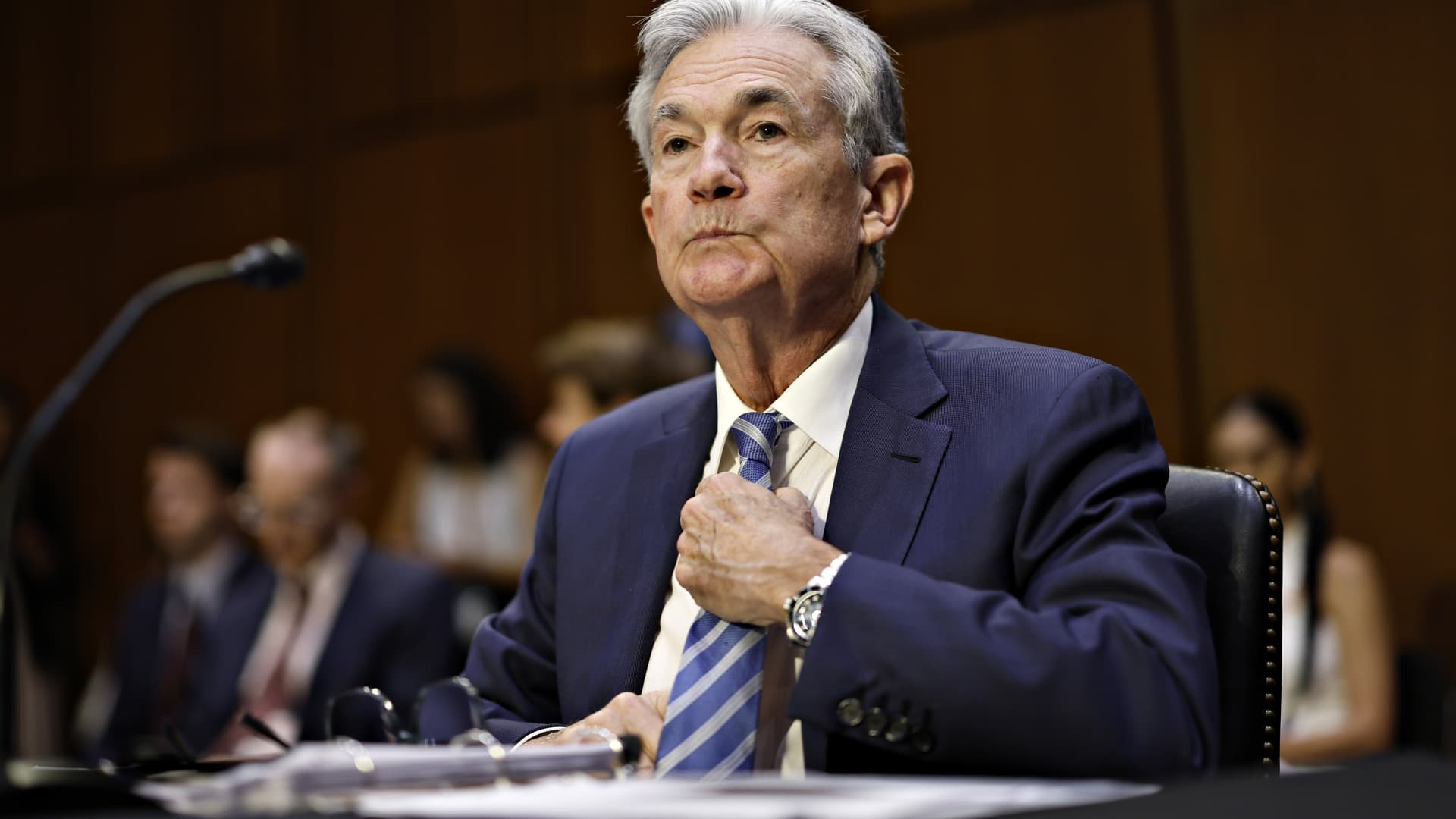
Jerome Powell, chairman of the US Federal Reserve, arrives to a Senate Banking, Housing, and Urban Affairs Committee hearing in Washington, D.C., U.S., on Wednesday, June 22, 2022.
Ting Shen | Bloomberg | Getty Images
Federal Reserve Chairman Jerome Powell told congressional lawmakers Wednesday that the central bank is determined to bring down inflation and has the ability to make that happen.
“At the Fed, we understand the hardship high inflation is causing. We are strongly committed to bringing inflation back down, and we are moving expeditiously to do so,” the Fed chief said in remarks for the Senate Banking Committee. “We have both the tools we need and the resolve it will take to restore price stability on behalf of American families and businesses.”
Along with expressing resolve on inflation, Powell said economic conditions are generally favorable, with a strong labor market and persistently high demand.
However, he acknowledged that inflation is running too hot and needs to come down.
“Over coming months, we will be looking for compelling evidence that inflation is moving down, consistent with inflation returning to 2%,” Powell said. “We anticipate that ongoing rate increases will be appropriate; the pace of those changes will continue to depend on the incoming data and the evolving outlook for the economy.”
He noted that the war in Ukraine and Covid-linked shutdowns in China are adding to inflation pressures, and added that the problem is not unique to the U.S. but is affecting many global economies.
Powell’s remarks are part of a congressionally mandated semiannual report on monetary policy – more commonly known in markets as the Humphrey Hawkins report and testimony, for the act which mandated them.
This is an especially delicate moment for Fed policy.
Over its past three meetings, the central bank has raised rates a cumulative 150 basis points – 1.5 percentage points – in an effort to tackle inflation that is running at its fastest annual pace in more than 40 years.
The 75 basis point increase at last week’s Federal Open Market Committee meeting marked the biggest single hike since 1994.
Sen. Elizabeth Warren (D-Mass.) warned Powell that the continued rate hikes could “tip this economy into recession” without stopping inflation.
“You know what’s worse than high inflation and low unemployment is high inflation and a recession with millions of people out of work, and I hope you’ll reconsider that before you drive the economy off a cliff,” she said.
Republican senators pressed Powell to clamp down on inflation, and asked whether White House policies such as regulations on the energy industry are intensifying price pressures.
“Inflations hitting my people so hard they’re coughing up bonds,” said Sen. John Kennedy (R-La.)
“We got a hell of a mess right now,” Kennedy added. “You’re the most powerful man in the United States, maybe in the world.”
Powell has stressed that he thinks tighter monetary policy will be an effective tool against inflation, and has said he thinks the economy is well positioned to handle higher rates. However, he also told Warren that higher rates won’t do much to lower soaring food and gasoline costs.
Cracks have been showing in the economy this year that indicate the higher rates are coming as the economy already is slowing.
Gross domestic product declined at a 1.5% annualized pace in the first quarter and is on pace to be flat in the second quarter, according to the Atlanta Fed. Housing sales have been plunging and there even have been some signs that the jobs market is slowly decelerating at a time when inflation-adjusted wages have fallen 3% over the past year.
Despite the economic wobbles, Powell and his fellow policymakers have indicated the rate hikes will continue. Projections released at the meeting last week point to the Fed’s benchmark short-term borrowing rate rising to 3.4% by the end of this year, from its current targeted range of 1.5%-1.75%.
This is breaking news. Please check back here for updates.
