


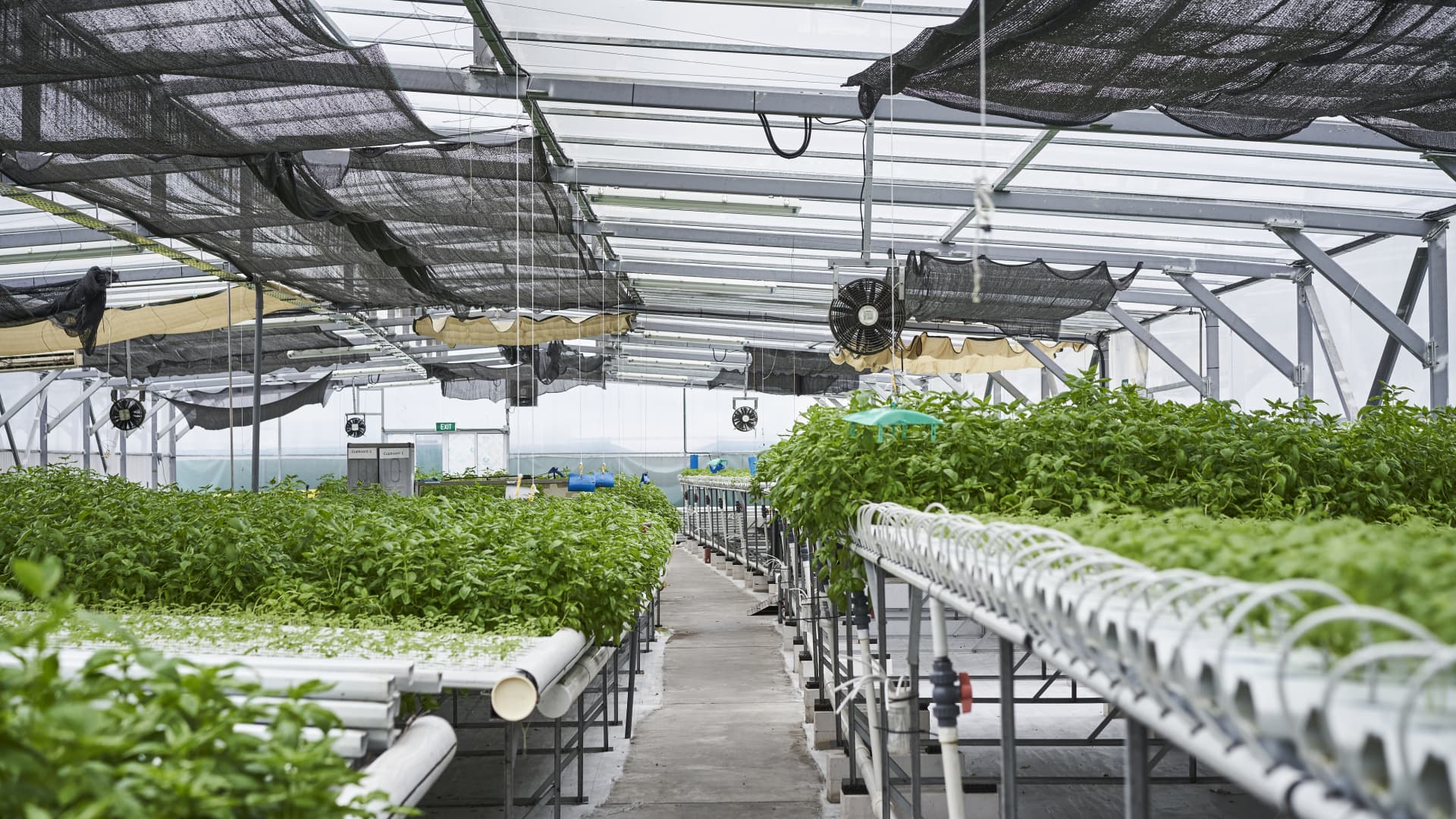
A rooftop farm in Singapore on May 27, 2020. The small island nation lacks natural resources and imports more than 90% of its food from more than 170 countries and regions.
Lauryn Ishak| Bloomberg | Getty Images
Singapore is known for its variety of street food and local cuisines, but many may not know it faces a persistent challenge — food security.
The increasingly pressing issue was thrust into the national spotlight after recent food export bans — in particular, the chicken export ban by neighboring Malaysia, from which Singapore imports 34% of its chickens.
As a small island nation, Singapore lacks natural resources — it imports more than 90% of its food from more than 170 countries and regions.
With the country vulnerable to many external headwinds, the government launched a “30 by 30” initiative to produce 30% of its nutritional needs by 2030.
But the country is already feeling the effects of rising food inflation.
Food prices rose by 4.1% in April from a year earlier, up from 3.3% in March, the Monetary Authority of Singapore and Ministry of Trade and Industry said.
Global situation
Hawker stall owners, in particular, are starting to feel the pinch as they’re under pressure to keep prices low for the masses.
Remus Seow, owner of Fukudon, a hawker stall selling Japanese rice bowls, is one example.
Over the past six months, the prices of products he buys, such as cooking oil, eggs, and meat, have gone up between 30% and 45%, he said.
Seow recently raised prices for the first time since he opened his stall two years ago. If prices keep increasing, 20% to 35% of customers may not patronize his stall again, he said.
The Monetary Authority of Singapore said elevated global food prices are expected to keep contributing to local food inflation beyond 2022.
Global food prices had already started to rise during the pandemic, but the Ukraine war has worsened those inflationary pressures.
Food shortages will continue in the short run, and possibly even into next year or two, said Dil Rahut, senior research fellow at the Asian Development Bank Institute.
Other countries cannot quickly jump in to fill in the gap left by Ukraine and Russia because it takes at least one year to grow fresh produce, Rahut said.
Similarly, Paul Teng, adjunct senior fellow at the S. Rajaratnam School of International Studies, warned that even if the war ends, food prices will not immediately revert to pre-war prices.
That’s because factors like the increased cost of fuel, labor shortages, and a disrupted supply chain will compound the existing shortage of food, keeping prices elevated, Teng said.
The World Bank has reported that food prices are expected to rise about 20% this year before easing in 2023.
Stumbling blocks
While Singapore is still doing relatively well in maintaining food security, its future is unknown, Teng said.
“Singapore has been downplaying agriculture and importing food,” he said. “Now we’ve done a U-turn and started to ramp up, but this needs time to pay off,” he added.
The “30 by 30” plan aims to give Singapore a level of self-production enough for it to tide over tough times, but that won’t be enough to completely replace imports, Teng said.
That’s because the government has decided to invest more in growing the country’s gross domestic product and the average household income rather than investing in agricultural activities, he added.
“As long as you have money, and as long as there’s no supply chain interruption, then you can always buy food somewhere because the volume we need is (relatively) not very high,” Teng said.
But while it would be “technically and technologically” possible for Singapore to achieve its goal, two issues remain — prices and consumer attitudes toward “novel food,” he added.
Teng said consumers are particular about buying “natural food” and may not accept “novel food” — like lab-grown chicken and alternative sources of protein — which is a big part of the “30 by 30” goal.
But Rahut warned that achieving the goal would be “very hard” because the deadline is nearing, and Singapore is still producing only 10% of its own nutritional needs.
People will also still buy imported food products if they’re cheaper than local produce unless the government can subsidize the products, he added.
Seow, likewise, said he wouldn’t buy local produce unless prices are able to match those of imports.
“But the only way (forward) is for the government to go ahead with it and do their best to sustain the prices, quality, and demand of what we need,” he said. “And then people will slowly accept (local produce).”
Rahut also suggested that marketing local produce as high quality and nutritious food may incentivize consumers to buy it at a higher price, just as some are willing to pay more for products that are marketed as organic.
What can Singapore do?
Both Teng and Rahut said the government can, in the short term, provide safety nets for the disadvantaged, for example through cash payments or vouchers.
But Teng added that one of Singapore’s weaknesses is that even though it tries to diversify its imports from a basket of countries, it’s still relying heavily on just one or two countries.
For example, Singapore imported 48% of its chickens from Brazil, and 34% from Malaysia in 2021, the Singapore Food Agency said.
Teng also noted that most of the chickens imported from Malaysia are live chickens, while the rest of the chickens imported from Brazil and other countries are frozen.
At the policy level, it will therefore be important to diversify imports for different kinds of produce, Teng said, such as finding more sources of live chickens to import from.
The government can also encourage more Singapore companies to grow food overseas and form agreements with other governments to ensure produce isn’t subjected to export bans, he added.
“The big picture solution is to make sure producing countries, exporting countries, have a surplus (of food), and there’s a lot of ways we can help other countries do that,” Teng said.
Similarly, Rahut added that since Singapore is such a technologically advanced country, it could look into helping other countries improve their food production systems.
“That will not only help Singapore to stabilize its food price and food security, but also global food security and food prices,” Rahut said.
