Wharton’s Jeremy Siegel is calling for a 100 basis point rate hike, and says markets may be “close to the bottom.”
A 100 basis point rate hike by the Federal Reserve on Wednesday will be “medicine to stop this inflation,” the Wharton professor of finance at the University of Pennsylvania told CNBC on Wednesday.
“The Fed needs to grab the narrative of inflation … it knows it was way too late,” Siegel said on “Squawk Box Asia.”
“[You] got to take your medicine now to get cured. If you just let it go, you’re going to have to take more medicine later on.”
With annual inflation hitting a 40-year high of 8.6% annual inflation in May, the likelihood of sharper aggressive rate hikes has sent markets into a tailspin amid fears of a global recession.
U.S. stocks tumbled into bear market territory earlier this week sending ripples across global markets.
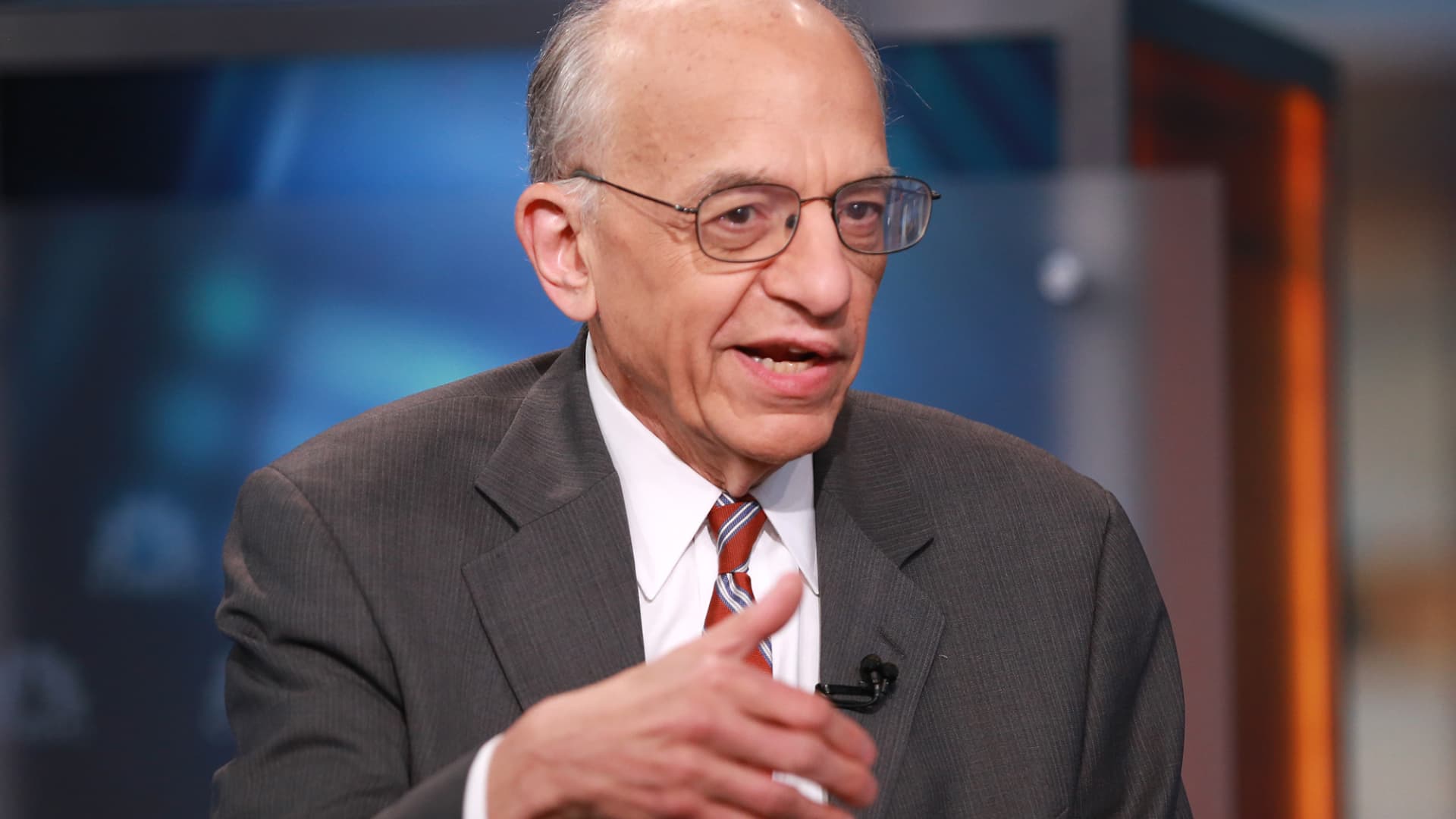
Jeremy Siegel
David Orrell | CNBC
Siegel said Fed chair Jerome Powell can justify such an aggressive move by bringing forward July’s expected 50 basis point hike, and combining it with the expected 50 basis points for June.
Anything less than a perceived forceful move by the Fed this week will indicate to markets it doesn’t have inflation under control, Siegal said.
“If [Powell] only does 50 [basis points], I think there is going to be a big disappointment. Then [markets] are going to say he doesn’t have control, he isn’t going fast enough,” he said.
Markets will rally
If the Fed nips the inflation problem in the bud, a markets rally will likely ensue as investors and firms factor in the higher rates and start to downgrade earnings forecasts.
Instead of panicking and chasing more aggressive rate hikes after introducing this 100 basis point hike, the Fed should wait for it to massage into the economy, Siegel said. Too many aggressive moves could trigger a severe recession, he added.
As it is, the financial markets have already factored in a mild recession for 2023, he added.
“I think you will get a rally, and [while] it is very hard to pick exact market bottoms, I think we are close to the bottom,” Siegel said, adding that the rally will unravel within “hours” of the Fed’s announcement.
The Fed needs to grab the narrative of inflation. You got to take your medicine now to get cured. If you just let it go, you’re going to have to take more medicine later on.
Jeremy Siegel
professor of finance, Wharton
“And that would signal we are taking the medicine to stop this inflation. If we take it sooner, we will be better off later on and there is going to be less likelihood of a recession in 2023,” he said.
If the Fed moves strongly on Wednesday, inflation should cool by the end of the year and if commodity prices start to follow stock markets into bear territory, then the U.S. economy is on its way to reining in inflation, Siegel told CNBC.
But as the U.S. economy is bloated with stimulus — and if the Fed moves prudently — a major recession can easily be averted, the professor said.
“There is still too much liquidity, too low unemployment, too much demand,” he said.
‘Unprecedented burst of money’
Excess liquidity and rising demand, driven mainly by government stimulus as a result of the pandemic, were responsible for forcing up prices even though supply chain constraints also played a part, Siegel added.
“We have [an] unprecedented burst of money,” he said.
For the first half of 2020 when the pandemic was at its height, a record $2 trillion surge in cash hit the deposit accounts of U.S. banks — a reflection of the amount of cash sloshing around in the U.S. economy.
In April 2020 alone, deposits grew by $865 billion, more than the previous record for an entire year.
“That was really the kernel of the explosion of demand. Certainly we have Covid problems, we have the Russian invasion, I understand that,” Siegel said.
“But what the Fed should have done … is to say, [it] needed the first stimulus after Covid hit,” he said. “Then it should have told the government you got to go to the bond market .. [it] cannot get a hand out from the Fed.”
“Then we would have interest rates go up much earlier and we would not have the inflation problem we have now,” he added.