Jyoti Bansal, co-founder and CEO of startup Harness.
Harness
Jyoti Bansal knows about weird acquisitions.
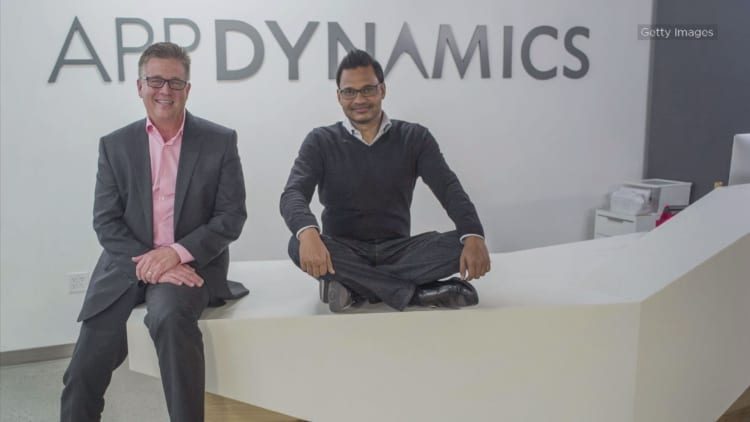
Eight years ago, his software company, AppDynamics, was on the doorstep of a blockbuster IPO. A day before the offering, Cisco swooped in and bought the company for $2.7 billion
Now Bansal is at the center of an equally unconventional combination.
Since 2020, Bansal has been running two startups as co-founder and CEO: Harness and Traceable. The former’s technology helps companies manage code and the latter’s software observes where companies are unintentionally letting out sensitive data.
Late this month or early next, Harness and Traceable will merge. The resulting company will have 1,100 employees, $250 million in expected 2025 annualized revenue, a 50% growth rate and a valuation of about $5 billion.
“It’s about the same size that AppDynamics was when we were about to go public,” Bansal told CNBC in an interview last week.
Through the combination, Bansal said, Harness will be able to sell more products to customers, and Traceable will be better insulated from competitors like HashiCorp, which IBM has agreed to buy, and Akamai, which acquired security startup Noname last year.
This time, Bansal wants an active stock ticker.
In an interview last year with CNBC’s Make It, Bansal said he was unfulfilled after selling AppDynamics and that he didn’t finish what he had started.
“Everyone told me, ‘You should retire. Go on the beach. What else do you need to do?'” Bansal said. “That was my first instinct, as well. I wanted to trek in the Himalayas, hike Machu Picchu, do a safari in Africa, see the fjords in Norway. In six months, my bucket list was done. And I started to realize: That’s not it for me.”
Bansal got back to work and set up Big Labs, a studio for exploring startup ideas. Big Labs spawned Harness in 2017 and then Traceable in 2020. Sanjay Nagaraj, Traceable’s other co-founder, recalled working on the security startup in a dedicated Big Labs room at Harness’ San Francisco headquarters.
The arrangement was unorthodox.
“I’ve never done this before, backed a CEO to run two companies simultaneously,” said Harrick, who joined Institutional Venture Partners in 2001 and sits on the boards of Harness and Traceable. “But Jyoti is that good. He’s not only a great executive, but he hires well and he delegates well, and so I just talked to Jyoti. I said, ‘This is a major risk.’ I got his assurance he wouldn’t do a third one.”
Establishing Harness and Traceable as separate companies made sense to Bansal at the time, because their products would typically get sold to different buyers within an organization. But that’s changed in the past year or two, he said, as engineering and technology leaders have started to also make decisions on procuring tools for securing code and data.
Employees took notice of the shift and, during all-hands meetings at both companies, would repeatedly ask Bansal about a consolidation, he said. Questions also came from clients.
“The Harness team would go set up a meeting with an executive at a bank or some of our customers,” Bansal said. “I would go into the meeting and the executive would say, ‘It’s a one-hour meeting. Can we save the last 15 minutes? Because I also want to talk about Traceable.'”
Bansal was effectively the first IT person at both companies, setting up the same Google productivity apps and Carta equity management software as each got started. A spokesperson said 70% of Traceable’s largest customers are Harness customers as well.
The cultures were also similar. As Harness and Traceable matured, Bansal picked a general manager to run each distinctive new product, or module. When examining revenue for the modules, executives at both startups rely on a theory that Battery Ventures investor Neeraj Agrawal calls “triple, triple, double, double, double,” or T2D3. The model, which Agrawal wrote about in TechCrunch in 2015, describes the annualized revenue growth that cloud software startups can target.
In November, Bansal told the two boards that his companies were on converging paths and that it would be difficult to keep them from competing with each other. He got clearance for a merger.
Initially, Traceable will operate as as its own unit within Harness, the parent company, and Nagaraj will be general manager. Bansal said the structure may change in the future.
He’s confident that the technologies will pair well together and can benefit from tighter integrations. Harness will be able to help clients understand the origin of their source code, and Traceable can show how people are using it.
Harrick calls it’s a good outcome, and said he’s excited to consolidate his bet on Bansal.
“I think it’s a benefit for all investors for him to focus on operating one company instead of two,” Harrick said.
WATCH: AppDynamics founder is building a new start-up