


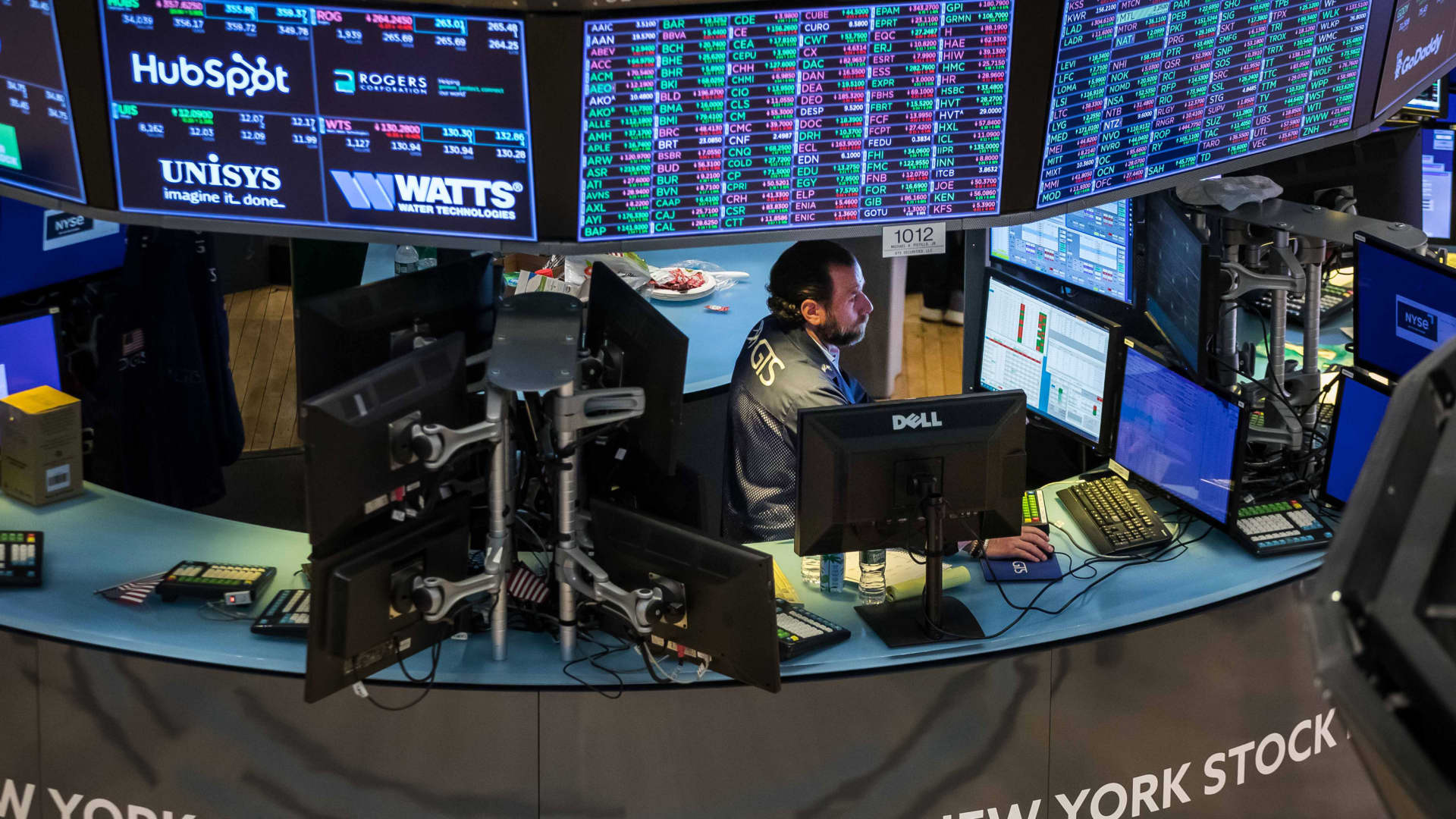
Trader on the floor of the NYSE, June 1, 2022.
Source: NYSE
Global markets are in the beginning of a fundamental shift after a nearly 15-year period defined by low interest rates and cheap corporate debt, according to Morgan Stanley co-President Ted Pick.
The transition from the economic conditions that followed the 2008 financial crisis and whatever comes next will take “12, 18, 24 months” to unfold, according to Pick, who spoke last week at a New York financial conference.
“It’s an extraordinary moment; we have our first pandemic in 100 years. We have our first invasion in Europe in 75 years. And we have our first inflation around the world in 40 years,” Pick said. “When you look at the combination, the intersection of the pandemic, of the war, of the inflation, it signals paradigm shift, the end of 15 years of financial repression and the next era to come.”
Wall Street’s top executives delivered dire warnings about the economy last week, led by JPMorgan Chase CEO Jamie Dimon, who said that a “hurricane is right out there, down the road, coming our way.” That sentiment was echoed by Goldman Sachs President John Waldron, who called the overlapping “shocks to the system” unprecedented. Even regional bank CEO Bill Demchak said he thought a recession was unavoidable.
Instead of just raising alarms, Pick — a three-decade Morgan Stanley veteran who leads the firm’s trading and banking division — gave some historical context as well as his impression of what the tumultuous period ahead will look and feel like.
Fire and Ice
Markets will be dominated by two forces – concern over inflation, or “fire,” and recession, or “ice,” said Pick, who is considered a front-runner to eventually succeed CEO James Gorman.
“We’ll have these periods where it feels awfully fiery, and other periods where it feels icy, and clients need to navigate around that,” Pick said.
For Wall Street banks, certain businesses will boom, while others may idle. For years after the financial crisis, fixed income traders dealt with artificially becalmed markets, giving them less to do. Now, as central banks around the world begin to grapple with inflation, government bond and currency traders will be more active, according to Pick.
The uncertainty of the period has, at least for the moment, reduced merger activity, as companies navigate the unknowns. JPMorgan said last month that second-quarter investment banking fees have plunged 45% so far, while trading revenues rose as much as 20%.
“The banking calendar has quieted down a bit because people are trying to figure out whether we’re going to have this paradigm shift clarified sooner or later,” Pick said.
Ted Pick, Morgan Stanley
Source: Morgan Stanley
In the short term, if economic growth holds up and inflation calms down in the second half of the year, the “Goldilocks” narrative will take hold, bolstering markets, he said. (For what its worth, Dimon, citing the Ukraine war’s impact on food and fuel prices and the Federal Reserve’s move to shrink its balance sheet, seemed pessimistic that this scenario will play out.)
But the push and pull between inflation and recession concerns won’t be resolved overnight. Pick at several times referred to the post-2008 era as a period of “financial repression” — a theory in which policymakers keep interest rates low to provide cheap debt funding to countries and companies.
“The 15 years of financial repression do not just go to what’s next in three or six months… we’ll be having this conversation for the next 12, 18, 24 months,” Pick said.
‘Real interest rates’
Low or even negative interest rates have been the hallmark of the previous era, as well as measures to inject money into the system including bond-buying programs collectively known as quantitative easing. The moves have penalized savers and encouraged rampant borrowing.
By draining risk from the global financial system for years, central banks forced investors to take more risk to earn yield. Unprofitable corporations have been kept afloat by ready access to cheap debt. Thousands of start-ups have bloomed in recent years with a money burning, growth-at-any-cost mandate.
That is over as central banks prioritize the battle against runaway inflation. The effects of their efforts will touch everyone from credit-card borrowers to the aspiring billionaires running Silicon Valley start-ups. Venture capital investors have been instructing start-ups to preserve cash and aim for actual profitability. Interest rates on many online savings accounts have edged closer to 1%.
But such shifts could be bumpy. Some observers are worried about Black Swan-type events in the plumbing of the financial system, including the bursting of what one hedge fund manager called “the greatest credit bubble of human history.”
Out of the ashes of this transition period, a new business cycle will emerge, Pick said.
“This paradigm shift at some point will bring in a new cycle,” he said. “It’s been so long since we’ve had to consider what a world is like with real interest rates and real cost of capital that will distinguish winning companies from losing companies, winning stocks from losing stocks.”

