


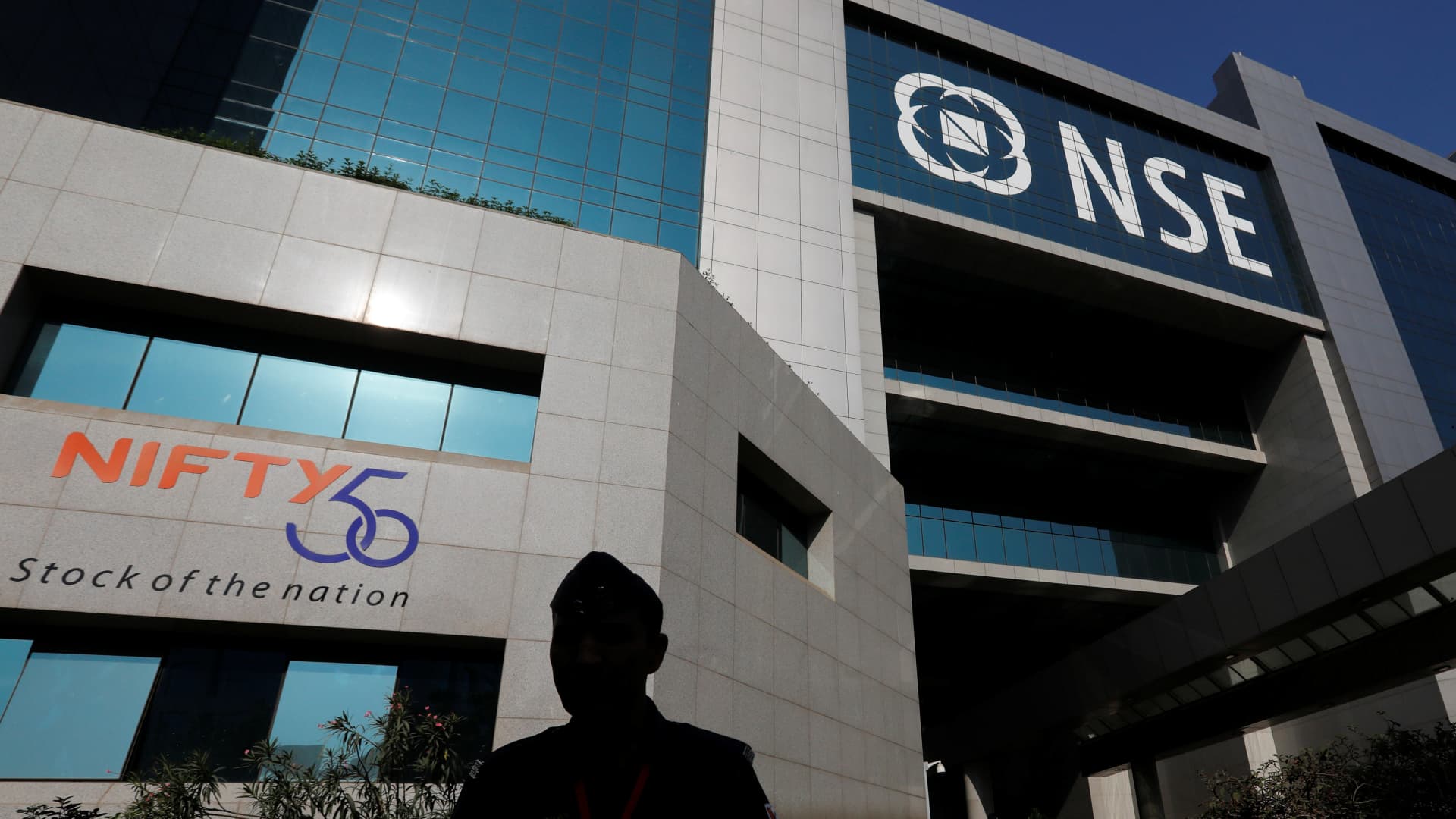
A guard walks past the National Stock Exchange building in Mumbai, India, on February 9, 2018.
Danish Siddiqui | Reuters
Indian and Chinese stock market capitalization may grow fourfold by 2050 as Asia turns from “laggard to leader” in the climate transition, according to Abrdn CEO Stephen Bird.
In a letter seen by CNBC marking the 30-year anniversary of the British investment company’s first Asian office opening in Singapore, Bird lauded the economic transformation over the last three decades that has seen more than a billion people lifted out of poverty.
He also noted that the region’s share of the global economy has become eight times larger than it was during the Asia Financial Crisis of 1997.
“Capital markets have also evolved and the region has switched from being mostly a destination for foreign investors to one where local investors dominate its markets,” Bird said.
He added that “the next 30 years looks to be every bit as exciting as the last,” and recommended investors remain calm during periods of volatility, keeping their “eye on the long game.”
Chinese stocks have endured a bruising year as President Xi Jinping’s “zero-Covid” strategy has stifled economic activity and caused supply chain bottlenecks that have rippled through global markets.
Goldman Sachs analysts recently said they were “seeing light at the end of the tunnel,” and Bird supported the long-term view that Asian equities can transition from “laggards to leaders,” in terms of both performance and their role in tackling the climate crisis.
“China and India are expected to become the world’s largest and third largest economies respectively in the next decade while their consumers will increasingly dictate global tastes and trends. Capitalization of their equity markets could also increase by a factor of four or more by 2050,” Bird predicted.
“Other countries in the region present exciting opportunities too. Bangladesh, Indonesia and Vietnam have some of the highest potential growth rates in the world, while Japan and South Korea’s aging populations have built up significant savings that need to be put to better work. And, as the region’s most open global financial center, Singapore will be at the heart of all of it.”
However, Bird acknowledged that progress is unlikely to be linear, with the globalization that has driven Asia’s economic growth in danger of fizzling out and climate change posing an “acute challenge” for the region.
“A by-product of Asia’s growth is that it has accounted for the lion’s share of the increase in global carbon emissions over the past three decades. This increased human footprint is also evident in rising air pollution and biodiversity loss,” he said.
While Asia alone cannot solve the climate crisis, its major economies must find ways to decouple their economic growth from fossil fuels, Bird suggested. Most major economies in the region have now adopted net-zero targets, while Asia is also playing a role in developing technological solutions to climate change.
“Whether in the form of solar panels, batteries for electric vehicles or green hydrogen, decarbonisation is dependent on Asian innovation,” Bird said.
Abrdn – which has around £464 billion ($586.35 billion) in assets under management as of most recent results – has observed that interest in sustainable investment among local investors is also on the rise, along with active engagement between asset managers and companies, creating potential opportunities for new forms of “sustainability-linked loans and bonds.”
Taking action
Bird – who took the reins of Abrdn in September 2020 after a 21-year career with Citigroup’s Asian and Latin American operations – urged Asian governments to strengthen the credibility of their net zero commitments, offering investors greater surety in allocating capital to the region.
“More countries should follow China’s lead and establish carbon pricing which would bring certainty and encourage investment in low-carbon technologies and infrastructure. The revenue generated could be recycled into ensuring that the zero-carbon transition is a just one,” he said.
“We would also encourage the greater use of dedicated climate-related instruments such as green bonds; this would help align the interests of capital markets participants while the increased issuance would also encourage portfolio diversification.”
The continent’s political, trade and economic forums should be an opportunity to harmonize climate and sustainability standards, Bird said, suggesting a continent-wide common framework could strengthen financial flows into Asia.
“This century is Asia’s century. It must also be the century in which economic objectives are reconciled with sustainability goals,” Bird concluded. “The financial industry can and must play a pivotal role in converging these two priorities, guiding investment to support both outcomes.”