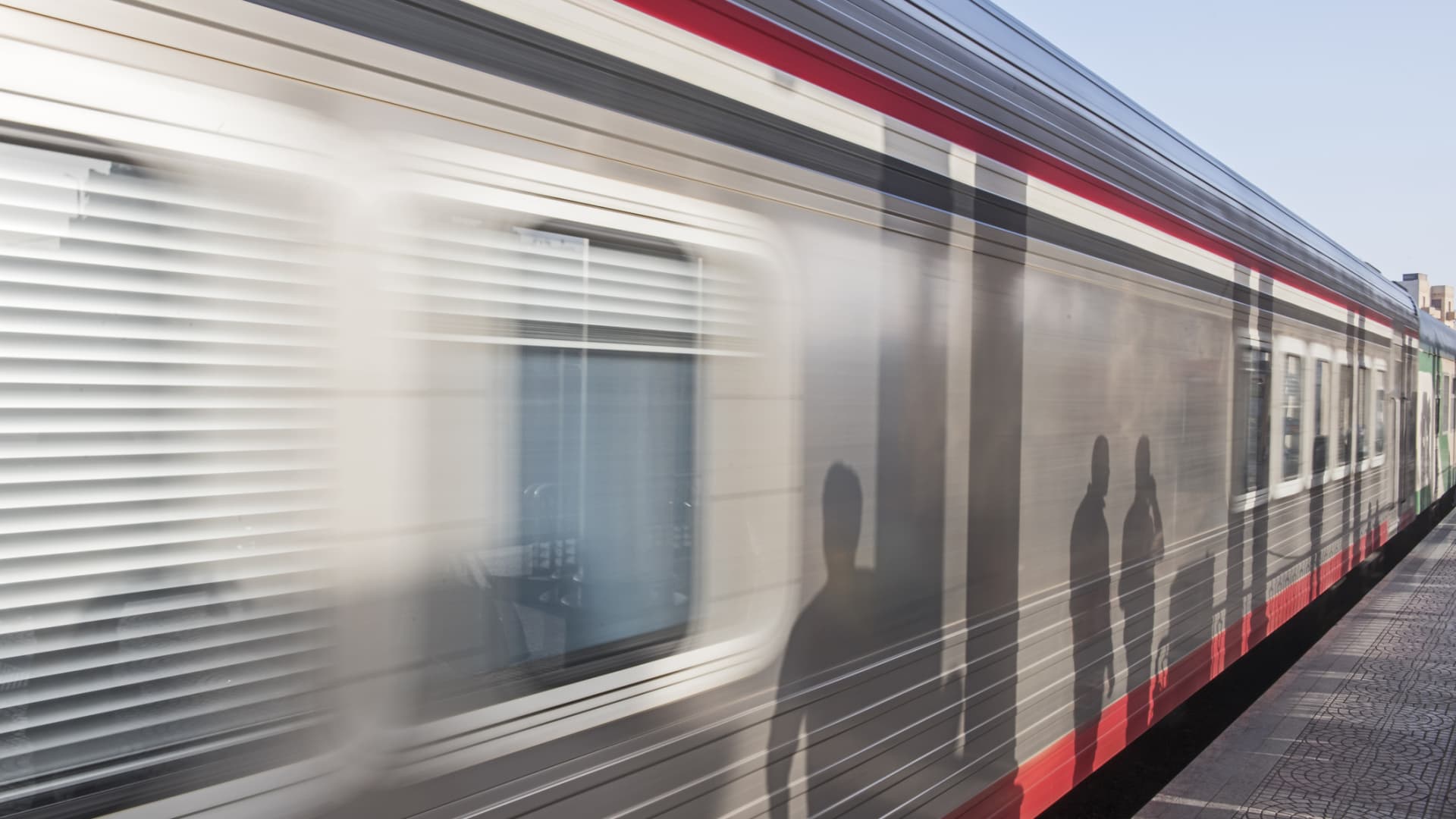
A train passes through a station in Egypt. The project involving Siemens Mobility will use trains that can reach a top speed of 230 kilometers per hour, and the line will be fully electrified.
Paulvinten | Istock | Getty Images
A new high-speed rail line is coming to Egypt, with developer Siemens Mobility saying it will link 60 cities across the country.
The fully-electrified lines will see trains with a top speed of 230 kilometers per hour and travel from the Red Sea to the Mediterranean, among other destinations.
According to Siemens Mobility, the electrification of the network will reduce carbon emissions by 70% when compared to making trips by bus or car. It added that the project would result in the world’s “sixth largest high-speed rail system.”
Siemens Mobility — a separately managed company of industrial giant Siemens — signed the contract to develop the rail line with the Egyptian National Authority for Tunnels, as well as consortium partners The Arab Contractors and Orascom Construction.
In a statement Saturday, Siemens Mobility said its share of the combined contract would amount to 8.1 billion euros, or around $8.7 billion. This figure includes a 2.7 billion euro contract signed in Sept. 2021 for the project’s initial line.
The new network in Egypt will be made up of three parts: a previously announced 660-kilometer line linking Ain Sokhna, on the Red Sea, to Alexandria and Marsa Matrouh on Egypt’s Mediterranean coast; a roughly 1,100 kilometer line between Cairo and Abu Simbel, close to the border with Sudan; and a 225 kilometer stretch between Luxor and Hurghada on the Red Sea.
“Together with our partners, we will develop from scratch a complete and state of the art rail network that will offer a blueprint for the region on how to install an integrated, sustainable, and modern transportation system,” Michael Peter, the CEO of Siemens Mobility, said.
The International Energy Agency has described rail as being “one of the most energy-efficient transport modes.” It is responsible for 9% of worldwide motorized passenger movement and 7% of freight, the IEA says, but only accounts for 3% of transport energy use.
It does, however, rely heavily on oil, which represented 55% of the sector’s total energy consumption in 2020. Under the IEA’s scenario for a net-zero energy system by the year 2050, oil use in rail would have to drop to “almost zero” by the middle of the century, being replaced by electricity — for the vast majority of rail energy needs — and hydrogen.
On the hydrogen front, Siemens Mobility is one of several companies that has been working on hydrogen trains. Others include East Japan Railway and European railway manufacturer Alstom, which has already carried passengers in Germany and Austria on hydrogen trains.