


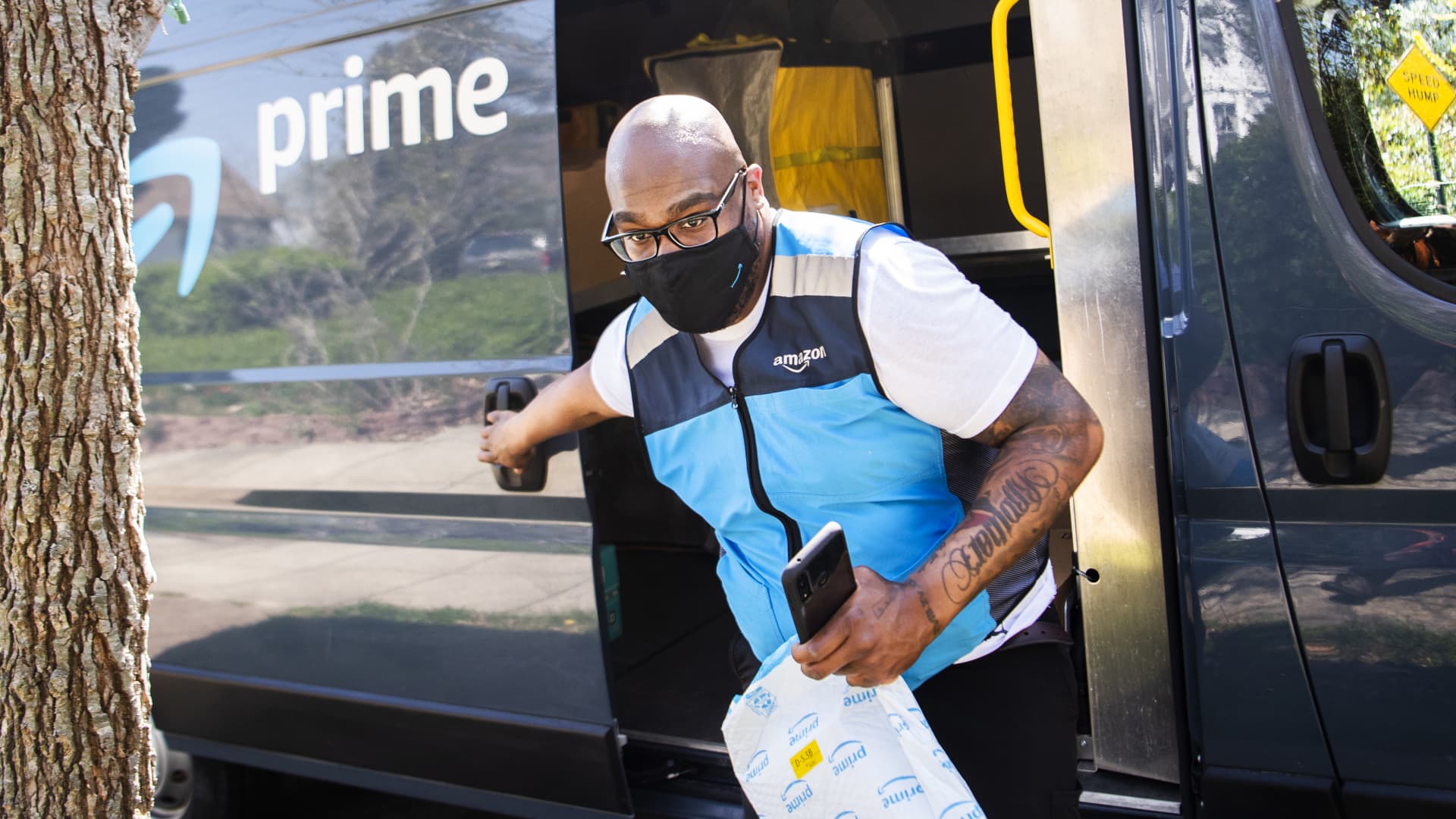
Amazon driver Shawndu Stackhouse delivers packages in Northeast Washington, D.C., on Tuesday, April 6, 2021.
Tom Williams | CQ-Roll Call, Inc. | Getty Images
Amazon’s delivery operations are suffering from an “escalating injury crisis,” driven largely by punishing quotas and pressure to ferry packages as quickly as possible, according to a new study.
Nearly one in five drivers making deliveries for Amazon suffered injuries in 2021, a 40% increase from last year’s injury rate, the Strategic Organizing Center said in a report released Tuesday.
The SOC, which is a coalition of labor unions including the International Brotherhood of Teamsters and the Service Employees International Union, analyzed data submitted by Amazon and its delivery partners to the Occupational Safety and Health Administration in 2021.
Amazon has increasingly relied upon a fast-growing network of third-party delivery companies to pick up packages at its warehouses and drop them at customers’ doorsteps. The third-party delivery companies are part of Amazon’s delivery service partner program, which was launched in 2018. In just a few years, the program has grown to include more than 2,000 DSPs in the U.S.
But as the program has expanded, Amazon has faced some scrutiny from labor advocates, lawmakers and DSPs who argue the company fails to ensure driver safety in its race to provide faster and faster delivery. Delivery drivers have also complained that the company requires them to meet strict production quotas, which increases the risk of injury on the job.
The SOC report found that contracted Amazon delivery drivers suffer injuries at nearly two-and-a-half times the rate of the non-Amazon delivery industry. It also found that, in 2021, seven Amazon drivers sustained injuries that were so severe that they either cannot perform their regular job, or are forced to miss work altogether, the report states.
Amazon’s last-mile delivery stations, the last link in Amazon’s fulfillment operations before packages are delivered to customers’ doorsteps, are also the “most dangerous” type of Amazon facility, with injury rates more than 40% higher than warehouses, the report says.
According to the report, Amazon’s “unmanageably high quotas” for delivery drivers are a major catalyst behind the high injury rates. It cites a class-action lawsuit filed by a Wyoming Amazon delivery partner, which claimed the company expected drivers to deliver about 350-400 packages per day per van. This amounts to drivers making one delivery every 1 to 2 minutes, presuming they don’t take any breaks, the report said.
Amazon delivery drivers commonly suffer injuries from trips, slips and falls, strains, dog bites, vehicle accidents and striking an object, such as a fence post, according to the report, which cites data from Pinnacol Assurance, a workers’ compensation insurance carrier in Colorado that analyzed Amazon DSP workforce claims in 2020.
In January, Amazon disclosed it spent $300 million on worker safety improvements in 2021. It said the rate of employees who missed work due to workplace injury dropped by 43% in 2020 from the prior year.
Earlier this year, Amazon CEO Andy Jassy said in his first letter to shareholders since taking the helm last July that Amazon’s injury rates were “a little lower than the average of our courier and delivery peers.”
SOC researchers argue that claim is “misleading on multiple levels” because it uses outdated data and excludes Amazon’s network of DSP drivers.
“Drivers hired by Amazon DSPs likely account for half of all Amazon delivery system workers in the U.S., yet the company does not include these drivers in its public reporting of injury rates,” the report states.
Amazon has instituted policies and measures aimed at improving safety among its delivery driver workforce, such as an app called “Mentor.” Drivers are required to continuously run the app while they’re on the job, and it generates a daily score of their driving performance. But drivers previously told CNBC the app produces errors, resulting in a lower score.
Last February, Amazon also began installing AI-enabled cameras in delivery vans to increase safety.
Increasing surveillance of employees hasn’t helped to reduce injury rates among Amazon delivery drivers, according to the SOC. Injury rates for DSP drivers rose 38% from 2020 to 2021, “despite Amazon’s introduction of additional surveillance in early 2021,” the report states.
The SOC said these systems increase the pressure that drivers feel to work at faster speeds to meet their delivery quotas.
“The real issue is Amazon’s sky-high production pressure and delivery quotas which push Amazon workers to work too fast and DSP drivers to risk injury as they rush to hit delivery targets,” according to the report.
Representatives from Amazon didn’t immediately respond to a request for comment.
WATCH: Amazon delivery companies skip safety checks to keep up with quotas
