




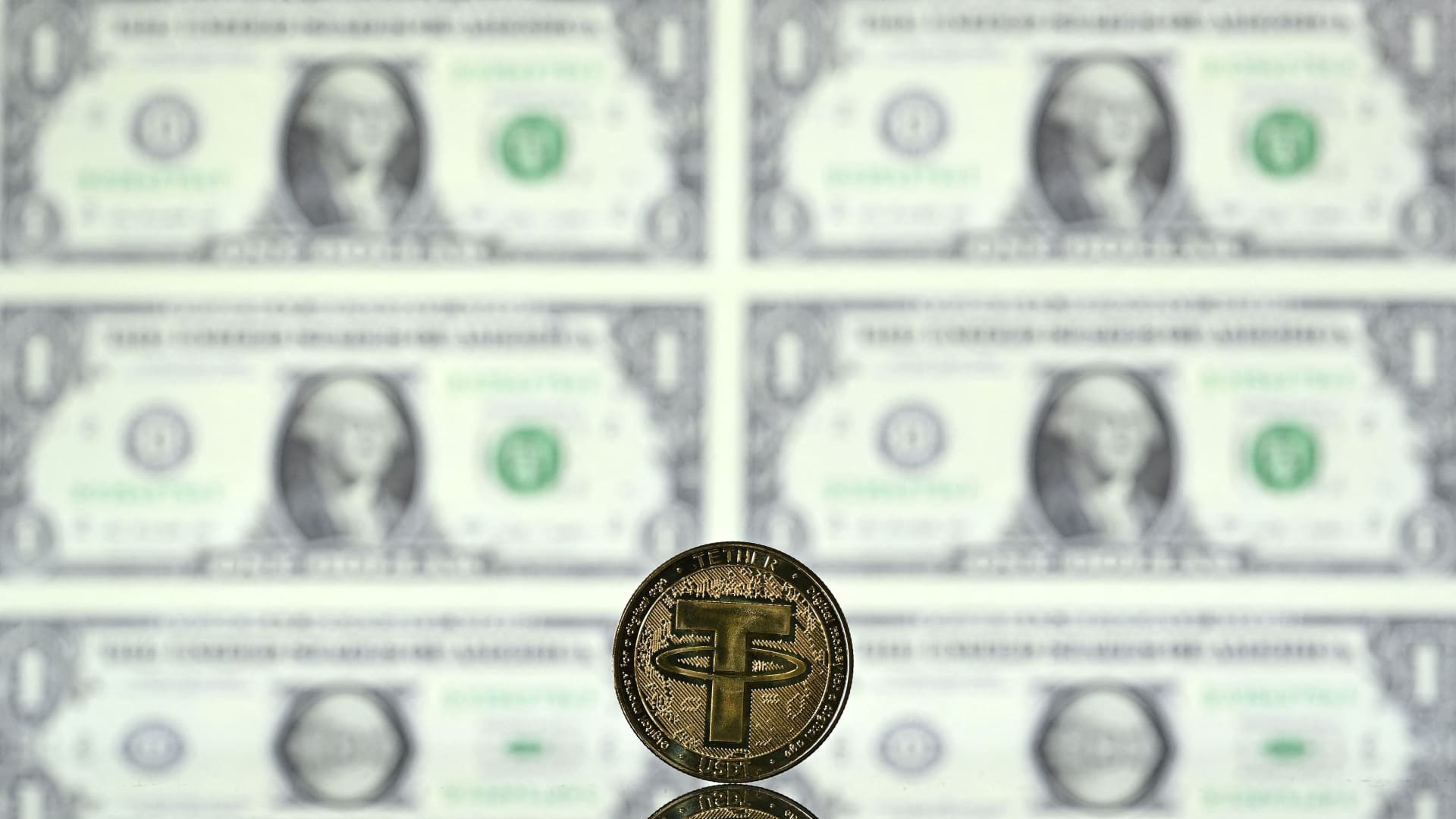
Tether claims its dollar-pegged token is “fully backed.”
Justin Tallis | Afp | Getty Images
Investors have yanked more than $10 billion out of tether in the past two weeks amid heightened regulatory scrutiny over stablecoins.
Tether, the world’s largest stablecoin, has seen its circulating supply plunge from a record $84.2 billion on May 11 to around $73.3 billion as of Monday, according to data from CoinGecko. About $1 billion was withdrawn late Friday evening.
The cryptocurrency, which is meant to be pegged to the U.S. dollar, temporarily dipped as low as 95 cents on May 12 after another type of stablecoin, terraUSD — or UST — plunged well below $1. That resulted in a sell-off in UST’s associated luna token, which in turn wiped out more than $40 billion in holders’ wealth.
The fallout from the collapse of Terra, the blockchain behind UST and luna, sent shockwaves through the crypto market, with bitcoin and other cryptocurrencies tumbling sharply. That’s causing concern for regulators.
“Whenever there’s a failure or a catastrophe in crypto, the fear is always that someone will misread the situation and overcorrect in a position that’s not helpful for the entire community writ large,” Kathleen Breitman, a co-creator of the Tezos blockchain, told CNBC.
“As much as I relish seeing things that don’t make sense fail, there’s always a tinge of like, ‘Are people going to extrapolate from this that everything that’s a stablecoin is unsound?’ That’s always the big fear.”
Unlike tether, UST wasn’t backed by fiat currency held in a reserve. Instead, it relied on some complex engineering where price stability was maintained through the destruction and creation of UST and its sister token luna. Investors were lured in by the promise of 20% savings yields from Anchor, Terra’s flagship lending platform, a rate many investors said was unsustainable.
Terra creator Do Kwon had also accumulated billions of dollars’ worth of bitcoin and other tokens through his Luna Foundation Guard fund, but nearly all of the funds were depleted in a futile effort to save UST.
Nevertheless, the panic over UST has drawn attention to other stablecoins — tether, in particular.
Regulators and economists have long questioned whether Tether has enough assets in its reserves to justify its stablecoin’s purported peg to the dollar.
The company previously claimed tether was backed one-to-one by dollars in a bank account, but subsequently revealed it was using other assets including commercial paper — short-term corporate debt — and even digital tokens as collateral after a settlement with the New York attorney general.
Last week, Tether said it reduced the amount of commercial paper it owns and increased its holdings of U.S. Treasury bills. For the first time, the British Virgin Islands-based firm said it also holds some foreign government debt. Tether declined to comment further on the source of its funds, but said it is pursuing a more thorough audit of its reserves.


