


Tesla China sales fell by 5.4% in the first half of the year, although the company retained third place in new energy vehicle sales, behind BYD and Geely, according to the China Passenger Car Association.
Bloomberg | Bloomberg | Getty Images
BEIJING — Tesla CEO Elon Musk has again touted the impending rollout of advanced driver-assist software in China, after reporting another quarter of disappointing earnings.
Since last year, driver-assist has become a selling point for cars in China’s fiercely competitive electric car market. Chinese authorities have also started to support the use of limited driver-assist technologies on the road for some companies.
Tesla’s Autopilot for navigating on highways is available locally, but not Full Self-Driving, which uses cameras and artificial intelligence to enable cars to automatically park, change lanes and slow down at stop signs. FSD is an upgrade to Tesla’s Autopilot driver assistant. For interested customers, Tesla has offered a limited version of its FSD technology in China for years.
“Pretty soon, we will ask for regulatory approval of the Tesla-supervised FSD in Europe, China and other countries. And I think we are likely to receive that before the end of the year,” Musk said on a second-quarter earnings call Wednesday Beijing time. That’s according to a FactSet transcript.
Musk has a long history of promising investors that futuristic Tesla products or services will be ready soon, even if they do not exist beyond a design concept. During the latest earnings call he announced Tesla’s robotaxi event would be postponed to October, after previously saying it would be held in August.
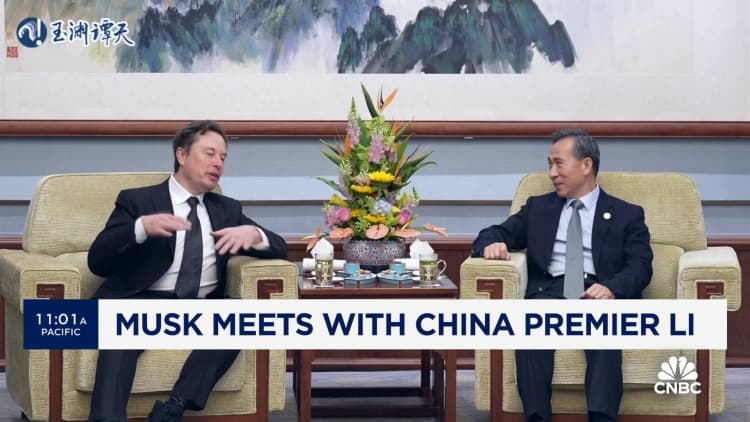
Musk in April had said FSD’s rollout to China “may be possible very soon,” according to his response to a question on X.
About a week after the social media post, Musk unexpectedly appeared in Beijing for a meeting with Chinese Premier Li Qiang during the first major auto show in the city in four years. Local authorities also removed restrictions on Tesla cars after the company’s China-made vehicles passed domestic data security requirements.
Full Self-Driving is currently only available in the United States and Canada. China accounts for about 22% of Tesla’s sales.
Tesla does not yet make or sell cars capable of full autonomous driving. It sells “Level 2” driver-assistance systems, marketed under the brand name FSD. Companies in China typically brand their versions with the term “navigation.”
Musk’s company has been sued in the U.S. by the California Department of Motor Vehicles for false advertising with its Autopilot and Full Self-Driving driver-assistance systems.
Tesla has responded that the DMV had been aware of its use of these brand names for years and chose not to take action. The firm believes Californian law on advertising of autonomous driving systems violates free speech.
China competition on driver assist
Multiple companies from tech giant Huawei to electric car startup Xpeng sell driver-assist capabilities in China. Xpeng in March 2023 expanded its driver-assist software to Shanghai city streets and subsequently Beijing.
“Tesla’s current FSD technology is somewhat of a laggard to what its competitors offer in China,” said Shay Natarajan, a North America-based partner at Mobility Impact Partners, a private equity fund that invests in transportation.
“When comparing Tesla’s FSD to other L2 self-driving offerings in China, I see two main takeaways,” she said. “Nio is a leader in self-driving technology. Their sensory inputs include camera, radar, LIDAR as well as ultrasonic sensors. This is the best of all worlds and leads to a very high level of precision and redundancy in the ability to sense the surroundings.”
Natarajan pointed out Nio charges about $55 a month for its driver assist features, about half what Tesla charges for FSD in the U.S.
Tesla has recently made big changes to its driver assistance software, marketed in the U.S. as Autopilot and FSD-S (Full Self Driving Supervised), garnering excitement and favorable reviews among the automaker’s many fans and owners.
— CNBC’s Ryan Browne and Lora Kolodny contributed to this report.
Clarification: This story has been updated to clarify that a limited version of Tesla’s FSD product has been available in China.


