


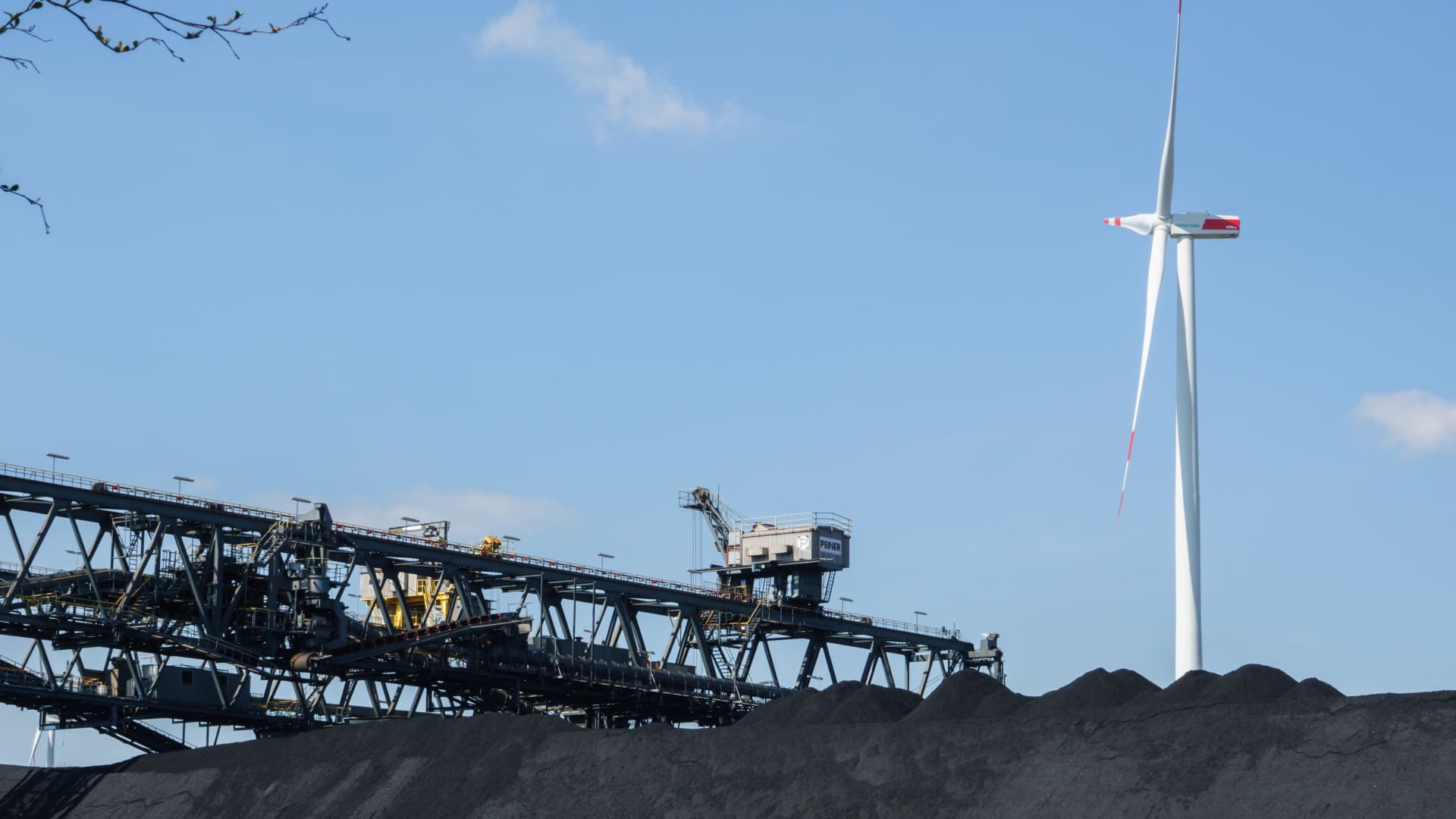
A wind turbine and coal in Lower Saxony, Germany. The EU’s desire to wean itself off Russian hydrocarbons means it will need to find fossil fuels from other parts of the world to plug supply gaps.
Mia Bucher | Picture Alliance | Getty Images
The European Commission has fleshed out details of a plan to ramp up the EU’s renewable energy capacity and reduce its reliance on Russian fossil fuels, at the same time acknowledging that existing coal facilities may have to be used for “longer than initially expected.”
A document outlining the Commission’s aims for the REPowerEU plan was published on Wednesday, highlighting the importance of energy savings, the diversification of energy imports and speeding up what it called “Europe’s clean energy transition.”
In total, it envisages extra investment of 210 billion euros ($220.87 billion) between 2022 and 2027. When it comes to renewables’ share in the EU’s energy mix, the Commission has proposed that the current target of 40% by 2030 should be increased to 45%.
The Commission’s proposals came on the same day the governments of Denmark, Germany, the Netherlands and Belgium said they would aim for a combined target of at least 65 gigawatts of offshore wind capacity by 2030. By the middle of the century, they are aiming for 150 GW of capacity.
On the fossil fuel front, the situation is a challenging one. Russia was the biggest supplier of both petroleum oils and natural gas to the EU last year, according to Eurostat.
The EU’s desire to wean itself off Russian hydrocarbons following the latter’s invasion of Ukraine means it will need to find oil and gas from other parts of the world to plug supply gaps.
The Commission said as much as 1.5 to 2 billion euros of investment would be needed to secure oil supply. To import enough liquefied natural gas and pipeline gas from other sources, an estimated 10 billion euros will be needed by 2030.
All the above comes at a time when the EU has said it wants to be carbon neutral by 2050. In the medium term, it wants net greenhouse gas emissions to be cut by at least 55% by 2030, which the EU calls its “Fit for 55” plan.
The Commission said REPowerEU could not work without what it called “a fast implementation of all Fit for 55 proposals and higher targets for renewables and energy efficiency.”
In this new reality, gas consumption in the EU would “reduce at a faster pace, limiting the role of gas as a transitional fuel,” the Commission said.
“However, shifting away from Russian fossil fuels will also require targeted investments for security of supply in gas infrastructure and very limited changes to oil infrastructure alongside large-scale investments in the electricity grid and an EU-wide hydrogen backbone,” it added.
“In parallel, some of the existing coal capacities might also be used longer than initially expected, with a role for nuclear power and domestic gas resources too,” the Commission said.
During a press conference on Wednesday the EU’s climate chief, Frans Timmermans, admitted that using less natural gas in a transitional phase would mean “you might use coal a bit longer — that has a negative impact on your emissions.”
“But if at the same time, as we propose, you rapidly speed up the introduction of renewables — solar, wind, biomethane — you then have the opposite movement,” he said.
Timmermans, who is the European Commission’s executive vice president for the European Green Deal, went on to stress the importance of finding a middle ground.
“If we can actually do what I say — reduce our energy consumption in combination with a speedier introduction of renewables — we will bring down our emissions even quicker than before,” he said.
“And then, of course we will have slightly higher emissions if people stick a bit longer to coal, but we need to strike the balance so that, on balance, we do not increase our emissions — we hopefully even decrease them more.”
Coal has a substantial effect on the environment, with Greenpeace describing it as “the dirtiest, most polluting way of producing energy.”
Elsewhere, the U.S. Energy Information Administration lists a range of emissions from coal combustion, including carbon dioxide, sulfur dioxide, particulates and nitrogen oxides.
The European Commission announcement drew criticism from a number of environmental organizations.
“These plans are supposed to fast-track the clean energy transition — but the European Commission’s latest strategy gives with one hand and takes with the other,” Eilidh Robb, an anti-fossil fuels campaigner at Friends of the Earth Europe, said.
“So-called REPowerEU contains useful and necessary strides towards renewable solutions but it simultaneously enables almost 50 fossil fuel infrastructure projects and expansions,” Robb said.


