


Passengers pass through O’Hare airport in Chicago, July 3, 2024.
Scott Olson | Getty Images
Record summer air travel demand isn’t translating to record U.S. airline profits. Carriers will have to answer for that disconnect when they report quarterly results this month.
Some airlines have forecast record demand, and in some cases, revenue. But higher labor and other costs have eaten into airlines’ bottom lines. To adapt to slower demand growth and other challenges, some carriers have slowed if not halted hiring compared with hiring sprees when they rebuilt after the pandemic.
And some airlines are facing delays of new, more fuel-efficient aircraft from Airbus and Boeing at the same time that a Pratt & Whitney engine recall has grounded dozens of jets.
Yet U.S. airlines have increased capacity, flying about 6% more seats in July than they did in July 2023, according to aviation data firm OAG. The expansion is keeping airfare in check, and stocks in the sector have fallen behind the broader market.
The NYSE Arca Airline Index, which tracks 16 mostly U.S. airlines, is down almost 19% this year, while the S&P 500 has advanced more than 16%.
‘Clear as mud’
What the third quarter will look like for airlines is “clear as mud,” Raymond James analyst Savanthi Syth said in a note Friday, citing headwinds such as potentially weaker spending from coach-class clientele, the Paris Olympics’ impact on some Europe bookings, and possible changes in corporate travel demand.
Also, some travelers have been opting for trips in late spring and early summer, raising questions about late-summer demand.
Investors will get more insight into the traditionally slower tail end of summer and the rest of the year when airlines report quarterly results, starting with Delta Air Lines on Thursday.
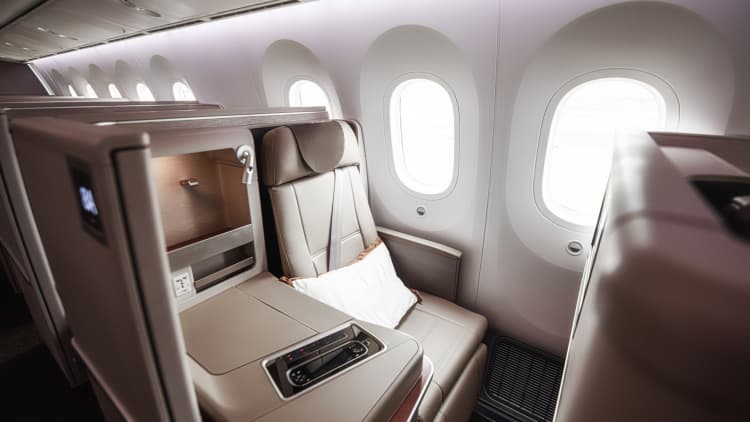
Analysts consider Delta the best of the bunch, thanks in large part to the airline’s success in marketing more expensive, premium seats and its lucrative deal with American Express.
In April, Delta, the most profitable U.S. airline, forecast quarterly adjusted earnings of $2.20 to $2.50 a share for the second quarter, which would be down from the adjusted $2.68 a share it brought in a year earlier.
Delta, its rival United Airlines, which reports the following week, and Alaska Airlines are top picks for Wolfe Research airline analyst Scott Group, who said in a June 28 research note that the three have less earnings risk and better free cash flow than other carriers.
Shares of Delta and United are each up about 14% this year through July 5, the standouts in a sector that is mostly down this year. Alaska shares are down about 2%.
Cheaper fares
Airports are bustling this summer. Nearly 3 million people, setting a record, passed through U.S. airport checkpoints on June 23 alone, according to theTransportation Security Administration.
Airlines have been expanding their schedules, both domestically and internationally, pushing down fares. U.S.-Europe capacity for July is up nearly 8% from a year ago, according to consulting firm Airline/Aircraft Projects, with new routes largely targeting leisure travelers.
Fare-tracking company Hopper reported in June that summer flights between the U.S. and Europe in coach were going for $892 on average, compared with $1,065 for summer 2023.
Airfare was down nearly 6% in May from a year earlier, according to the latest U.S. inflation data.
Lowered forecasts
Despite higher numbers of passengers, some carriers have admitted weaker sales than expected because of the increased flights. American Airlines on May 28 cut its second-quarter revenue and profit forecasts and announced its chief commercial officer was leaving after a sales strategy backfired.
“The domestic supply and demand imbalance has led to a weaker domestic pricing environment than we had forecast,” American Airlines CEO Robert Isom said at a Bernstein industry conference the next day. “There’s more discounting activity than we saw a year ago. Now, industry capacity is expected to come down in the second half of the year, and that should help.”
Travelers at New York’s LaGuardia Airport
Leslie Josephs/CNBC
Southwest Airlines cut its second-quarter forecast in late June, citing shifting demand patterns. The Dallas-based airline is under pressure to quickly change its long-profitable business model — which has no seat assignments and one class of service — as big rivals such as United and Delta tout strong growth from premium cabins.
The airline is trying to fend off activist investor Elliott Investment Management, which disclosed a nearly $2 billion stake in the carrier in June and called for a leadership change.
“We will adapt as our customers’ needs adapt,” Southwest CEO Bob Jordan said at an industry event hosted by Politico on June 12, discussing potential new revenue initiatives.
Both American and Southwest report second-quarter results toward the end of July.
Making changes
Some money-losing carriers, such as JetBlue Airways and Frontier Airlines, are already making changes.
JetBlue has been cutting unprofitable flights this year and making sure that planes outfitted with its high-end Mint business cabin, where tickets can go for more than four times a coach fare, is on the right routes.
Meanwhile Frontier Airlines and fellow discounter Spirit Airlines have done away with change fees for standard coach tickets and above, following larger, legacy carriers’ move during the pandemic. Both budget airlines announced in May that they will start offering bundled fares to include seat assignments and other add-ons that they used to charge for.
Spirit, which is struggling with the fallout from a judge’s ruling that blocked JetBlue from buying the airline, and is the most affected by the Pratt engine grounding, last week warned some 200 pilots they could be furloughed this year, according to the pilots union.
At Spirit’s annual shareholder meeting in June, CEO Ted Christie brushed off suggestions that Spirit is considering filing for Chapter 11 bankruptcy protection, with a more than $1 billion debt payment due in September 2025.


