



An editorial montage of the Japan flag and Japanese yen funds financial institution notes
Javier Ghersi | Instant | Getty Photos
Japan’s central lender raised desire fees on Tuesday for the 1st time since 2007, ending the world’s only unfavorable charges routine on early signs of robust wage gains this year.
The Bank of Japan although cautioned it is not about to embark on aggressive charge hikes, stating that it “anticipates that accommodative financial disorders will be maintained for the time remaining,” offered the fragile advancement in the world’s fourth-biggest financial system.
The BOJ elevated its small-term interest premiums to all over % to .1% from -.1%, according to its statement at the conclusion of its two-working day March coverage meeting. Japan’s negative charges routine experienced been in position since 2016.
The BOJ also abolished its radical generate curve regulate coverage for Japanese sovereign bonds, which the central lender has used to goal extended-term curiosity prices by obtaining and providing bonds as required.
The central financial institution while will continue on getting government bonds well worth “broadly the exact sum” as just before — presently about 6 trillion yen for each month.
It would vacation resort to “nimble responses” in the kind of greater JGB buys and mounted-rate buys of JGBs, among the other points, if there is a rapid increase in lengthy-expression desire prices.

Scaling back of its radical asset buys and quantitative easing, the BOJ explained it would quit acquiring trade-traded cash and Japan actual estate financial investment trusts (J-REITS). It also pledged to slowly and gradually decrease its buys of industrial paper and company bonds, with the purpose of halting this observe in about a 12 months.
These variations mark a historic shift and signify the sharpest pull back again in one particular of the most intense monetary easing workout routines in the entire world, which was aimed at lifting the Japanese economy out of its deflationary spiral.
The Japanese yen weakened to as substantially as 149.92 versus the greenback, although the Nikkei stock index swung between gains and losses next the BOJ final decision. Yields on the 10-year and 30-12 months JGBs dipped.
Economical markets had repositioned more than the past week as nearby Japanese information studies and preliminary wage negotiation success fanned speculation that the BOJ could normalize premiums a thirty day period previously, ahead of its April meeting.
Inflation goal in sight
The BOJ had scarcely budged from its ultra-unfastened monetary policy posture despite “main core inflation” — which excludes foodstuff and electrical power price ranges — exceeding its 2% goal for a lot more than a calendar year, as policymakers viewed cost boosts were being mainly imported.
BOJ Governor Kazuo Ueda had regularly claimed the result of this year’s yearly “shunto” wage negotiations would be important to sustainable cost will increase. The Bank of Japan expects larger salaries to guide to a virtuous spiral with domestic desire fueling inflation.
“Products and services prices have ongoing to boost reasonably, partly owing to the average wage raises observed thus far,” the BOJ mentioned in a statement.
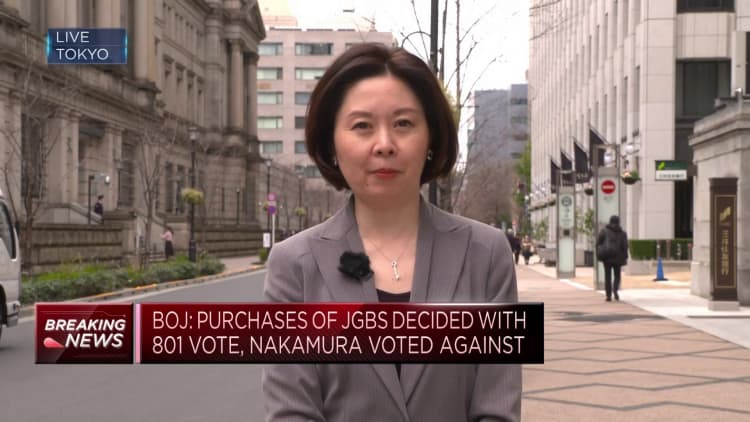
“As these latest facts and anecdotal info have gradually shown that the virtuous cycle in between wages and selling prices has come to be a lot more strong, the Financial institution judged it came in sight that the selling prices steadiness goal would be obtained in a sustainable and steady method toward the stop of the projection period of time of the January 2024 outlook report,” it extra.
Ongoing “shunto” spring wage negotiations concerning Japan Inc and its unionized staff have so significantly yielded a weighted normal 3.7% spike in base shell out, Rengo, Japan’s greatest federation of trade unions stated Friday in its initially provisional update.
This is even additional robust than final year’s gains, which were the steepest spike in three decades.
This is a creating story. You should test for updates.


