




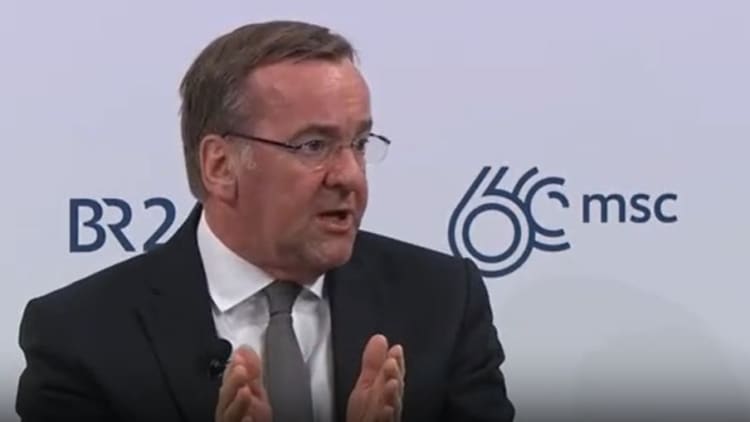
Germany’s defense minister mentioned on Saturday that his country’s determination to invest 2% of GDP on protection was just the beginning level and that more would very likely be needed.
Earlier in the day, German Chancellor Olaf Scholz insisted that the 2% spending focus on would be met “in the 2020s, in the 2030s and beyond.”
Even so, Boris Pistorius, Germany’s federal minister of defense, stressed that expending 2% was generally designed to be a minimal.
“2% can only be the start out of it. We could — we are going to in all probability have to have much more — in the next several years,” Pistorius stated on a CNBC-moderated panel at the Munich Stability Meeting.
The feedback appear following former U.S. President Donald Trump explained very last weekend that he “would stimulate” Russia “to do what ever the hell they want” to NATO associates that will not fulfill the alliance’s protection investing pointers.
Previous US President and 2024 presidential hopeful Donald Trump speaks at a “Get Out the Vote” Rally in Conway, South Carolina, on February 10, 2024.
Julia Nikhinson | Afp | Getty Illustrations or photos
In 2006, NATO member countries dedicated to shelling out a minimum of 2% of their gross domestic product on protection, “to keep on to make certain the Alliance’s military services readiness.” This calendar year, 18 of 31 NATO users are anticipated to achieve the target — up from just a few in 2014.
Pistorius cited rising geopolitical tensions all over the world, such as in Europe, the Indo-Pacific and Africa, as the cause he expects defense investing to enhance.
“We need extra attention, on the just one hand facet, to what is heading on in the entire world, for the reason that all people has to engage there. The U.S., we NATO, European Union and many others,” he claimed.
“And at the similar time, we have to attain … far more in Europe simply because some others, like for instance the U.S., could shift their focus more to the Indo-Pacifc and … not to do as substantially as ahead of in Europe. So in any circumstance, we are challenged and we have to acknowledge that.”
When requested by CNBC’s Silvia Amaro no matter whether a 4% paying out goal was sensible, Pistorius refused to ensure a amount, in its place arguing that it was about paying out what was wanted, together with funding the growth of the defense marketplace.
“We might get to 3% or probably even 3.5%, it is dependent on what is going on in the world,” he extra.