


Companies are under intense pressure to speak out on a variety of political issues at local, state and national levels. Whether it is police action in a city, Disney in Florida, or the likely wave of calls for more business response to the bombshell leak in the Roe v. Wade Supreme Court case, the current era is one in which business leaders are expected to take a stand, or face potentially worse repercussions for remaining silent.
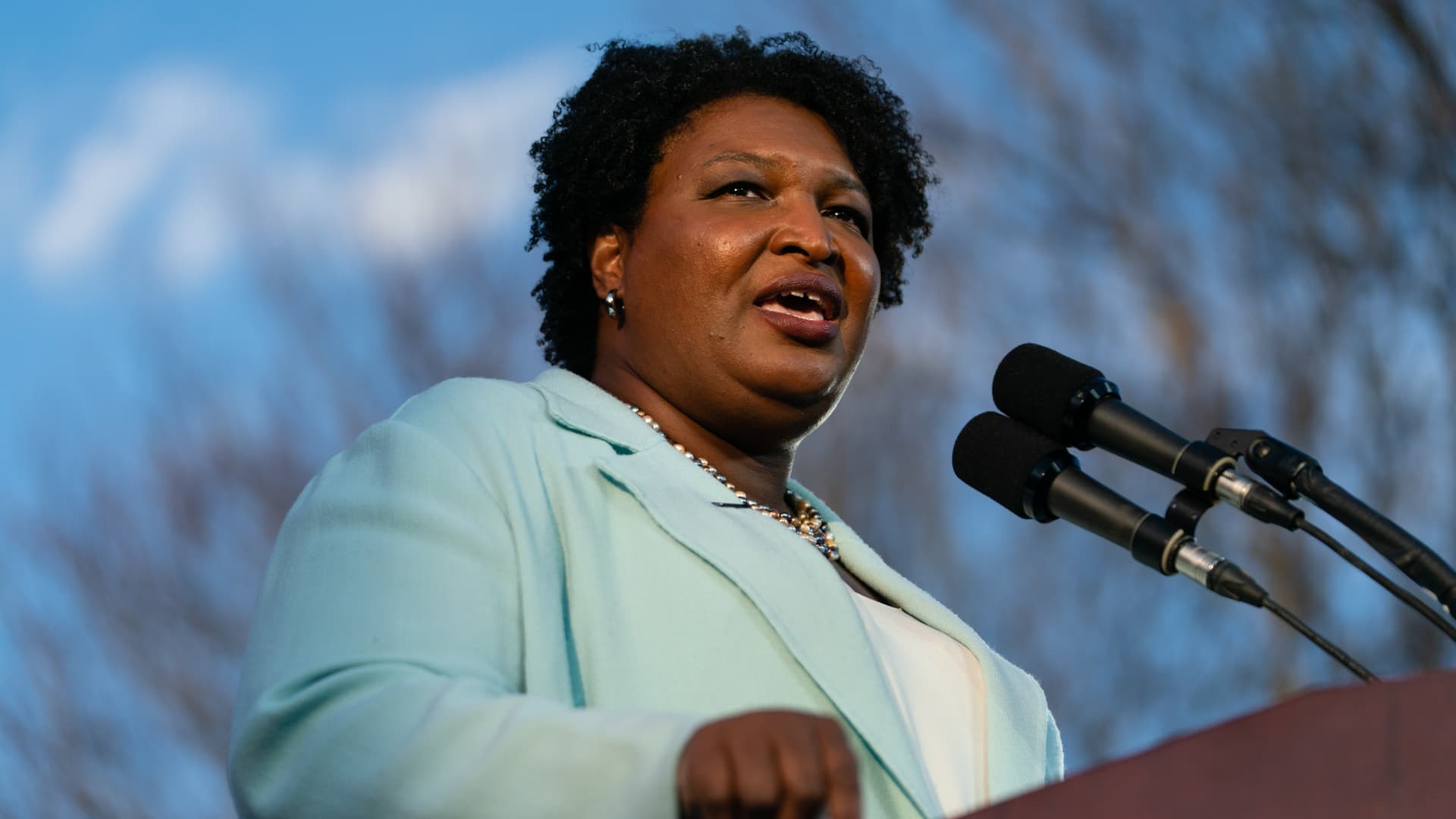
There may be no more influential voice in the Democratic Party — no less from a state that has featured prominently in big political-corporate fault lines — than Stacey Abrams, current candidate in the Georgia governor race. But Abrams says that assuming companies should speak out on every political issue is a mistake.
“Performative value means nothing to me,” Abrams said on Thursday at CNBC’s Small Business Playbook virtual event. “It shouldn’t be performing values because you think that’s what people want to see from you.”
Abrams is a small business owner, and at the CNBC event, she made clear that she is a “capitalist.”
“We should want to make money,” she said.
But it is important to remember, Abrams added, especially for small businesses, “that we enter the world as citizens, we don’t divorce ourselves from who we are when we open the doors.”
This means also accepting that customers come with their full selves when they come through the doors and any decision to speak out on politics is a decision to show your full self to those customers.
“We should be really selective about the way we are willing to impose our belief systems,” Abrams said. “But some things are so fundamental about who we are, we have too,” she added.
For the 1.1 million small business owners in her home state of Georgia, she said making choices about where to take a stand on political issues implies being willing to lose business, even if another form of value is gained.
During every major movement in this country’s history, from civil rights to women’s rights to LGBTQ rights, businesses have had to stand up. But the answer should not always be a reflective “yes,” and it shouldn’t be based on an accounting of only dollars and cents.
“The decision should be because you can’t meet your own moral compass, can’t be respectful of your own moral core,” Abrams said.
Her co-founder, Lara Hodgson — who is more conservative politically and with whom Abrams co-authored the recent book “Level Up” — said some businesses are created with purpose as part of their DNA. Their latest venture together, Now, which provides invoice payment solutions to small business owners for a fee, serves a diverse set of clients, employees and investors. And Hodgson and Abrams have to make sure they are true to what the business is built on, and that is to help small business owners facing cash flow difficulties.
When a business pivots, as theirs did after a failed effort to create the next big global beverage giant under the brand Nourish, it is important to remember that a pivot represents not a total change of direction, but a fundamental position from which a new opportunity is being sought. For Abrams and Hodgson, that pivot DNA may include certain beliefs, but from a market opportunity perspective, it led to the problem of small business financing. “Don’t use the business to go out and talk about other things,” Hodgson said. “We are very laser focused on leveling the playing field for small business.”
The two often have disagreements, and they have different strengths and weaknesses. Abrams, who ran one of the most successful voter registration drives in modern history and was credited with delivering key Georgia races to the Democratic Party, says she is great with numbers that many entrepreneurs (and legislators) don’t understand.
“We’re very different, we’re not best friends,” Abrams said. “This gives us space to be incredibly honest, and not be in each others’ lives every minute of the day. If you’re waking up and working and going to bed talking to the same person, it will cloud your mind and create an echo chamber.”
Hodgson said when they do disagree, they approach the topic with curiosity first and criticality second.
“When one of us shares a point of view, rather than jumping to judgment, we ask ourselves what can we be curious about, what can we learn from,” she said.
And amid differences of opinion, sharing a firm of idea of impact and outcome will outweigh any particular friction points. “99.9% of the goal, we agree on the outcome, and how we would go about getting there is very different, but as long as the focus is the outcome and the impact, the different approaches are incredibly positive.”


