


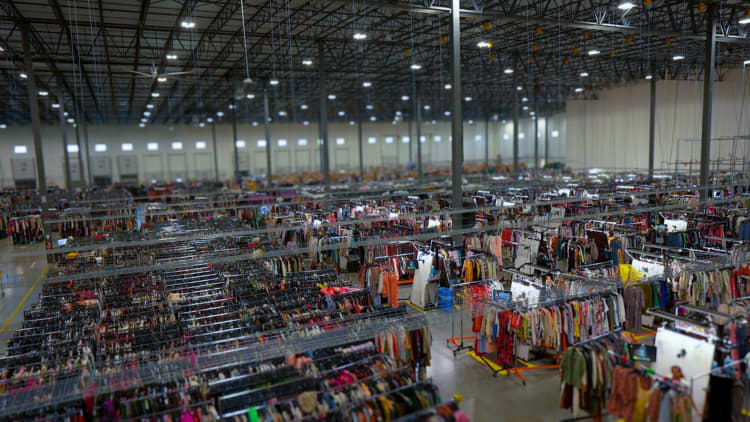
Nuuly warehouse
Natalie Rice
Urban Outfitters’ clothing rental service Nuuly has eked out its first profit thanks to a steady stream of new subscribers and a whopping 86% jump in revenue, hitting the benchmark before competitor Rent the Runway, which has yet to turn a profit nearly 15 years into its history.
The brand, which offers a $98 monthly subscription service for six items of clothing, saw $65.5 million in revenue and an operating profit of $300,000 during its fiscal third quarter ended Oct. 31. In the year-ago period, Nuuly posted $35.3 million in revenue and an operating loss of $3 million.
The milestone marks the first time Nuuly has earned money since its launch in 2019, a goal for the company from the beginning as it looked to prove it could run a clothing rental business profitably. While there is wide demand for clothing rental services, particularly among younger consumers, the logistics of rental have made it difficult to make money, threatening the platforms’ viability.
“We set out with a plan to build a business that we thought could be quite big and we set out with a plan to build a business that had the potential to be profitable,” David Hayne, Nuuly’s president and Urban’s chief technology officer, told CNBC in an interview. “And that’s what we’ve been able to accomplish.”
The brand’s meteoric rise as one of the go-to clothing rental services among Gen Z and Millennial consumers comes as competitor Rent the Runway struggles to turn a profit nearly 15 years into its history.
Nuuly’s active subscriber count, which reached 198,000 during the quarter, also eclipses Rent the Runway’s, which stood at 137,566 as of July 31. In April, CEO Jenn Hyman told CNBC the company needs to reach 185,000 subscribers to have enough free cash flow to cover all of its fixed costs, variable costs and the cost of its inventory. She said Rent is a “stone’s throw away” from profitability. The company is due to report third-quarter earnings on Dec. 5.
Nuuly turned an operating profit in part because it is buoyed by the larger Urban business, which supplies many of the clothes that are available to renters and covers some of its costs. Given the size of Urban and its inventories, Nuuly can be efficient in ways that Rent cannot.
In response, Rent told CNBC its definition of profitability differs from Nuuly’s and isn’t comparable. The company added that it has stronger unit economics than Nuuly and its sales routinely exceed the newcomer’s. Further, Rent said its gross margins are double Nuuly’s.
Nuuly and Rent’s services are similar in that they both offer clothing for rent on a monthly basis for all sorts of occasions. Rent has long differentiated itself by focusing on designer brands and consumers seeking a higher-end products, while Nuuly started out by offering a more casual selection of clothing for everyday wear. These days, both companies offer a range of casual and formal options, although Rent still focuses more on designer brands.
The clothing rental market is still a budding industry. As brands look to convince consumers to rent instead of buy, offering a wide-ranging assortment has proven critical.
“We wanted to give her, the subscriber, a chance to rent for something she could wear to the office, something she could just wear when she’s lounging around at home, or that dress that she wants to wear to a wedding,” said Hayne, the son of Urban’s founder and CEO Richard Hayne. “We wanted to build an assortment that was expansive enough and varied enough that she could have options for whatever her next month’s need was, whether or not she’s going to a wedding or has an event, whatever it may be.”
Urban beats on top and bottom lines
Across the Urban business, the retailer performed better than expected on both the top and bottom lines.
It posted earnings per share of 88 cents, compared with expectations of 82 cents, according to LSEG, formerly known as Refinitiv.
Sales came in at $1.28 billion, compared with expectations of $1.26 billion, according to LSEG.
Same store sales rose 5.6% in the quarter, higher than the 4.9% uptick analyst had expected, according to StreetAccount.
Anthropologie, which sells hip, higher-end clothes and home goods, drove the quarter with $550 million in revenue. Comparable sales were up 13.2% during the quarter, well ahead of the 9.5% increase that analysts had expected, according to StreetAccount.
However, Urban’s namesake brand, known for its quirky assortment and sprawling mall stores, saw sales drop by about 12% to $324 million. Comparable sales also fell by 14.2%, which is worse than the 12% decline that analysts had expected, according to StreetAccount.
Frank Conforti, the co-president and chief operating officer of Urban, said in a statement to CNBC that the company has “more work to do” at its namesake brand and is “laser focused on that opportunity.”
In its release, Urban didn’t share any guidance on what it expects for its holiday quarter and the overall fiscal year.

