


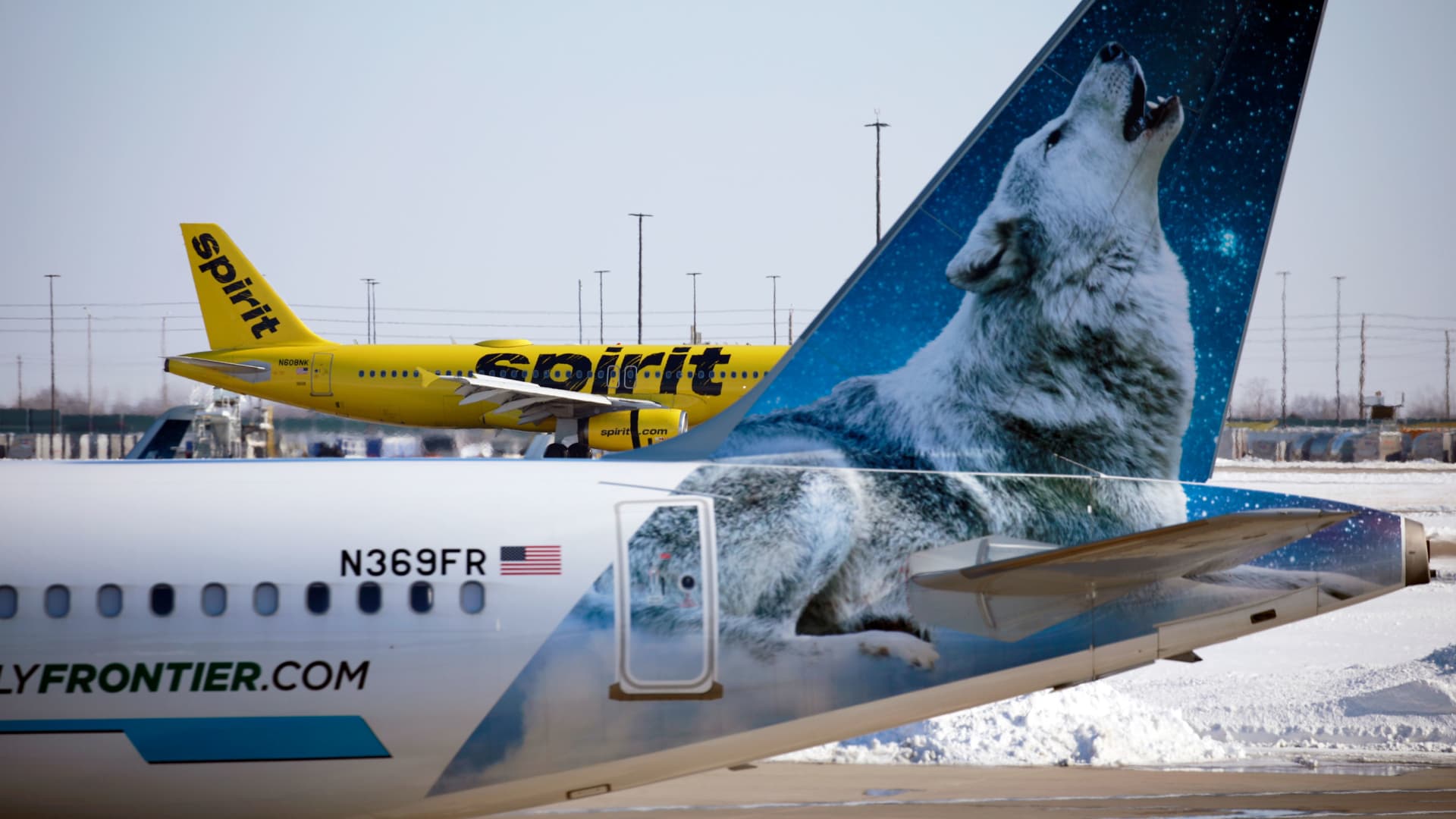
A Frontier Airlines airplane taxis past a Spirit Airlines aircraft at Indianapolis International Airport in Indianapolis, Indiana.
Luke Sharrett | Bloomberg | Getty Images
FORT WORTH, Texas — Airlines have a record 260 million seats to fill this quarter, and to do it, they’re offering fares that will run you about the same as a pair of movie tickets.
Southwest Airlines, for example, last month offered one-way fares of $29 for flights early in the morning or at night, just one example of airline discounting for off-peak periods.
“I would characterize the amount of discounting or sales that we’re doing today as a bit more than normal,” Ryan Green, Southwest’s chief commercial officer, told reporters at the Skift Aviation Forum earlier this month. He said the industry’s increased capacity in recent months means there are more seats to fill, even though the carrier’s average fare was up in the last quarter from a year ago.
Leisure travelers, meanwhile, have largely returned to more traditional booking patterns after years of pandemic swings in demand, leaving airlines looking for ways to fill planes outside of holidays or other popular travel periods.
“Typically, you see a step increase in price at each seven-day mark before a flight,” said Scott Keyes, founder of Scott’s Cheap Flights, a flight-deal company that recently rebranded as Going. But airlines are either dropping last-minute fares or not raising them as much as usual, he said.
Airlines have scheduled a record 259.8 million seats for domestic flights in the fourth quarter, up nearly 8% from last year, on 1.86 million flights, up 6% from 2022, according to aviation-data firm Cirium.
Getting the balance right in the off-season is a challenge for airlines, which make the majority of their revenue in the second and third quarters during the busy spring and summer seasons. Most major carriers reported record revenue and strong demand during those periods, with some executives reporting higher growth for international destinations over domestic ones.
Falling fares
The U.S. inflation read for September showed airfare dropped more than 13% from a year earlier, while overall consumer prices rose.
JetBlue Airways said average fares dropped more than 12% in the third quarter during the same period of 2022 to $201.73.
Budget carrier Spirit Airlines said fares dropped nearly 28% from a year earlier to $48.73, though non-ticket revenue, which includes add-ons such as seat selection fees and checked bags, rose 1% to $67.70.
The Miramar, Florida-based airline, which JetBlue is trying to buy, warned about fare discounting before Thanksgiving and said, “unfortunately, we have not seen the anticipated return to a normal demand and pricing environment for the peak holiday periods.”
Fellow ultra-discounter Frontier Airlines said fares averaged a little more than $39 in the last quarter, down 32% from a year ago.
All three carriers forecast losses for the last three months of the year.
Rethinking capacity
Declining pricing power in the off-peak periods has forced carriers to rethink where they’re deploying their planes.
Southwest plans to slow its growth next year to address the shifting demand patterns, though CEO Bob Jordan described demand on an earnings call late last month as “strong.”
“Capacity is the most precious commodity you have to produce revenue, and you got to deploy that capacity as efficiently as possible against demand,” Jordan said during the Skift Aviation Forum.
The carrier is planning to fly less on nonpeak days, like Tuesdays, compared with higher-demand periods, a measure that also prioritizes crews’ time so they are ready fly more when it’s busy, Jordan said.
Frontier Airlines CEO Barry Biffle told CNBC that one thing the airline is changing is finding less crowded markets for its flights.
“We are concentrating our growth away from the saturated markets,” he said. “We will not shrink in Orlando and Vegas, but we’re probably not going to grow it either.”
Holiday demand is still strong
With shifting demand comes those eye-catching, double-digit fares.
But they’re usually gone quickly and are nearly guaranteed to be unavailable for peak holiday periods, with demand expected to hit or break records.
Delta Air Lines said it expects to carry between 6.2 million and 6.4 million passengers from Nov. 17 to Nov. 28 during the Thanksgiving period, compared with 5.7 million last year and 6.25 million in 2019. United Airlines said it expects to fly 5.9 million passengers from Nov. 17 to Nov. 29, up 13% from last year and 5% more than 2019. American Airlines forecast a record 7.8 million travelers from Nov. 16 to Nov. 28, up from 7 million last year and beating out 2019 by around 200,000 customers.
Southwest CEO Jordan said year-end holiday bookings are running ahead of last year’s pace.
Flight tracker Hopper said “good deal” domestic fares, which it defines as the bottom 10th percentile of available fares, are averaging $248 for Thanksgiving, down from $271 last year and $276 in 2019.
Could it last?
Airlines are now poring over their schedules for 2024 to try to best use their aircraft while they face higher costs such as fuel and labor that have pinched margins.
“You’re seeing carriers put out fares that look kind of like our fares, and what you should really think about is that that’s not going to be permanent,” Frontier’s CEO Biffle said, citing costs.
Carriers have gotten more sophisticated about addressing shifting demand patterns, meaning they can cut flights or capacity during travel lulls.
Next year, fares are likely to stabilize, but it’s too early to tell what promotional fares will be, said Henry Harteveldt, founder of travel industry consulting firm Atmosphere Research Group.
“If inflation really continues at the torrid place it has been, if we see hiring soften, airlines may feel a need to invest in deeper promotion,” he said.
One advantage for full-service carriers is the variety of fares and products they can offer, from no-frills basic economy to first class, Harteveldt. That means they could increase their inventory of cheaper basic economy fares during weaker demand periods, or raise fares when demand is high for premium seats.
Airlines “have the most sophisticated cash registers of any industry,” he said.
Don’t miss these stories from CNBC PRO:


