


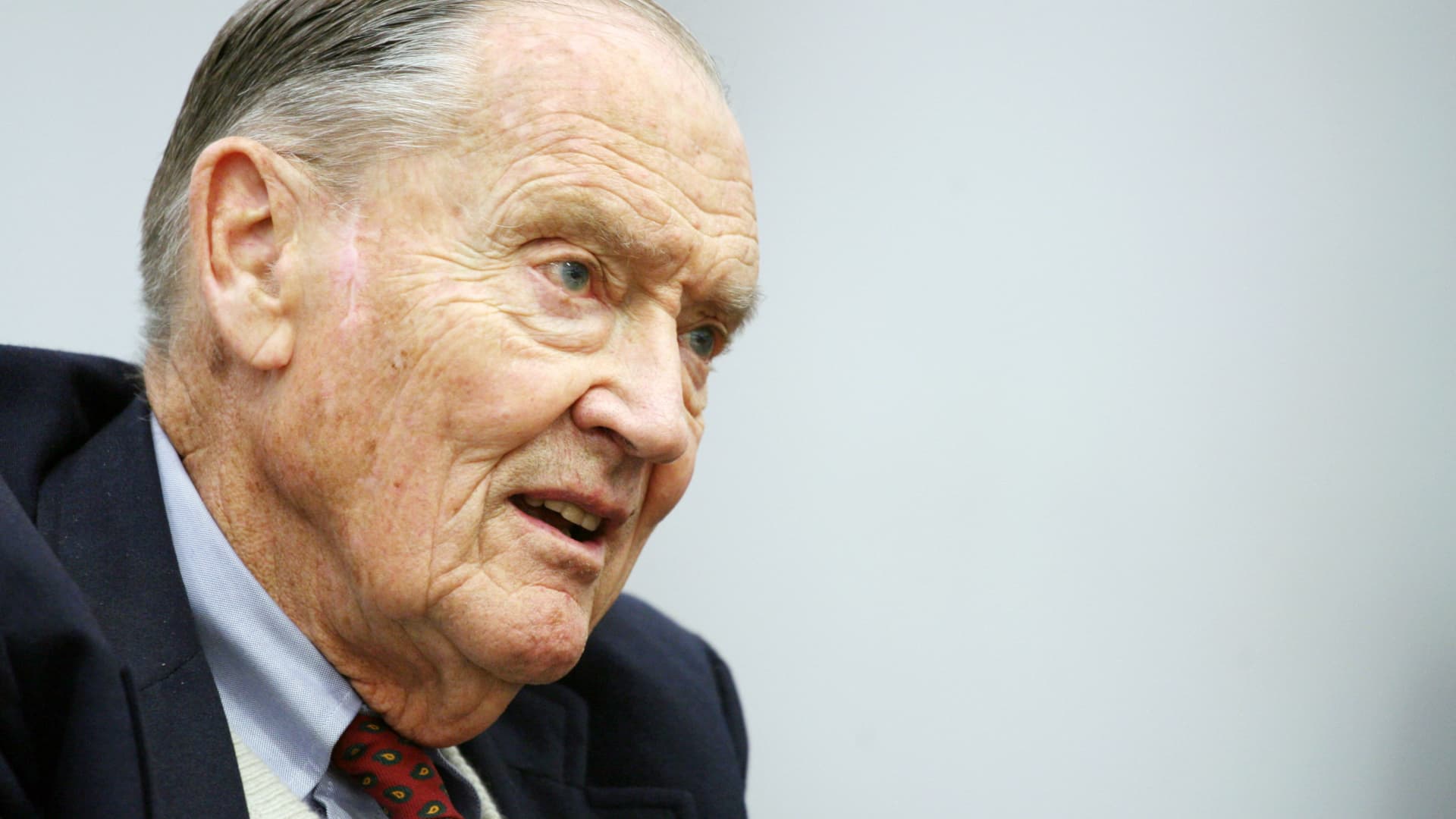
Jack Bogle
Mark Lennihan | AP
Boring investing is making a comeback.
With the meme-stock rally in the rearview mirror and interest rates surging, individual investors are rediscovering the philosophy made famous by Vanguard’s founder, Jack Bogle. The father of market indexes preached low-cost, passive investments that compound over years. Fans call themselves “Bogleheads,” and the strategy “lazy” investing.
They’re well positioned for the current market. Timing has proved difficult this year, with eight days accounting for all of the S&P 500’s gains, according to DataTrek. Higher rates have slammed tech and growth stocks, which dominated retail traders’ portfolios during the pandemic. GameStop, the original meme trade, is down roughly 85% from its all-time high.
Dan Griffin, a self-proclaimed Boglehead based in Florida, said he watched the meme stock rally in amusement. The current market condition is proof that his “tortoise” investing approach is the right one to building long-term wealth, he said.
“It’s a little bit of vindication,” Griffin told CNBC. “I’m happy to be the boring investor, I’m happy to be the tortoise. While the hare does win sometimes, the tortoise more often than not, is going come out ahead.”
Christine Benz, a director of personal finance and retirement planning for Morningstar, said investors are gravitating towards higher yields right now to capture value — another core principle of the Bogleheads.
“Bogleheads are investing for the very long haul — the idea is that you’re putting money into your account and just adding to it, maybe not touching it or looking at it for another 30 years,” she said. “The meme stock phenomenon seemed so focused on being incredibly plugged into your portfolio and monitoring your investments — I see the Bogleheads’ philosophy as being antithetical to all of that.”
Wall Street Bets to Bogleheads
Brokerage firm Robinhood, once synonymous with day trading, is seeing a similar pivot to higher yields and longer-term thinking.
The company launched retirement accounts this year, and offers 3% back on cash as it tries to diversify away from slumping trading fees. Robinhood’s co-founder and CEO Vlad Tenev told CNBC that investors have been moving into cash, money market funds and bond ETFs. He noted more chatter in Bogleheads’ Reddit group, versus the infamous Wall Street Bets.
“One of the really interesting things that we’ve seen over the past couple of months is Robinhood being mentioned, and discussed in these traditional passive investing forums, like Bogleheads on Reddit,” Tenev said. “People are building long-term portfolios on Robinhood, taking advantage of the better economics and the tools to do that.”
Bond ETFs are one way retail investors have tried to capture rising interest rates. The SPDR Bloomberg Barclays 1-3 Month T-Bill ETF (BIL) was the third most-bought name last week after the Invesco QQQ Trust (QQQ) and SPDR S&P 500 ETF (SPY), according to Vanda Research. It saw the largest single-day of net inflows to the ETF since the firm began measuring it almost a decade ago.
“Clearly, income-seeking retail investors are taking advantage of the new high-rate regime, which had been missing from the investment landscape since the pre-GFC [Great Financial Crisis] years,” Marco Iachini, senior vice president of Vanda Research, said in a note to clients. “Some are calling it ‘T-Bill and chill.'”
Younger investors are even more exposed to fixed income compared to their older counterparts. In its annual study, Schwab Asset Management shows millennial ETF investors have 45% of their portfolios in fixed income — compared to 37% for Generation X. The survey showed 51% of millennials plan to invest in bond ETFs next year, compared to 40% of baby boomers.
While far from a meme stock, the move to fixed income could still be risky.
The iShares 20+ Year Treasury Bond ETF (TLT), has seen $19.8 billion in assets flood in this year, according to BlackRock. If yields go up, funds like TLT will suffer — since bond yields move inversely to prices. That’s been the case this year, with TLT down about 50% from its record high. On the other hand, if yields fall, bond funds should outperform.
Don’t miss these stories from CNBC PRO: