


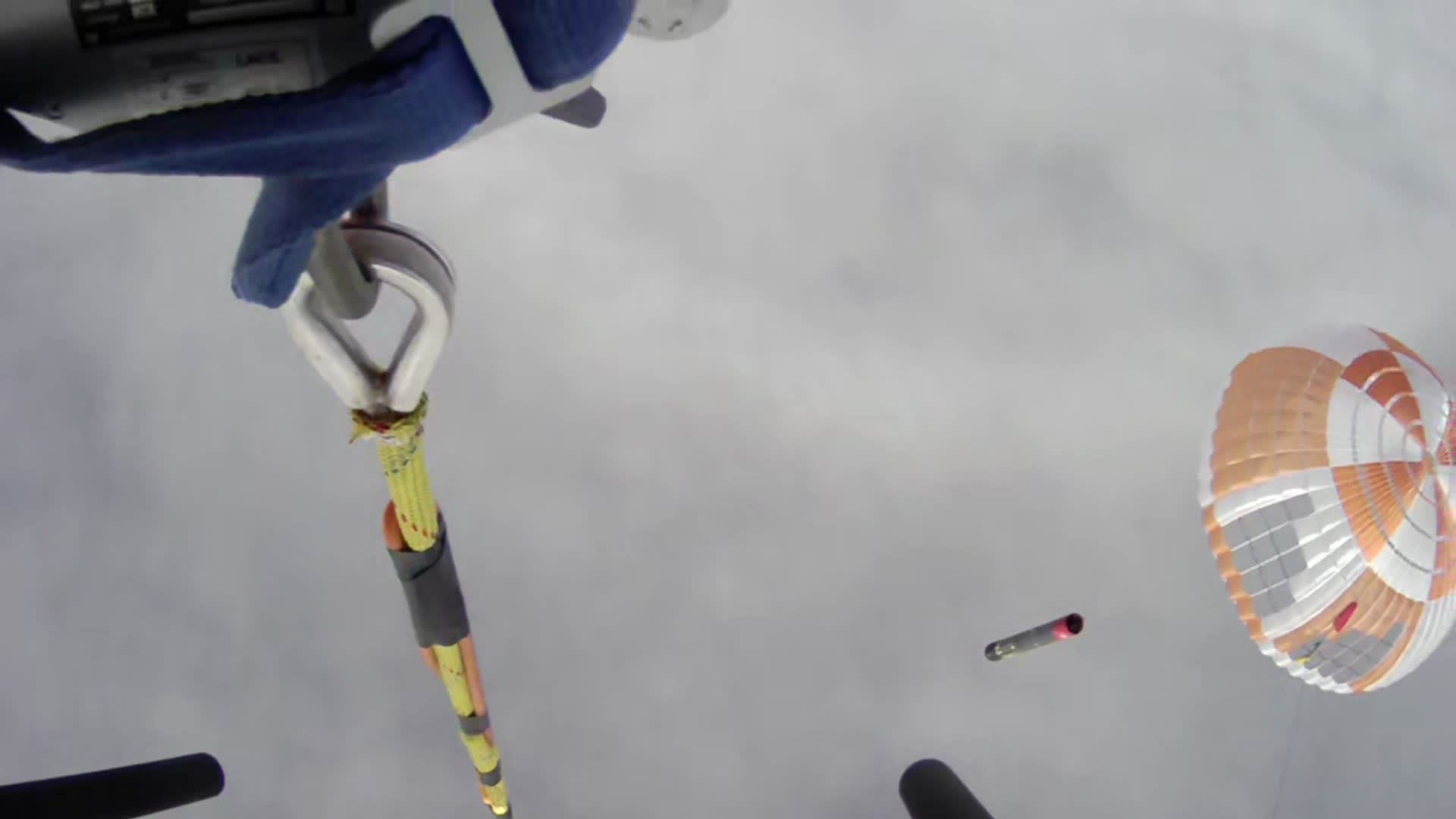
The Electron booster comes into view of the company’s helicopter for the catch.
Rocket Lab
Rocket Lab CEO Peter Beck heralded the company’s first attempt on Monday to catch its Electron rocket booster using a helicopter after launch as “phenomenal,” telling CNBC that the test “achieved 99%” of the company’s goals toward reusing rockets.
“Yesterday was a demonstration that it all works – it’s all feasible. You can successfully control and reenter a [rocket] stage from space, put it under a parachute .. and then go and recover it with a helicopter in midair,” Beck said.
Rocket Lab wants to make its rocket boosters reusable, like those of Elon Musk’s SpaceX, but with a very different approach. After launching its Electron rocket from New Zealand on Monday, the company used a helicopter to snag the parachute that was slowing the rocket’s booster down as it returned to Earth.
SpaceX uses its rocket’s engines to slow down during reentry and deploys wide legs to land on large pads.
While Rocket Lab’s helicopter “had a good hook up” and began flying while carrying the booster, Beck said, the helicopter’s pilot saw that the load from the booster was different than previous testing and released the booster, which dropped into the Pacific Ocean. The booster was then recovered from the water by Rocket Lab’s ship. Beck said the rocket is in “excellent” condition and that the pilot “made the right call.”
Rocket Lab’s Sikorsky S-92 helicopter is capable of lifting 5,000 kilograms, Beck noted, with the Electron booster weighing “just a little under 1,000 kilograms.” While the test had “a ton of margin,” Beck said, Rocket Lab used “really conservative estimates” to maximize safety during the catch. The helicopter flies with a crew of three: A pilot, a co-pilot and a spotter.
In making its boosters reusable, Rocket Lab would be able to launch more often while simultaneously decreasing the material cost of each mission.
Beck disclosed that the Electron’s booster makes up between 70% and 80% of the total cost of the vehicle. Reusing it would bring significant savings for the company and shrink the number of boosters it needs to produce.
Rocket Lab will next return the Electron booster to its factory to strip it down, inspect it and begin the process of refurbishing it for the next flight.
While Beck cautioned that the company needs “to do a bunch of testing” on the booster, Rocket Lab will “endeavor to fly that one again” – in what would be its first reused rocket launch.
Beck estimates about half of Rocket Lab’s missions will utilize reusable rockets. Night launches, when the helicopter wouldn’t fly, or launches that require the rocket’s full capability bring that number down. (Rocket Lab loses about 10% of payload capacity on the Electron in its reusable configuration.)
“Reusability is an iterative process. As we’ve seen with SpaceX – for the first one, the turnaround time was six months or more, and then look to where they are now: taking weeks for turnaround,” Beck said.

