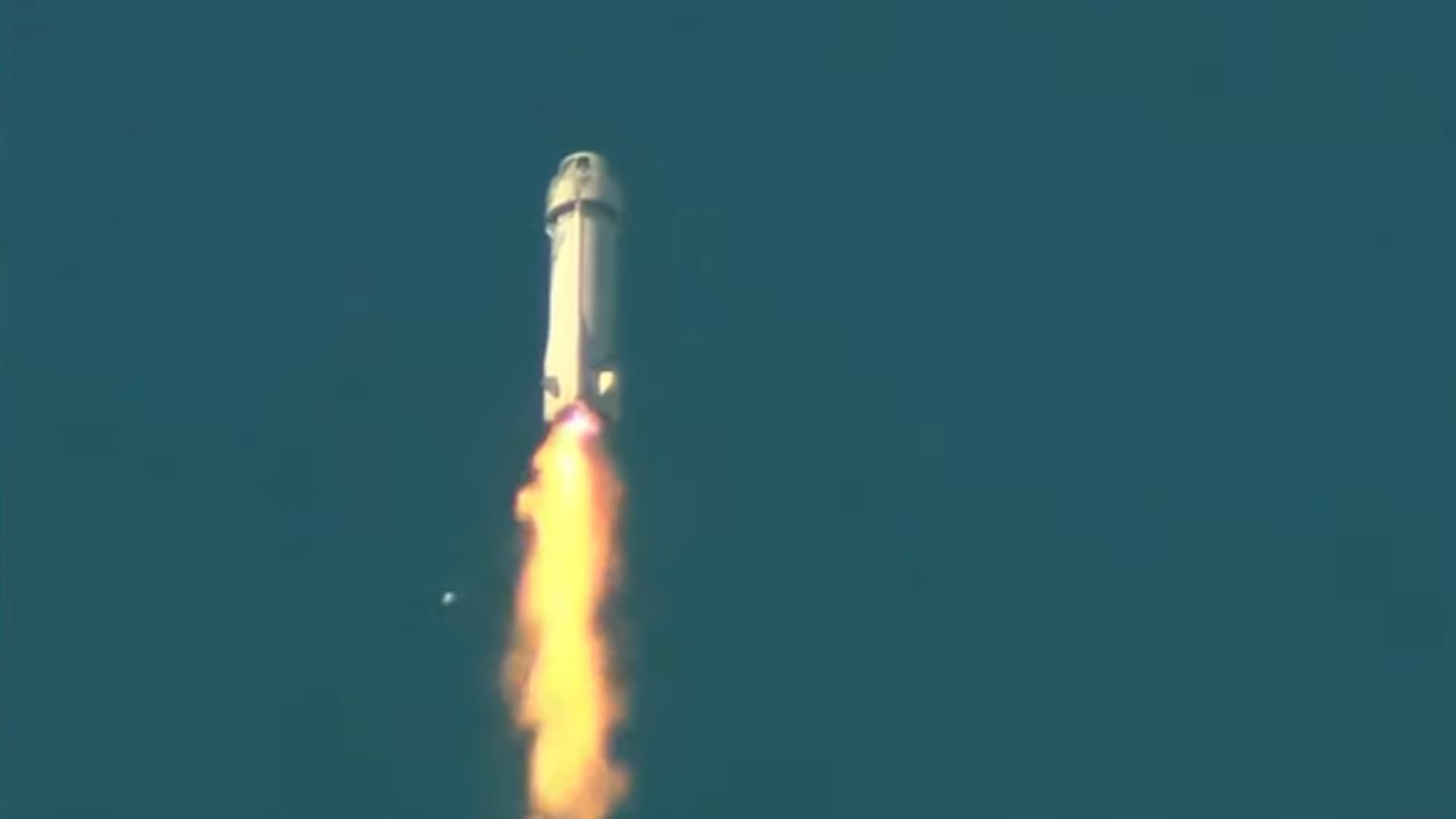
The moment of the anomaly during the New Shepard cargo mission NS-23, in which the booster’s engine failed.
Blue Origin
The Federal Aviation Administration closed its investigation into last year’s failed flight of a cargo mission by Jeff Bezos’ Blue Origin, the regulator announced Wednesday.
Blue Origin is required by the FAA to “implement 21 corrective actions,” the regulator said in a statement. The FAA noted that Blue Origin will not be clear to launch New Shepard until after Blue Origin implements “all corrective actions that impact public safety” and receives an updated launch license.
“We’ve received the FAA’s letter and plan to fly soon,” a Blue Origin spokesperson said in a statement.
The 21 required actions include the “redesign of engine and nozzle components to improve structural performance during operation as well as organizational changes.” The FAA did not comment further on specifics of the corrections.
In September 2022, the company’s New Shepard rocket was flying a cargo mission when it suffered a failure. Earlier this year, Blue Origin said the source of the issue was an overheated part in the rocket engine’s nozzle. No people were onboard, as the NS-23 mission was carrying science and research payloads.
Sign up here to receive weekly editions of CNBC’s Investing in Space newsletter.
Blue Origin said its investigation found that NS-23 flight’s engine failure was due to “operational temperatures that exceeded the expected and analyzed values of the nozzle material.” The company recovered fragments of the BE-3PM engine’s nozzle, finding “clear evidence of thermal damage and hot streaks resulting from increased operating temperatures.”
The New Shepard rocket launches from Blue Origin’s private facility in West Texas, carrying people and payloads above 100 kilometers, or more than 340,000 feet, for a couple minutes of weightlessness. The capsule is flown autonomously, with no human pilot, and floats down with the assistance of a set of parachutes to land in the Texas desert. The New Shepard rocket booster is reusable, returning to land on a concrete pad near the launch site.
To date, Blue Origin has flown 31 people past the edge of space with New Shepard.
Blue Origin has said since March that it expects to return New Shepard to flight “soon.” The crucial re-flight of the rocket is planned to carry the same research payloads that didn’t make it to space on the NS-23 mission, without crew.