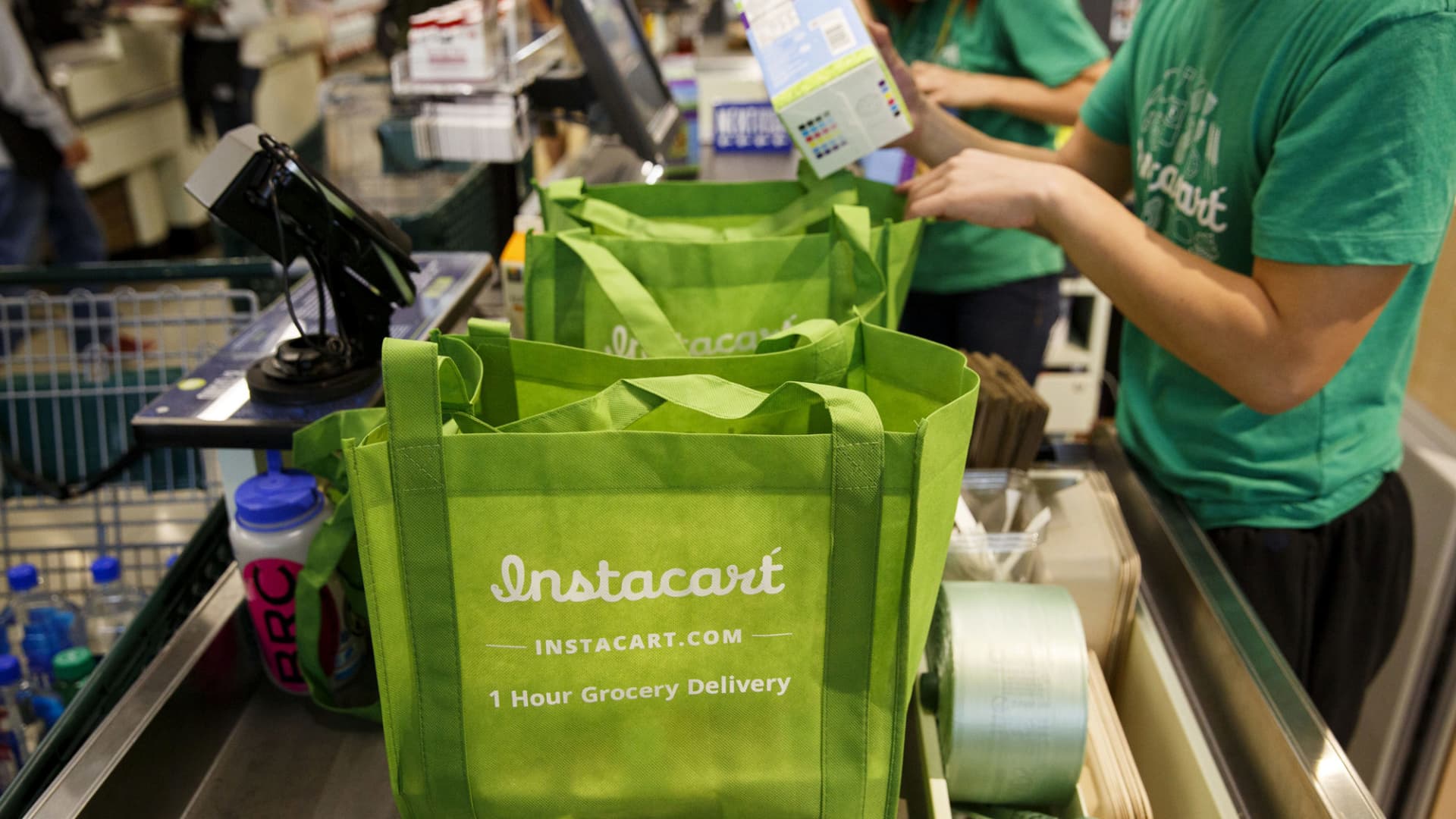
InstaCart employees fulfill orders for delivery
Patrick T. Fallon | Bloomberg | Getty Images
Tech investors last week finally heard utterance of their favorite three-letter acronym: IPO.
It’s been 20 months since a notable venture-backed tech company went public in the U.S., and the chatter in Silicon Valley has centered around who will break the ice. On Friday, grocery delivery startup Instacart and data and marketing automation company Klaviyo filed for stock market debuts.
Earlier in the week, chip designer Arm, which is owned by Japan’s SoftBank, said it plans to hit the Nasdaq seven years after being taken private in a $32 billion acquisition.
The three companies have very little in common, but collectively they represent a test of the excitement level among public market investors for new opportunities. Depending on how they perform out of the gate, their offerings could propel others to follow in the fourth quarter.
“Other teams will watch the reception of these and it could encourage some of those management teams to stop waiting around for yesteryear and just get it done,” said Lise Buyer, founder of IPO consultancy Class V Group.
By “yesteryear,” Buyer is referring to the kinds of valuations tech companies were achieving in 2020 and 2021, which were record years for tech IPOs. Software vendor Snowflake, which debuted in late 2020 and saw its price-to-sales multiple shoot up to about 50, now trades at under 17 times revenue. Food delivery company DoorDash has seen its stock drop by more than two-thirds since its high in 2021, even though revenue has since grown by over 60%.
“We aren’t going back to 2021 anytime soon,” Buyer said.
Instacart, backed at high prices by venture firms including Sequoia and Andreessen Horowitz, has had a big valuation haircut ahead of its IPO. After raising private cash at a $39 billion valuation in early 2021, the company slashed that number to $24 billion in March of last year as tech stocks sank and growth slowed dramatically in a post-Covid world. The valuation reportedly fell by another 50% by late 2022.
DoorDash, which is probably Instacart’s closest public market comparison, currently trades at 3.8 times revenue. That kind of multiple would value Instacart at around $11 billion.
Instacart, which reported revenue growth of 15% in the latest quarter to $716 million, has managed to turn a profit for five straight periods by keeping costs in check and slashing head count. Net income increased to $114 million from $8 million a year earlier.
Klaviyo, which was valued at $9.5 billion in a 2021 funding round, has not been forced to reduce its valuation, according to Pitchbook and public reports. Founded in 2012, the company’s technology helps clients store user data and build profiles that enable targeted marketing via email, text messages and other channels.
Andrew Bialecki, CEO and co-founder of Klaviyo, poses for a portrait in Boston on Sep. 5, 2019.
Barry Chin | Boston Globe | Getty Images
Even though it has a much lesser-known brand, Klaviyo is growing significantly faster than Instacart, with revenue in the second quarter climbing 50% to $164.6 million. The business swung to a profit of $10.9 million in the period after losing close to $12 million a year earlier.
When looking for comparisons, the Bessemer Cloud Index, which consists of about 70 publicly traded cloud companies, provides the cleanest data. Klaviyo’s growth rate would put it near the top of the index, where companies trade at around 12 times revenue. That would imply a valuation for Klaviyo in the neighborhood of $7 billion.
Klaviyo’s biggest institutional backer is Summit Partners, followed by e-commerce software vendor Shopify, which is a key business partner. Venture firm Accel is also an investor.
According to Buyer, it’s not surprising to see companies filing to go public right now. The way SEC rules work, management teams and bankers have to wait at least 15 days after the IPO filing before they can start their roadshow. The offering could take place two weeks later.
Companies that filed last week can hit the road in early September, right after Labor Day, and go public in the middle of the month.
“Historically, late August is when you see filings for companies that want to be first in the back-to-school season,” Buyer said. “The timing makes all sorts of sense. People are coming back from the summer holidays with a fresh look at the market and interest in adding new names in Q4.”
While Instacart and Klaviyo could have significant implications for startup investors as they look at what to expect for the rest of 2023 and into next year, Arm has a slightly different audience.
The chip designer is owned by Masayoshi Son’s SoftBank, which is seeking liquidity after losing billions of dollars in recent years on mistimed and overly aggressive investments in names like WeWork, Chinese ride-hailing company Didi and Indian hotel company Oyo.
Not only is Arm much bigger than a typical venture-backed company at the time of IPO, but it’s based in the U.K. and was a public company in the past.
Arm, whose technology is critical to almost all of the world’s smartphones, reported $524 million in net income on $2.68 billion in revenue in its fiscal 2023, which ended in March, according to its filing. Arm’s 2023 revenue was slightly down from the company’s 2022 sales of $2.7 billion.
To capture a public market valuation of $32 billion, Arm would need a multiple of roughly 61 times earnings. Within the semiconductor market, Nvidia towers over everyone, with a price-to-earnings ratio of 114. But that’s a company that’s tripled in value this year and just told investors to expect 170% sales growth in the current quarter. Elsewhere in the chip space, Qualcomm trades for 15 times earnings and Applied Materials has a ratio of 19.
The technology sector may be starting to slow again. The Nasdaq is up 30% this year, coming off its worst year since 2008, but an outsized portion of the gains come from huge rallies in shares of Nvidia and Meta. So far in August, the Nasdaq is down 5.3% and is headed for its first monthly drop since February.
But at some point, companies have to stop focusing on market conditions and just decide it’s time to be public, Buyer said, as there hasn’t been a significant VC-backed tech IPO in the U.S. since HashiCorp and Samsara went public in December 2021.
The market will determine a company’s value, and if it performs over time, there will always be opportunities to sell shares at a higher price.
“You’ve got to prove your worth in the marketplace,” she said.
WATCH: Founders Fund’s Keith Rabois talks the IPO landscape