


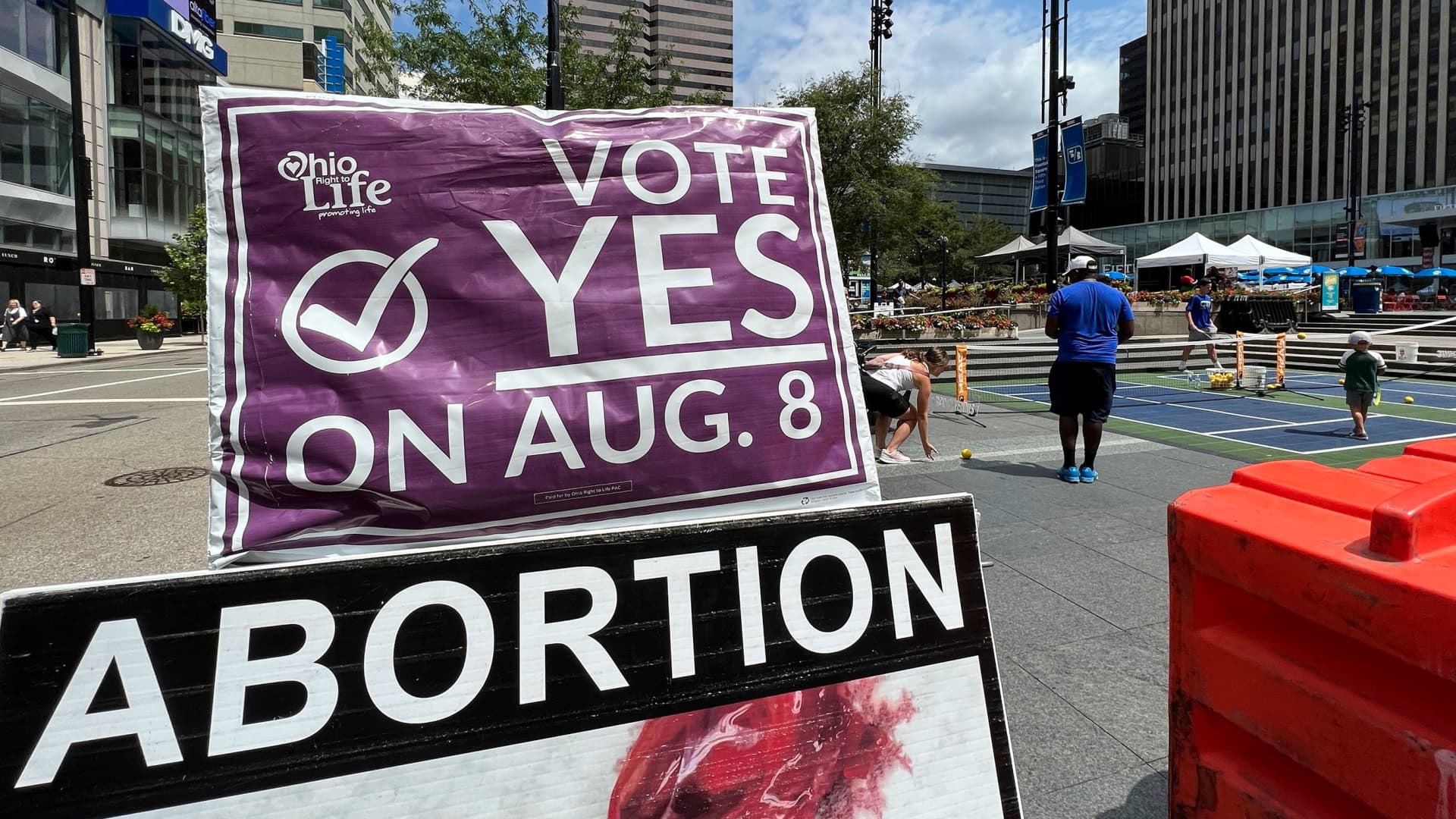
A sign asking Ohioans to vote in support of Issue 1 sits above another sign advocating against abortion rights at an event hosted by Created Equal on Thursday, July 20, 2023, in Cincinnati, Ohio.
Patrick Orsagos | AP
The people of Ohio on Tuesday are voting on a ballot initiative that would make it significantly more difficult to enshrine abortion rights into the state constitution this fall, and to approve a minimum wage hike expected to be on the ballot next year.
The Republican-backed proposal, known as Issue 1, would raise the minimum threshold of votes needed to amend the state constitution by popular referendum, from a simply majority up to 60% of ballots cast.
Early voter turnout has been high, which is unusual for special elections and likely reflects intense voter interest in abortion rights issues. Nearly 700,000 Ohioans had already cast their ballots through Sunday, according to the Associated Press. That’s more than double the early voting tally during high profile primary elections in 2018 and 2022, according to AP.
Voters in the Buckeye State will head to the polls again in November to cast their ballots on an amendment that would protect a right to abortion and prohibit the state from interfering in women’s reproductive decisions.
The amendment would also make access to contraception, fertility treatment and miscarriage care a constitutional right.
A poll conducted by USA Today and Suffolk University in July found that 58% of Ohioans support the amendment to enshrine abortion rights in the state constitution. Ohioans’ support for abortion is just shy of the 60% that would be needed if Tuesday’s ballot initiative passes.
Ohioans United for Reproductive Rights, the coalition that drafted the amendment to protect abortion, is aiming to strike a decisive blow that would erase the state’s six week ban and block any future effort to restrict reproductive rights in the Ohio. The state’s six-week ban is currently on hold due to a court ruling.
The coalition is made up of the Ohio chapter of the American Civil Liberties Union, Planned Parenthood’s state advocacy organization, and numerous other state groups that support reproductive rights.
Ohioans United for Reproductive Rights filed the amendment protecting abortion rights with the state attorney general in February, and received the go-ahead to start collecting signatures in March.
Only then did Republicans in the state legislature move to raise the minimum threshold to pass constitutional changes.
The Ohio General Assembly approved Issue 1 in May and set the August 8 election date. Every Democrat in the state legislature and five Republicans in the state House opposed the effort.
Across the country, activists have increasingly taken the issue of abortion rights directly to voters through state referendums in the wake of the U.S. Supreme Court’s June 2022 decision to overturn Roe v. Wade, which protected the procedure as a constitutional right nationwide for nearly 50 years.
Kansas and Kentucky rejected anti-abortion amendments last year, while voters in California, Michigan and Vermont codified the procedure as a right under their state constitutions.
Republican donor Richard Uihlein, CEO of the packing supply company Uline, has bankrolled Protect Our Constitution, the main political action committee campaigning for Issue 1. Uihlein contributed $4 million to the group as of July.
Reproductive rights groups such as NARAL Pro-Choice have slammed the attempt to raise the threshold for constitutional changes to 60% from a simple majority as a transparent “power play” designed to prevent voters from enshrining abortion rights in Ohio.
More than just abortion rights are at stake in Tuesday’s vote. The 60% threshold could also threaten efforts to raise Ohio’s minimum wage to $15 through a referendum that is expected to be on the ballot in November of 2024.
If approved, the wage hike would go into effect in stages, and reach $15 in 2028.


