


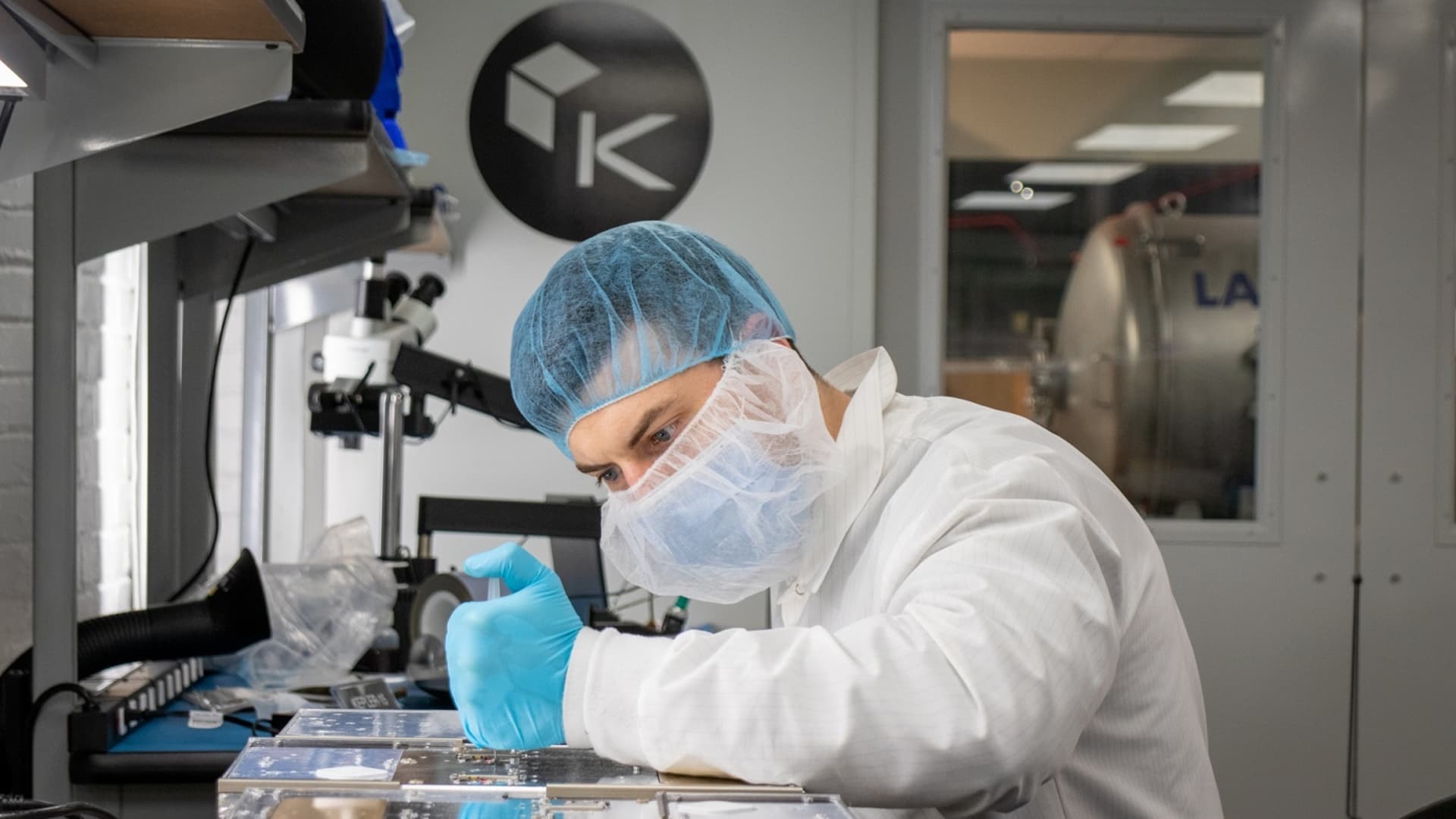
Senior satellite technician Chris Summers completes the final pre-flight checks on satellites Kepler-16 and Kepler-17.
Kepler Communications
Private investment in space companies, especially from venture capital, showed “signs of stabilization” in the second quarter after steady declines over the past year, according to a report Monday by New York-based Space Capital.
Investment in space companies had dropped steadily since its peak in 2021, as companies felt the macroeconomic effects of a tightened funding environment and rising interest rates. Layoffs and cost-cutting arrived at many space companies in recent months, and M&A activity in the sector is expected to heat up as valuations come down.
But Space Capital’s Q2 report pointed to indicators that the space market looks to be near a bottom, highlighting the return of hiring for space jobs to 2020 levels.
Sign up here to receive weekly editions of CNBC’s Investing in Space newsletter.
“The reset in the financial markets has brought about healthier market dynamics, enabling disciplined investors to identify opportunities and invest in high quality companies at lower valuations,” Space Capital managing partner Chad Anderson wrote in the report.
Space infrastructure companies brought in $4.9 billion of private investment in the second quarter, including the close of Maxar’s recent go-private sale at a $4.1 billion equity value.
Though the Maxar deal made up the bulk of the Q2 total, Space Capital noted that growth-stage investments are outstripping late-stage, with raises in the former category making up 74% of total equity rounds, “signaling a healthy top-of-funnel” in the sector’s economy.
The quarterly Space Capital report divides investment in the industry into three technology categories: infrastructure, distribution and application. Infrastructure includes what would be commonly considered as space companies, such as firms that build rockets and satellites.


