


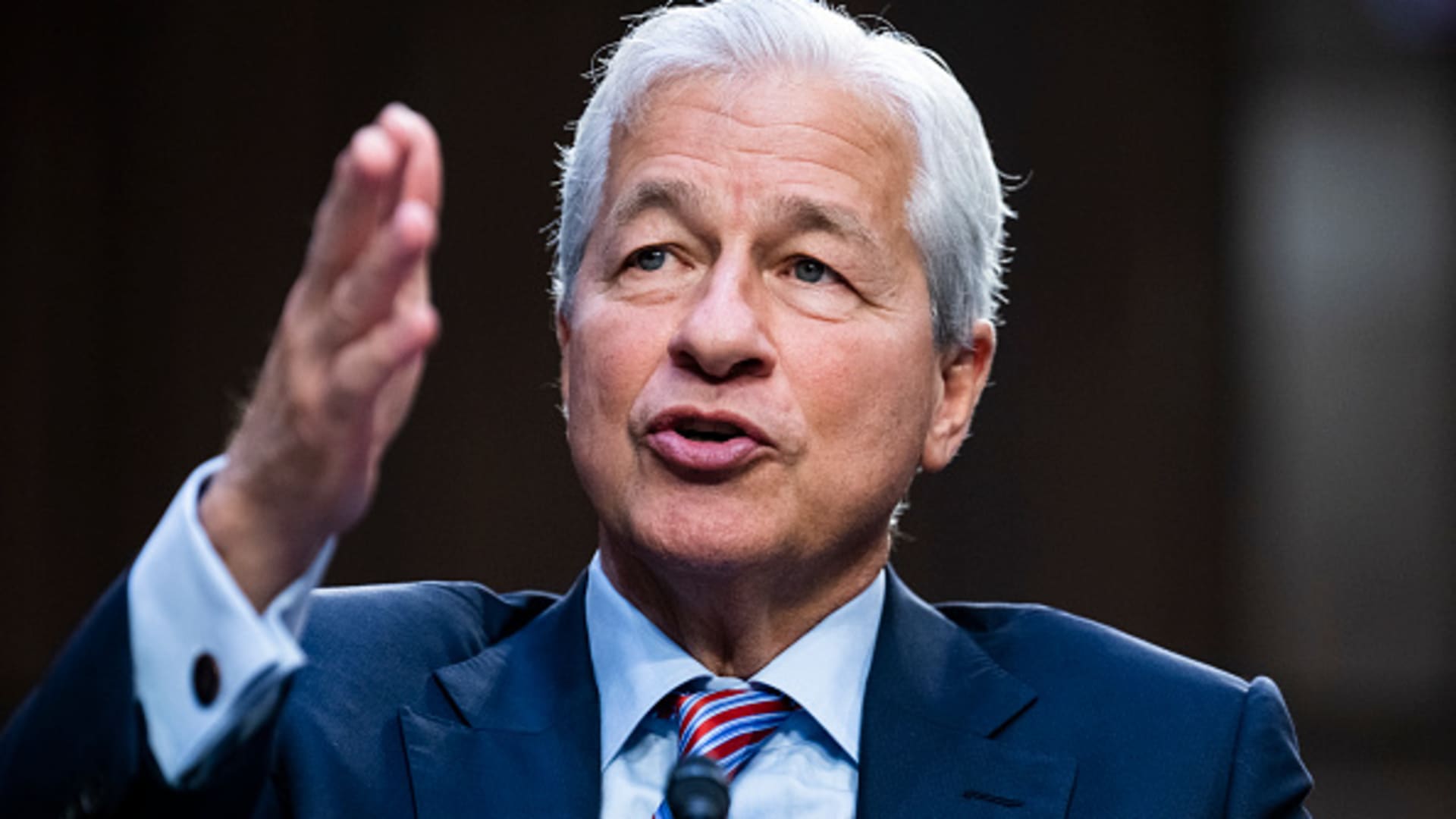
Jamie Dimon, CEO of JPMorgan Chase, testifies during the Senate Banking, Housing, and Urban Affairs Committee hearing titled Annual Oversight of the Nations Largest Banks, in Hart Building on Sept. 22, 2022.
Tom Williams | CQ-Roll Call, Inc. | Getty Images
JPMorgan Chase executives warned Friday that tougher regulations in the wake of a trio of bank failures this year would raise costs for consumers and businesses, while forcing lenders to exit some businesses entirely.
When asked by Wells Fargo analyst Mike Mayo about the impact of changes proposed by Federal Reserve Vice Chair for Supervision Michael Barr in a speech earlier this week, JPMorgan CEO Jamie Dimon said that other financial players could end up winners.
“This is great news for hedge funds, private equity, private credit, Apollo, Blackstone,” Dimon said, naming two of the largest private equity players. “They’re dancing in the streets.”
Blackstone and Apollo didn’t immediately respond to requests for comment on Dimon’s remarks.
Banks face requirements to hold more capital as a cushion against risky activities from both U.S. and international regulators. Authorities are proposing higher capital requirements for banks with at least $100 billion in assets after the sudden collapse of Silicon Valley Bank in March. But that also coincides with a long-awaited set of international rules spurred by the 2008 financial crisis referred to as the Basel III endgame.
Rise of the shadow banks
“How much business leaves JPMorgan or the industry if capital ratios go up as much as potentially proposed?” Mayo asked.
CFO Jeremy Barnum said that banks would raise prices on end users of loans and other products before ultimately deciding to leave some areas entirely.
“To the extent we have pricing power and the higher capital requirements means that we’re not generating the right return for shareholders, we will try to reprice and see how that sticks,” Barnum said.
“If the repricing is not successful, then in some cases, we will have to remix and that means getting out of certain products and services,” he said. “That probably means that those products and services leave the regulated perimeter and go elsewhere.”
After the 2008 financial crisis, heightened rules forced banks to pull back from activities including mortgages and student loans. For corporations and institutional players, acquisitions and other huge loans are now increasingly funded by private equity players like Blackstone and Apollo.
That has contributed to the rise of non-bank players, sometimes referred to as the “shadow banking” industry, which has concerned some financial experts because they generally face lower federal scrutiny than banks.


