



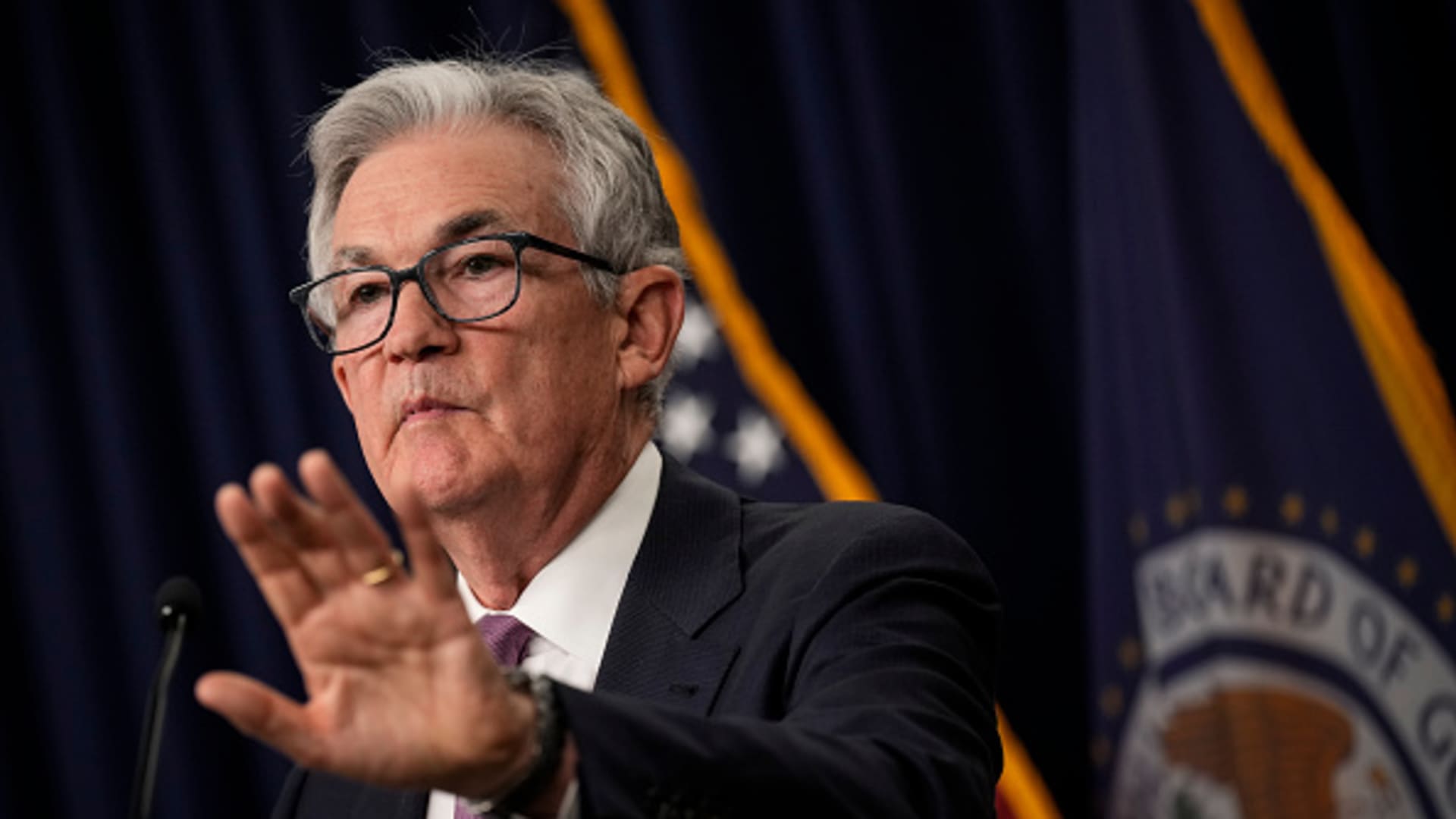
U.S. Federal Reserve Board Chairman Jerome Powell speaks in the course of a news convention pursuing a conference of the Federal Open Industry Committee (FOMC) at the headquarters of the Federal Reserve on June 14, 2023 in Washington, DC.
Drew Angerer | Getty Pictures Information | Getty Pictures
Central banking companies are at “the stop of the starting” in their fight against inflation, as quite a few elements preserve main charges persistently high, according to leading Societe Generale economist Kokou Agbo-Bloua.
Marketplaces are eagerly awaiting vital inflation prints from the U.S. afterwards this 7 days, with the main annual consumer price tag index (CPI) — which excludes unstable meals and power charges — remaining persistently high to day, irrespective of the headline determine step by step edging nearer to the Federal Reserve’s 2% target.
The persistence of labor market place tightness and the evident resilience of the economic system usually means the sector is pricing all-around a additional-than 90% opportunity that the Fed will hike interest costs to a assortment of amongst 5.25% and 5.5% at its meeting later on this month, according to CME Group’s FedWatch software.
U.S. inflation cooled in Might to an annual 4%, its most affordable annual rate in extra than two yrs, but main inflation rose by .4% month-on-thirty day period and 5.3% calendar year-on-year.
In evaluating the present condition of global policymakers’ attempts to tame inflation, Agbo-Bloua quoted previous British Prime Minister Winston Churchill’s remarks in a 1942 speech: “Now this is not the conclude. It is not even the beginning of the conclusion. But it is, possibly, the close of the beginning.”

“The selection one ‘original sin,’ so to talk, is that governments have put in a substantial amount of income to retain the economy that was place in hibernation to help save human life, so we’re conversing about 10-15% of GDP,” Agbo-Bloua, global head of economics, cross-asset and quant investigate at Societe Generale, instructed CNBC.
“The 2nd level — clearly you experienced the war in Ukraine, you had the supply chain disruptions — but then you also had this massive buildup in excess financial savings moreover ‘greedflation,’ so companies’ potential to raise prices by far more than is warranted, and this is why we see profit margins at document levels about the earlier 10 years.”
Corporations have formulated a “organic immunity” towards fascination premiums, Agbo-Bloua argued, considering that they have been in a position to refinance their stability sheets and pass increased input rates on to individuals, who are now expecting bigger prices for merchandise and providers.
“Previous but not minimum, the labor sector is super limited and you have decrease labor efficiency growth which now is pushing device labor expenditures and you get this negative spiral of wage costs,” he said.
“The central banking institutions need to cause a economic downturn to pressure unemployment to decide up and build ample need destruction, but we’re not there still.”
The impact of financial plan tightening often lags the serious financial system by all over three to five quarters, Agbo-Bloua reported. But he highlighted that the excessive personal savings developed up all through the pandemic made an supplemental buffer for people and homes, when businesses ended up ready to maintenance balance sheets. He suggested that this has served to maintain the labor market place resilient, which will very likely extend this lag time.
Inducing a recession
In purchase to manage believability, Agbo-Bloua hence claimed central banking institutions — and in distinct the Fed — will need to have to retain increasing fascination charges until eventually they induce a economic downturn.
“We believe that the economic downturn or slowdown really should manifest in the U.S. in Q1 of next year due to the fact we consider the cumulative tightening is ultimately going to have its outcomes, it truly is not disappearing,” he explained.
“Then in Europe, we you should not see a recession in the euro location, simply because we see demand 2 to 3 percentage points higher than supply, and consequently we see far more of a slowdown but not economic downturn.”
In conditions of exactly where the economic downturn in the U.S. will start out to take keep, he prompt it will most very likely “creep into company financial gain margins” that are still lingering around file levels, through the “wage expansion phenomenon that is fundamentally heading to eat into earnings.”
“The 2nd place is that buyer investing designs will also sluggish down, so we imagine it is a blend of all of these components that should really eventually push a slowdown,” he extra.
“Then all over again, if you search at the latest route of desire fees, it looks like we may well see much more tightening prior to this is possible to arise.”
‘Recession postponed, but not canceled’
This sentiment was echoed by Nathan Thooft, co-head of worldwide asset allocation at Manulife Asset Administration, who explained while economies had a much better get started to 2023 than anticipated and have so considerably mostly averted a complex recession, this is additional a scenario of the recession staying “postponed rather than canceled.”
“The tightening of credit rating disorders and the slowdown in lending counsel that we’ve so far managed to hold off the impending recession as opposed to averting it completely,” Thooft stated in the asset manager’s mid-12 months outlook on Friday.
“Even so, regardless of whether a economic downturn in fact takes [place] is considerably a lot less suitable than how lengthy we could be caught in a period of below-pattern GDP advancement.”
He recommended that with world wide advancement envisioned to settle at around 2.5% this 12 months and future, beneath the 3% threshold that would herald a international economic downturn if breached.
“If forecasts are right, it suggests that world-wide GDP development would occur in 15.2% underneath pattern, a state of affairs final witnessed through the pandemic in 2020 and, ahead of that, in the 1940s.”