


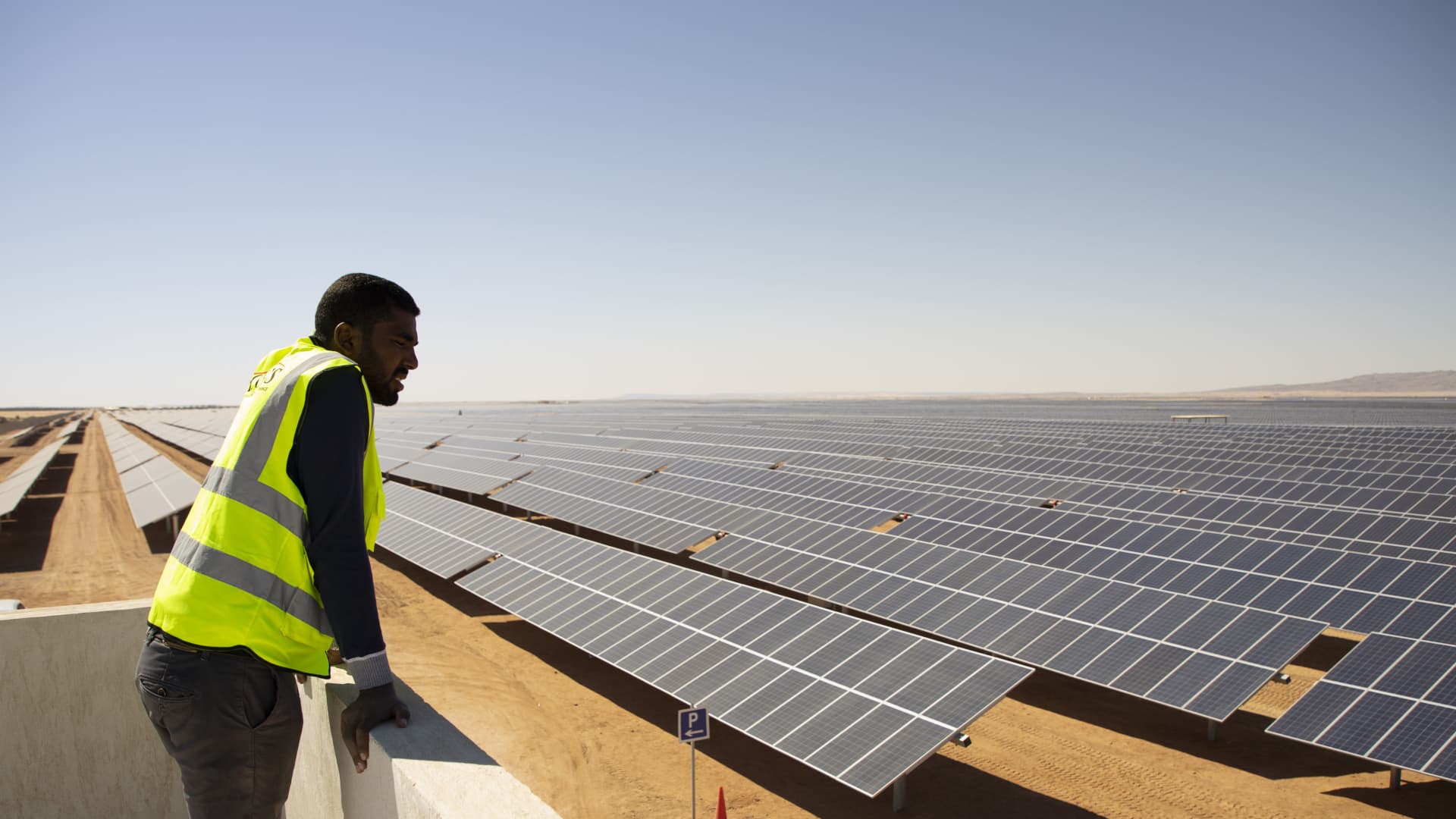
Masdar says Egypt’s abundance of solar and wind will “allow generation of renewable power at a highly competitive cost – a key enabler for green hydrogen production.”
Ute Grabowsky | Photothek | Getty Images
The UAE’s Masdar and Egypt’s Hassan Allam Utilities have signed agreements with state-backed Egyptian organizations that will see the parties work together on the development of large-scale green hydrogen projects.
In an announcement Sunday, Masdar — which is owned by Abu Dhabi state fund Mubadala — said the two agreements related to facilities earmarked for the Mediterranean coast and Suez Canal Economic Zone.
The projects in Egypt are aiming for an electrolyzer capacity of 4 gigawatts by the year 2030, with production of as much as 480,000 tons of green hydrogen annually.
Described by the International Energy Agency as a “versatile energy carrier,” hydrogen has a diverse range of applications and can be deployed in sectors such as industry and transport.
It can be produced in a number of ways. One method includes using electrolysis, with an electric current splitting water into oxygen and hydrogen.
If the electricity used in this process comes from a renewable source such as wind or solar then some call it green or renewable hydrogen.
While there is excitement in some quarters about hydrogen’s potential, the vast majority of its generation is currently based on fossil fuels.
“Masdar and Hassan Allam Utilities see Egypt as a hub for green hydrogen production, targeting the bunkering market, export to Europe, and boosting local industry,” Masdar said in a statement.
“Egypt enjoys abundant solar and wind resources that allow generation of renewable power at a highly competitive cost — a key enabler for green hydrogen production,” it added. “Egypt is also located within close proximity to markets where demand for green hydrogen is expected to grow the most, providing robust opportunity for export.”
Masdar’s mention of Europe is instructive and illustrates how the hydrogen sector could develop in the years ahead as major economies attempt to decarbonize.
In July 2021, the CEO of Italian firm Snam outlined a vision for the future of hydrogen, saying the “beauty” of it was that it could be easily stored and transported.
Speaking to CNBC’s “Squawk Box Europe,” Marco Alverà spoke about how current systems would be used to facilitate the delivery of hydrogen produced using renewable sources as well as biofuels.
“Right now, if you turn on your heater in Italy the gas is flowing from Russia, all the way from Siberia, in pipelines,” he said.
“Tomorrow, we will have hydrogen produced in North Africa, in the North Sea, with solar and wind resources,” Alverà said. “And that hydrogen can travel through the existing pipeline.”
For its part, the European Union’s executive arm, the European Commission, has laid out plans to install 40 GW of renewable hydrogen electrolyzer capacity in the EU by the year 2030.
Alongside this goal, the commission’s plan also envisages an extra 40 GW “in Europe’s neighbourhood” that would “export to the EU.”
The past few years have seen a host of companies weigh in on the topic of hydrogen.
In a recent interview with CNBC, Michele DellaVigna, Goldman Sachs’ commodity equity business unit leader for the EMEA region, sought to highlight the important role he felt it would have going forward.
“If we want to go to net-zero we can’t do it just through renewable power,” he said.
“We need something that takes today’s role of natural gas, especially to manage seasonality and intermittency, and that is hydrogen,” DellaVigna argued, going on to describe hydrogen as “a very powerful molecule.”
The key, he said, was to “produce it without CO2 emissions. And that’s why we talk about green, we talk about blue hydrogen.”
Blue hydrogen refers to hydrogen produced using natural gas — a fossil fuel — with the CO2 emissions generated during the process captured and stored. There has been a charged debate around the role blue hydrogen can play in the decarbonization of society.
“Whether we do it with electrolysis or we do it with carbon capture, we need to generate hydrogen in a clean way,” DellaVigna said. “And once we have it, I think we have a solution that could become, one day, at least 15% of the global energy markets which means it will be … over a trillion dollar market per annum.”


