


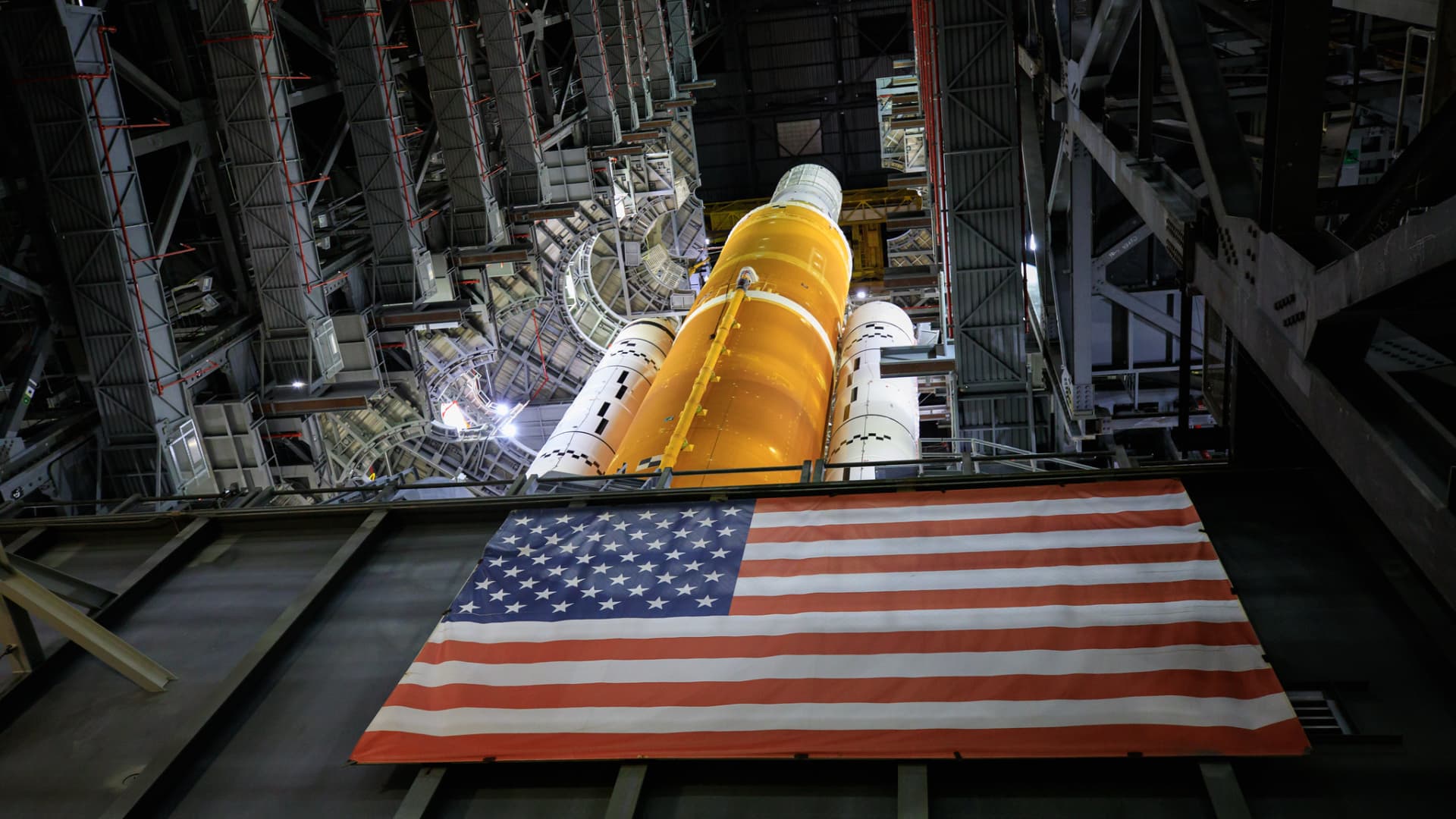
The Artemis 1 mission Space Launch System (SLS) rocket
Frank Michaux / NASA
Wilson Aerospace, a small family-run tools company based in Colorado, is suing Boeing for a wide range of claims concerning allegedly stolen intellectual property over the last two decades.
The company’s lawsuit centers around multiple custom-designed tools that Wilson says it created for Boeing. Boeing, in turn, “rewarded Wilson’s efforts by brazenly stealing” the IP related to multiple devices, the complaint says. Wilson filed suit in a Washington federal court on Wednesday.
The scope of the damages is “hard to quantify,” according to one of the company’s lawyers, Pete Flowers. Still, Boeing’s actions have hurt Wilson to the tune of “hundreds of millions of dollars,” he told CNBC
Wilson’s complaint alleges that its tools – used for NASA projects including the International Space Station and its Space Launch Systems moon rocket – helped Boeing win billions in contract awards and fees from the government. Wilson also alleges that the counterfeit version of the tools that Boeing made led to leaks on the ISS and the SLS – and “put lives at risk,” including astronauts.
The company brought 10 claims against Boeing, including for copyright infringement, misappropriation and theft of trade secrets, and fraud.
In a statement to CNBC, a Boeing spokesperson said that Wilson’s “lawsuit is rife with inaccuracies and omissions,” but declined to share specifics when asked.
“We will vigorously defend against this in court,” Boeing said.
Sign up here to receive weekly editions of CNBC’s Investing in Space newsletter.
Led by David Wilson, who founded the eponymous firm in 1999, the Colorado-based company invents specialty aerospace tools such as its “Fluid Fitting Torque Device,” or FFTD, used for tightening and loosening fittings such as those in “cramped, difficult to access areas on spacecraft.” Wilson developed variations of FFTD, as well as other tools and assemblies, for use on the ISS, the Space Shuttle-era experimental module SPACEHAB, as well as Boeing’s Starliner capsule and Dreamliner aircraft.
Central to the lawsuit is work done by Wilson for Boeing from 2014 to 2016 to use an FFTD product to solve an issue attaching the rocket’s engines to SLS “with the precise amount of torque.” Wilson alleges the aerospace giant downloaded proprietary information, cut off communications with the company, and built “counterfeit” variations that Boeing passed on as its own to NASA.
“Although Boeing paid Wilson for some of its work over the years, Boeing’s primary approach was to steal Wilson’s intellectual property through deception and other illegal means, rather than to compensate,” the complaint alleges.
Additionally, the alleged theft resulted in mismatched components and “inferior products.” According to the complaint, “the mismatched tools have caused some fluid leaks that have continually delayed the SLS launch, costing NASA hundreds of millions of dollars while unjustly enriching Boeing.”
The 74-page complaint cites correspondence with multiple Boeing employees, including one who emailed in September 2020 that Boeing misused Wilson’s IP and created “a safety concern for on-orbit hardware.” Among those allegedly counterfeit tools, another of Wilson’s lawyers, Lance Astrella, told CNBC that an earlier variation of FFTD is believed to be stuck on the ISS after becoming trapped due to Boeing using incorrect calibration data after copying the tool.
Wilson pointed to prior litigation as examples of “a broader pattern of criminal behavior by Boeing,” such as theft of Lockheed Martin trade secrets in 2006.
“We fully believe that there are other companies, probably small American-owned companies, that have been affected by this same activity inside Boeing,” Wilson lawyer Flowers told CNBC.
Read the full copy of Wilson’s complaint below:


