


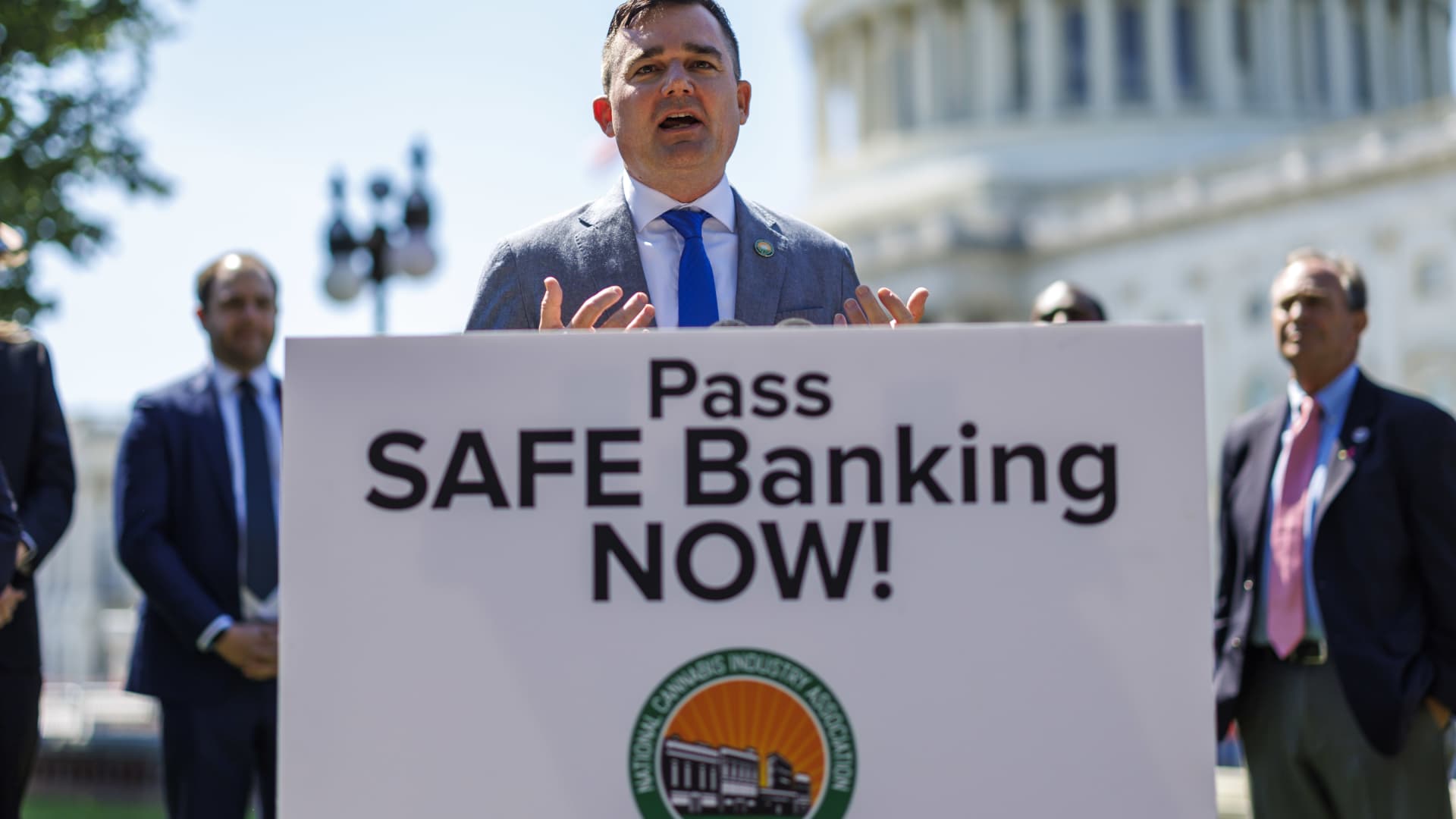
Aaron Smith, chief executive officer of the National Cannabis Industry Association, speaks during a news conference on the Safe Banking Act outside the US Capitol in Washington, D.C., on Wednesday, Sept. 14, 2022.
Ting Shen | Bloomberg | Getty Images
The Senate Banking Committee is holding its first-ever hearing Thursday on a bipartisan bill that would allow the cannabis industry to access traditional banking services — which marijuana businesses see as critical to their survival.
The meeting, titled “Examining Cannabis Banking Challenges of Small Businesses and Workers,” will hear testimony from lawmakers on both sides of the aisle, including Sens. Jeff Merkley, D-Ore., and Steve Daines, R-Mont., who reintroduced the standalone bill last week. The committee will also hear from witnesses including the Cannabis Regulators of Color Coalition, Drug Policy Alliance and the United Food and Commercial Workers International Union.
Thursday’s hearing will determine next steps in getting the bill to the Senate floor for a vote, as Senate Majority Leader Chuck Schumer and other key lawmakers express support for it. It comes as the marijuana industry, which is facing a downturn even as more states approve legal markets, has pushed Congress to take action on the issue.
“Without full access to the banking and payments system, legal cannabis businesses are forced to operate in the shadows,” said Sen. Sherrod Brown, an Ohio Democrat and chairman of the committee, during opening remarks.
Many business owners also rely funds from friends and family in lieu of small business and bank loans because “they might go through all the cost and effort, only to be denied,” Brown said.
Echoing Brown, committee ranking member Sen. Tim Scott, R-S.C., said that “Congress has a responsibility to ensure that all legal industries have access to financial institutions and services.”
But he added that lawmakers must eliminate the possibility of loopholes in money-laundering laws before the act becomes law. Any loopholes could make it harder for law enforcement to catch drug and weapons traffickers, Scott said.
Senate action on the bill is welcome news to executives across the industry, including Craig Sweat, the owner of Uncle Budd NYC, the company that first brought mobile dispensary trucks to New York City.
“I’ve been held up for so long that I have product that is sitting and getting old,” said Sweat, who after years of operating his mobile dispensary company and then a delivery service, has entered into a lucrative manufacturing and licensing partnership with Omnium Canna to produce his products.
“I have no way of transferring funds, I can’t pay staff, I’m just sitting on my hands,” Sweat said, adding that his latest business venture hasn’t been able to launch as banks, fearful of federal prosecution, have been giving him the “runaround.”
The Secure and Fair Enforcement Banking Act, also known as SAFE, hit a wall in Congress last year after lawmakers excluded it from a $1.7 trillion government funding bill. It was the seventh time the legislation, which has always had strong bipartisan support, failed to get through the Senate after passing in the House of Representatives.
Last month, the bill, which has been tweaked since last session, was reintroduced by Sens. Merkley and Daines, and Reps. Dave Joyce, R-Ohio, and Earl Blumenauer, D-Ore. The bill has strong bipartisan support with 38 additional cosponsors in the Senate and eight more cosponsors in the House.
Under federal law, banks and credit unions face federal prosecution and penalties if they provide services to legal cannabis businesses since it is still a Schedule I substance, along with heroin and LSD. Schedule I substances, according to the federal Drug Enforcement Administration, are defined as drugs with no currently accepted medical use and a high potential for abuse.
Without access to traditional banks, legal marijuana businesses can’t access loans and capital, or even use basic bank accounts. As such, businesses are are forced to operate in a cash-only model, which can result in robbery, money laundering, and organized crime.
Key components of the bill protect banks that work with state-legal cannabis businesses. The legislation would shield them from being penalized by federal regulators, creating a safe harbor from criminal prosecution, liability and asset forfeiture for banks, their officers or employees.
The new version of the plan also extends safe harbor to organizations that assist underserved communities including the Community Development Financial Institutions and Minority Depository Institutions — smaller institutions that tailor to communities that have often lacked access to banking services.
This week, the American Bankers Association, which represents banks of all sizes from every state in the country, sent a letter thanking the committee for taking up the matter and urging senators to “markup and advance the legislation as soon as possible.”

