


Agriculture may feed the world, but it is also contributing to global warming. Agriculture production uses about 70% of the Earth’s fresh water and makes up about a third of greenhouse gas emissions. But it doesn’t have to. Farming is moving inside, and farmers aren’t exactly what they used to be. New forms of farming, new technology and new companies are greening the greenery.
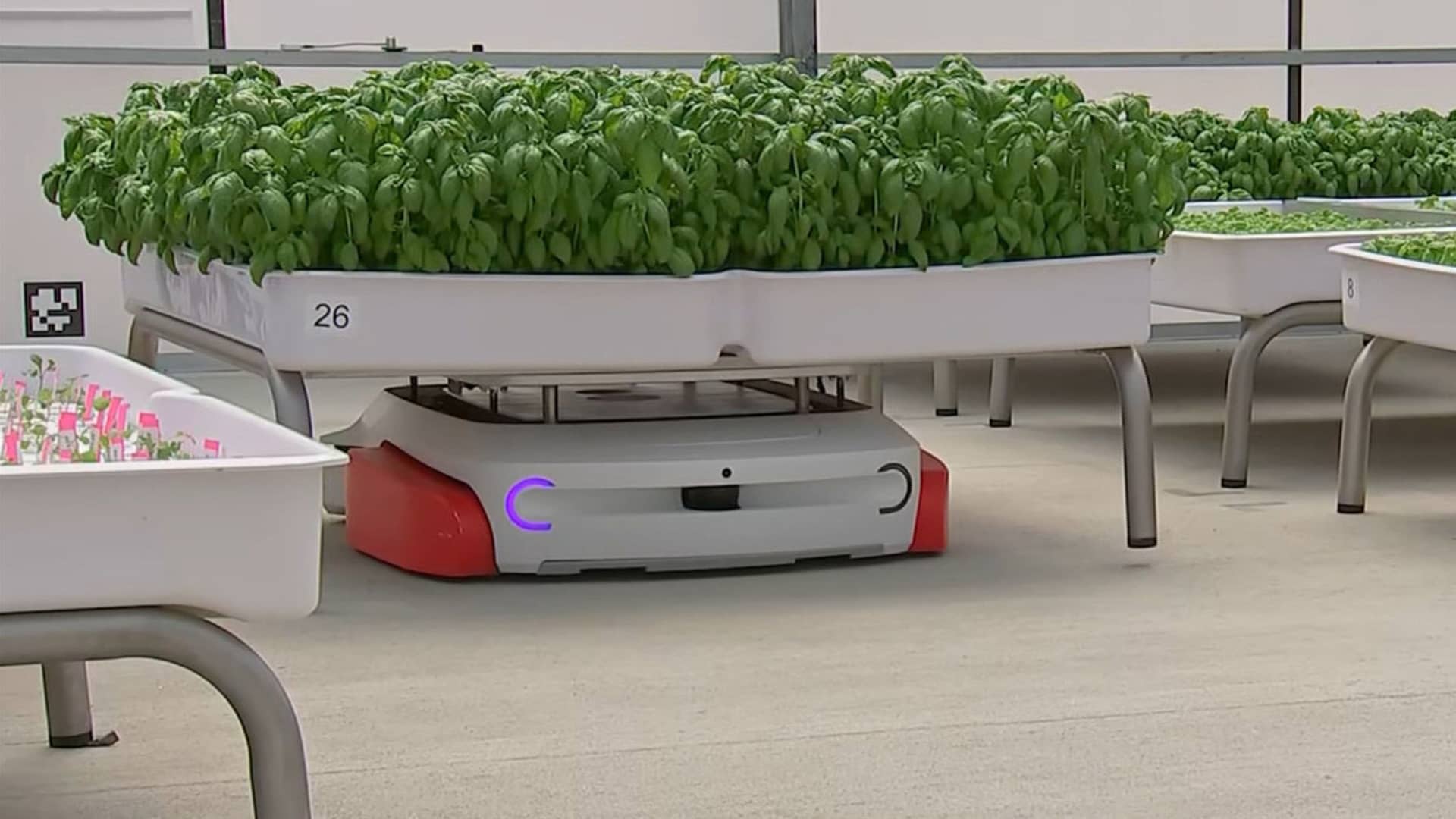
Take for example Grover and Phil. They are autonomous robots — or farmers of the future, working at Iron Ox, a 6-year-old, Silicon Valley-based farm tech start-up. It grows produce in natural light greenhouses, with the goal of decentralizing farming in order to grow crops closer to consumers in a more sustainable way.
“We have different robots that are tending to the plants, they’re checking on it, they’re scanning for issues, and they’re adjusting the amount of nutrients it gets, the amount of water it gets,” explained Brandon Alexander, CEO of Iron Ox.
Robot works the hot house at Iron Ox, a Silicon Valley clean agriculture startup.
CNBC
Iron Ox’s method is in direct contrast to what Alexander, who grew up on a Texas farm, calls the “spray and pray” approach to agriculture, where more chemicals create more quantity at the expense of quality. Growing indoors allows farmers to grow any crop at any time, regardless of climate and of climate change. It also uses hydroponics, growing crops without soil so water goes directly to the roots.
“A lot of the water in field farming gets just washed out and never actually reaches the plant. And when 70% of your fresh water is going into that farming, and only 10% of that actually reaches the plants. It’s just generating a lot of waste,” he said.
Iron Ox does not consider itself “vertical farming,” which is another type of technology designed to limit greenhouse gases by growing in smaller spaces. While there is definitely competition in the clean agriculture space, Alexander says he welcomes it.
“In the indoor farming space today, even with all the investments into it, frankly these investments are a drop in the bucket in terms of the potential of the space. Food done right has the ability to reach more people than the top five tech companies combined,” he added.
Iron Ox is now expanding to Texas, just outside Austin. It sells to retailers such as Whole Foods, as well as to local restaurants. Alexander says the company will produce about 100 times more produce over the next 18 months than it’s currently producing.
The company is backed by Bill Gates’ Breakthrough Energy Ventures, Crosslink Ventures, R7 Partners, Eniac Ventures, Pathbreaker and i/o Ventures and Amplify Ventures. Total funding to date: $98 million.

