


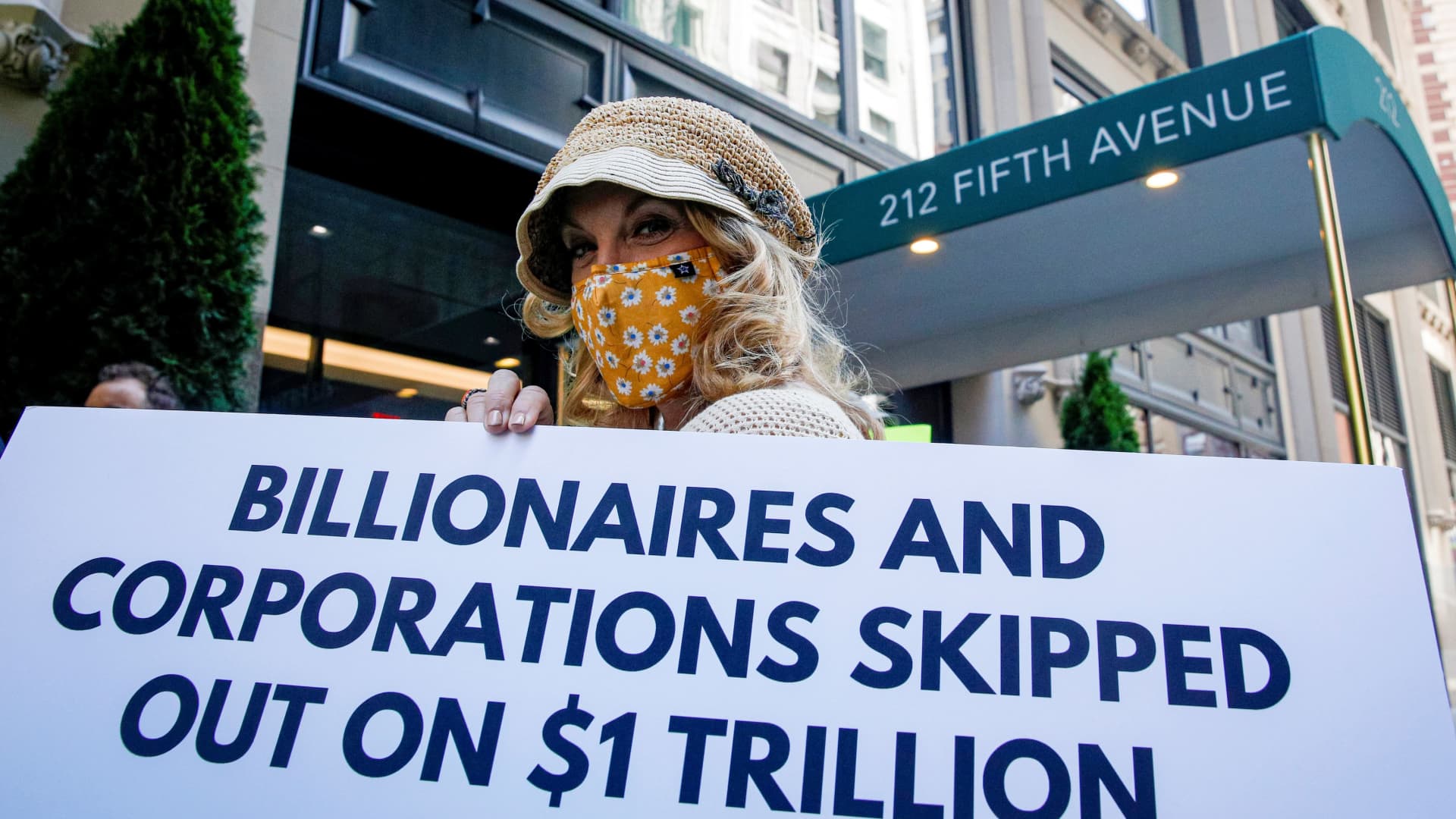
The current United States tax code allows some of the biggest company names in the country to not pay any federal corporate income tax.
In fact, at least 55 of the largest corporations in America paid no federal corporate income taxes on their 2020 profits, according to the Institute on Taxation and Economic Policy. The companies include names like Whirlpool, FedEx, Nike, HP and Salesforce.
“If a large, very profitable company isn’t paying the federal income tax, then we have a real fairness problem on our hands,” Matthew Gardner, a senior fellow at the Institute on Taxation and Economic Policy (ITEP), told CNBC.
What’s more, it is entirely legal and within the parameters of the tax code that corporations can end up paying no federal corporate income tax, which costs the U.S. government billions of dollars in lost revenue.
“[There’s] a bucket of corporate tax breaks that are deliberately in the tax code … . And overall, they cost the federal government roughly $180 billion each year. And for comparison, the corporate tax brings in about $370 billion of revenue a year,” Chye-Ching Huang, executive director of the NYU Tax Law Center, told CNBC, citing research from the Tax Foundation.
CNBC reached out to FedEx, Nike, Salesforce and HP for comment. They either declined to provide a statement or did not respond before publication.
The 55 corporations cited by ITEP would have paid a collective total of $8.5 billion. Instead, they received $3.5 billion in tax rebates, collectively draining $12 billion from the U.S. government, according to the institute. The figures don’t include corporations that paid only some but not all of these taxes.
“I think the fundamental issue here is there are two different ways in which corporations book their profits,” Garrett Watson, senior policy analyst at the Tax Foundation, told CNBC. “The amount of profits that corporations may be reporting for financial purposes may be very different from the profits that they are reporting [for tax purposes.]”
Some tax expenditures, which come in many different forms, are used by some companies to take advantage of rules that enable them to lower their effective tax rates.
For example, Gardner’s research into Amazon’s taxes from 2018 to 2021 showed a reported $79 billion of pretax U.S. income. Amazon paid a collective $4 billion in federal corporate income tax in those four years, equating to an effective annual tax rate of 5.1%, according to Gardner’s ITEP report, about a quarter of the federal corporate tax rate of 21%.
Amazon told CNBC in a statement, “In 2021, we reported $2.3 billion in federal income tax expense, $5.2 billion in other federal taxes, and more than $4 billion in state and local taxes of all types. We also collected an additional $22 billion in sales taxes for U.S. states and localities.“
One controversial form of federal tax expenditure is the offshoring of profits. The foreign corporate income tax — anywhere between 0% and 10.5% — can incentivize the shifting of profits to tax havens.
For example, Whirlpool, a U.S. company known for manufacturing home appliances both in the U.S. and Mexico, was cited in a recent case involving both U.S. and Mexican taxes.
“[Whirlpool] did that by having the Mexican operation owned by a Mexican company with no employees, and then having that Mexican company owned by a Luxembourg holding company that had one employee,” Huang told CNBC. “And then it tried to claim that due to the combination of the U.S., Mexico and Luxembourg tax rules … it was trying to take advantage of the disconnect between all of those tax systems to to avoid tax and all of those countries and of court said, no, that goes too far.”
Whirlpool defended its actions in a statement to CNBC: “The case before the Sixth Circuit has never been about trying to avoid U.S. taxes on the profits earned in Mexico. This tax dispute has always been about when those profits are taxed in the U.S. In fact, years before the original Tax Court decision in 2020, Whirlpool had already paid U.S. tax on 100% of the profits it earned in Mexico. Simply put, the IRS thought Whirlpool should have paid those U.S. taxes earlier.”
Watch the video above to learn about how the most profitable companies in the country maneuver through the complicated tax system and what policy solutions may close some loopholes.


