


Alena Vorobiova hadn’t thought much about bitcoin before Russia invaded Ukraine in February. Fast forward to border closures and shelling on her hometown, cash shortages at ATMs across the country, and the central bank suspending electronic cash transfers — and she decided to give bitcoin a try.
Whereas money providers often charge transfer fees of 10% or more when you send $100 from the U.S. to Ukraine, bitcoin’s Lightning Network, which is a payments platform built on bitcoin’s base layer, slashes the cost of transactions to virtually zero.
Vorobiova and CNBC decided to put Lightning payments to the test — with the expertise and translation skills of bitcoin developer Gleb Naumenko, who is currently hiding out in the western part of Ukraine as the war rages on.
The bottom line? It really does work as well as bitcoin boosters say it does.
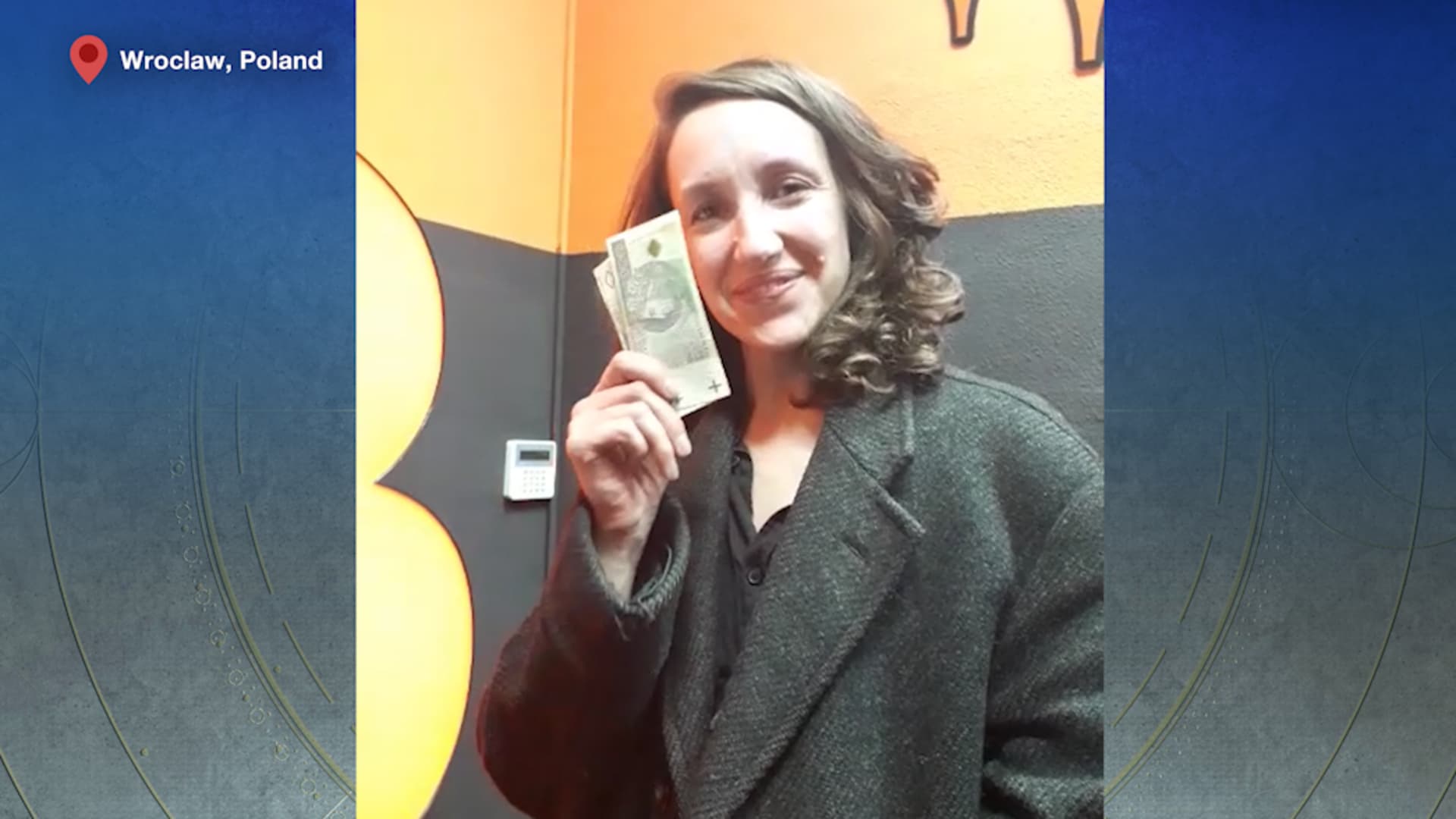
The process of downloading a crypto wallet onto Vorobiova’s phone, transferring bitcoin over the Lightning Network from the U.S. to Poland, and withdrawing the equivalent in Polish currency from a bitcoin ATM from the southwest city of Wrocław took less than three minutes.
Alena Vorobiova withdraws Polish zloty from a bitcoin ATM in Poland.
Sending sats from Dallas to Miami to Poland
Last August on a road trip from Houston to Dallas, Peter McCormack — founder and host of the popular What Bitcoin Did’ podcast — taught CNBC how to use the Lightning Network to make instant payments to anyone in the world.
The tutorial took less than 60 seconds and involved four basic steps: We downloaded the Blue Wallet app and generated a one-time invoice in the form of a QR code. McCormack scanned that QR code using a similar app on his own phone, and then transferred 100,000 satoshis, or sats (the smallest denomination of bitcoin, about 0.00000001 BTC) from his account to ours. The total transfer was equivalent to about $50.
Eight months later, from a hotel room in Miami on the sidelines of the Bitcoin 2022 conference, CNBC decided to pay that knowledge — and some of those sats — forward.
On a three-way video call with Naumenko in Western Ukraine, Vorobiova in Southwest Poland, and CNBC in Miami, we followed a very similar sequence of events.
With the guidance of Naumenko, Vorobiova downloaded the Muun wallet app, a different type of self-custodial wallet for bitcoin and Lightning, made a four-digit pin, and generated an invoice as a QR code. CNBC then captured that QR code using the scan mode in the Blue Wallet and transferred over 50,000 of sats from McCormack. The fees amounted to fractions of a penny. (For purposes of the experiment, Naumenko transferred another 50,000 because the bitcoin ATM had a minimum withdrawal amount.)
Bitcoin developer Jeff Czyz tells CNBC that Lightning wallets are compatible because they all have to implement the Basis of Lightning Technology, or BOLT, specification, which defines a layer-2 protocol for sending payments across the Lightning Network.
“A Lightning wallet app is akin to a bank, in that sending money between banks requires them to speak the same language,” said Czyz, a developer with Jack Dorsey’s team known as Spiral (formerly Square Crypto). That common language is the BOLT specification.
“The Lightning Network consists of nodes connected by payment channels, which are used to forward payments across the network without the need to trust intermediaries,” continued Czyz.
Alena Vorobiova withdraws Polish zloty from a bitcoin ATM in Poland.
Just like the tutorial in the car, the process of transferring sats from Miami to Wrocław also took about a minute.
From there, Vorobiova — who followed her sister and niece to the Polish city of Wrocław to help them get settled — went to one of the fifteen bitcoin ATMs in Wrocław and requested a withdrawal.
She accomplished this by using a QR code that the ATM spit out. She scanned the QR code into her phone using the Muun app, transferred her bitcoin into the ATM’s account, and the ATM in turn issued the money. She ended up with 170 zloty, the Polish currency, worth about 100,000 sats or $40. The ATM company took a fee of 10 zloty, or about 5.5% of the total transaction.
“That’s the same flow as making a payment for a good or service using Lightning,” explained Czyz.
For Vorobiova, this was more of a fun experiment. She is able to go back and forth from Ukraine to Poland, and she tells CNBC that she is following the guidance of Ukrainian regulators to just use credit cards for the time being.
But the process illustrates how refugees with no cash and no way of accessing their belongings can use crypto wallets for banking.
Some Ukrainians use it to facilitate peer-to-peer transactions, while others have found that Lightning is a cheap and fast way to receive donations and remittances from anywhere in the world. In Poland, for example, there are more than 175 bitcoin ATMs, allowing refugees who fled with bitcoin to cash it back out for fiat currency.
“Me sitting in California, I can still send you any amount of money instantly to your phone anytime,” said Gladstein.
“We don’t have to worry about the fact that you’re a refugee. It doesn’t matter that you don’t have a Polish passport or a bank account. None of these things matter,” continued Gladstein.

