


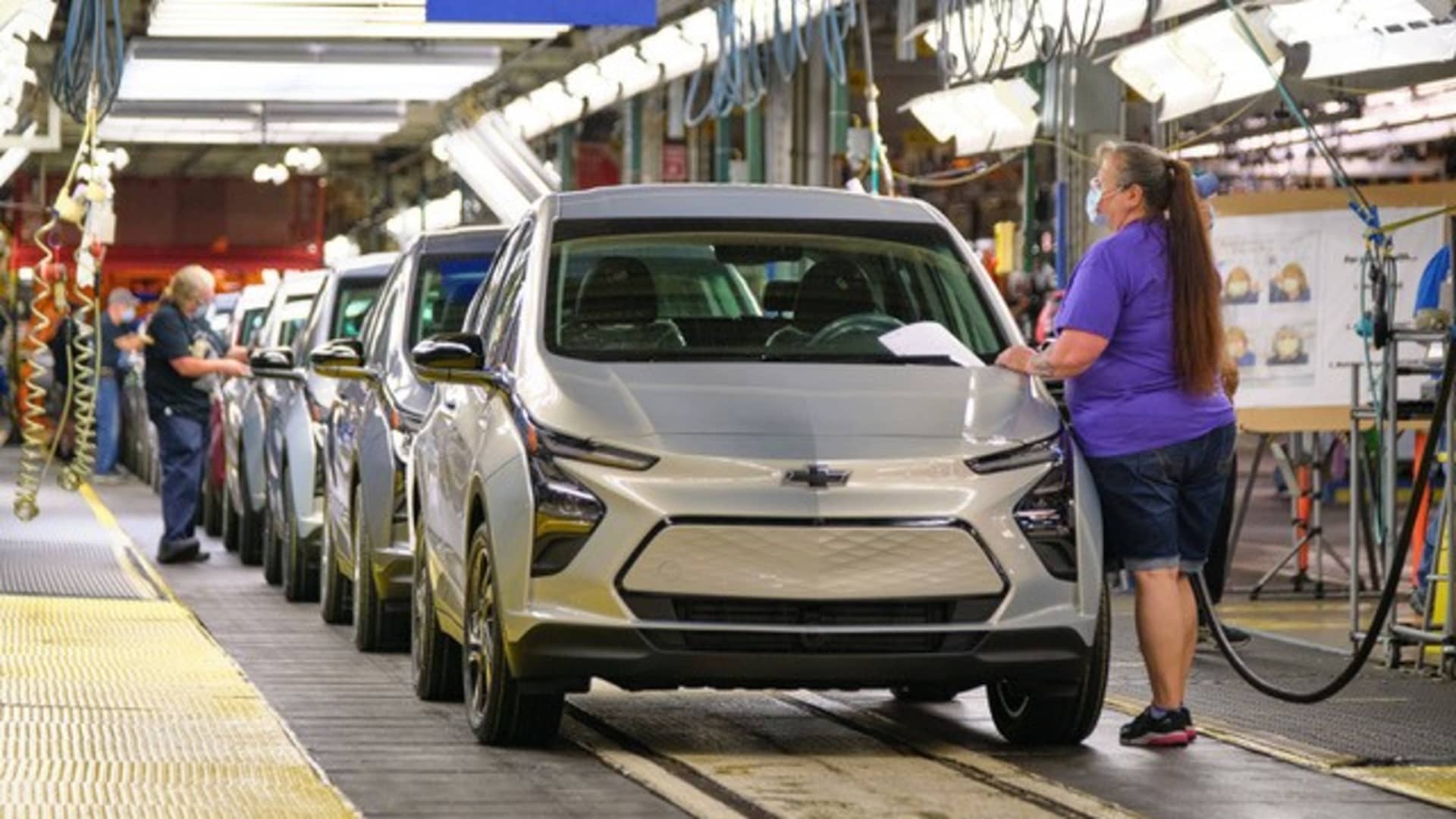
UAW Local 5960 member Kimberly Fuhr inspects a Chevrolet Bolt EV during vehicle production on Thursday, May 6, 2021, at the General Motors Orion Assembly Plant in Orion Township, Michigan.
Steve Fecht for Chevrolet
The Treasury Department is delaying plans to issue proposed guidance for the sourcing of electric vehicle batteries for federal tax incentives from the end of this month to March.
The sourcing of materials and batteries for EVs is a major part of the Inflation Reduction Act’s federal tax credits of up to $7,500 for consumers, which was signed into law by President Joe Biden in August.
That means some electric vehicles that are not expected to comply with the new standards will continue to be eligible for the credits until the proposed guidance issued. Other non-battery elements of the IRA will still take effect Jan. 1, including new income caps for eligible buyers and restrictions on vehicle pricing.
Some have argued the sourcing guidelines for vehicle materials are unrealistic given the current supply chain. Other countries and non-domestic automakers such as Hyundai have argued the rules should be defined more broadly to allow some exemptions.
The Treasury said late-Monday that it will issue the “anticipated direction of the critical mineral and battery component requirements” by the end of this month, and that nothing will take effect until the proposed guidance is issued in March.
The Inflation Reduction Act limits EV tax credits to vehicles assembled in North America and is intended to wean the U.S. off battery materials from China, which reportedly accounts for 70% of global supply of battery cells for the vehicles.
For a $3,750 critical minerals credit, the law states that 40% must be extracted or processed in the U.S. or in a country where the U.S. has a free-trade agreement, or from materials that were recycled in North America.
Credit for the other $3,750 requires that at least 50% of battery components were manufactured or assembled in North America. The percentage requirements for both rise annually to reduce reliance on foreign countries.
Starting Jan. 1, a tax credit will not be available to single individuals with a modified adjusted gross income of $150,000 or higher. The income cutoff is higher for others — $225,000 for heads of household and $300,000 for married couples who file a joint tax return.
Cars with a retail price of more than $55,000 also aren’t eligible, nor are vans, SUVs or trucks that cost $80,000 or more.


