


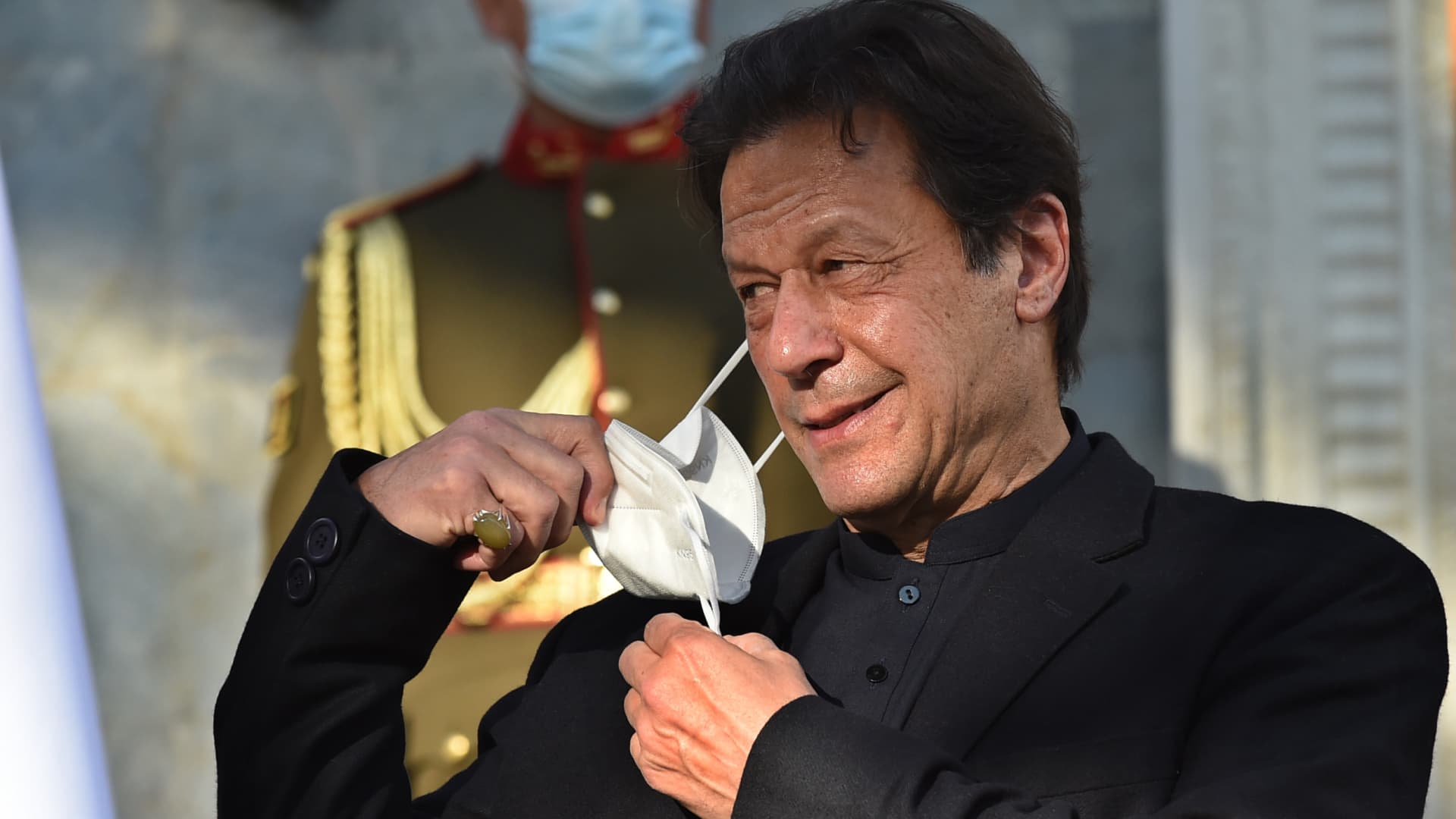
Questions remain on whether the Pakistan Supreme Court could disallow Pakistan’s Prime Minister Imran Khan’s (above) call for early elections.
Wakil Kohsar | Afp | Getty Images
As a cricket bowler, the equivalent of a baseball pitcher, sports legend Imran Khan was famous for his so-called “inswinger.” His deceptively lazy ball often began slowly but suddenly curled sharply inward, taking the batter completely by surprise.
As Pakistan’s Prime Minister, Khan’s move on Sunday to force fresh elections after dodging a no-confidence motion against his government caught the opposition completely off guard as well.
It was a clever ploy. But will it knock off the opposition?
Questions remain on whether the Pakistan Supreme Court — which is expected to weigh in on whether the deputy speaker violated the constitution when he dismissed the no-trust vote — could disallow Khan’s call for early elections.
More critically, will the army — the country’s real power center with which Khan has had a worsening relationship — make its move?
The powerful army has ruled Pakistan for more than half of its 73 years since independence. It wields considerable power in internal politics, security and foreign policy.
On Sunday, Khan avoided an attempt to oust him when Deputy Speaker Qasim Khan Suri refused to hold the no-confidence vote. Suri, a member of Khan’s ruling party, claimed there was “foreign interference” in the attempt to unseat Khan.
Khan took a calculated gamble in his move to call for early elections, said Associate Professor Iqbal Singh Sevea, the director of the Institute of South Asian Studies at the National University of Singapore.
“Imran Khan is betting on retaining his support base and the opposition splintering. The opposition parties are only united by the desire to topple Imran Khan’s government and are unlikely to be able to retain a united front,” he told CNBC on Monday.
Imran Khan has been the favorite son of the military for quite a few years. But he had a spat with the army chief a number of months ago. That relationship is not in a good place.
Michael Kugelman
Deputy director for South Asia, Wilson Center
The court ruling is the first step and there’s an “outside chance” that the court could still reverse Khan’s decision, Michael Kugelman, deputy director and senior associate for South Asia at Wilson Center in Washington DC told “Asia Squawk Box.”
The opposition seems to have a case, according to Iqbal.
“At the very least, it seems to be a misapplication of Article 5 of the constitution,” he said. He was referring to an article which says loyalty is the basic duty of every citizen, and the chair’s ruling implied that members of the opposition who filed the no-confidence motion were acting against Pakistan.
Still, Khan’s electoral gambit may pay off because it’s pegged to “a strong and loyal base,” Iqbal said.
“Over the past few days, Khan has been mobilizing this base through mass rallies and public speeches with a view towards the next election. His message of fighting corruption and political dynasties, together with his appeal to religious symbolism, has won him support,” the professor said.
Khan’s party emerged as the big winner in mayoral and local body elections in Khyber Pakhtunkhwa last week.
“Having said that, inflation and the price of utilities have led to disillusionment amongst sections that voted for him,” said Iqbal. Pakistan’s inflation is over 10% this year and Khan’s handling of the economy has come under attack by the opposition.
The army, which has so far been neutral, is another big unknown.
“Imran Khan has been the favorite son of the military for quite a few years. But he had a spat with the army chief a number of months ago,” Kugelman said. “That relationship is not in a good place. So that means the army chief will not go out of his way to do Imran Khan any favors.”
A number of factors are in play but the next few days may bring some clarity.