


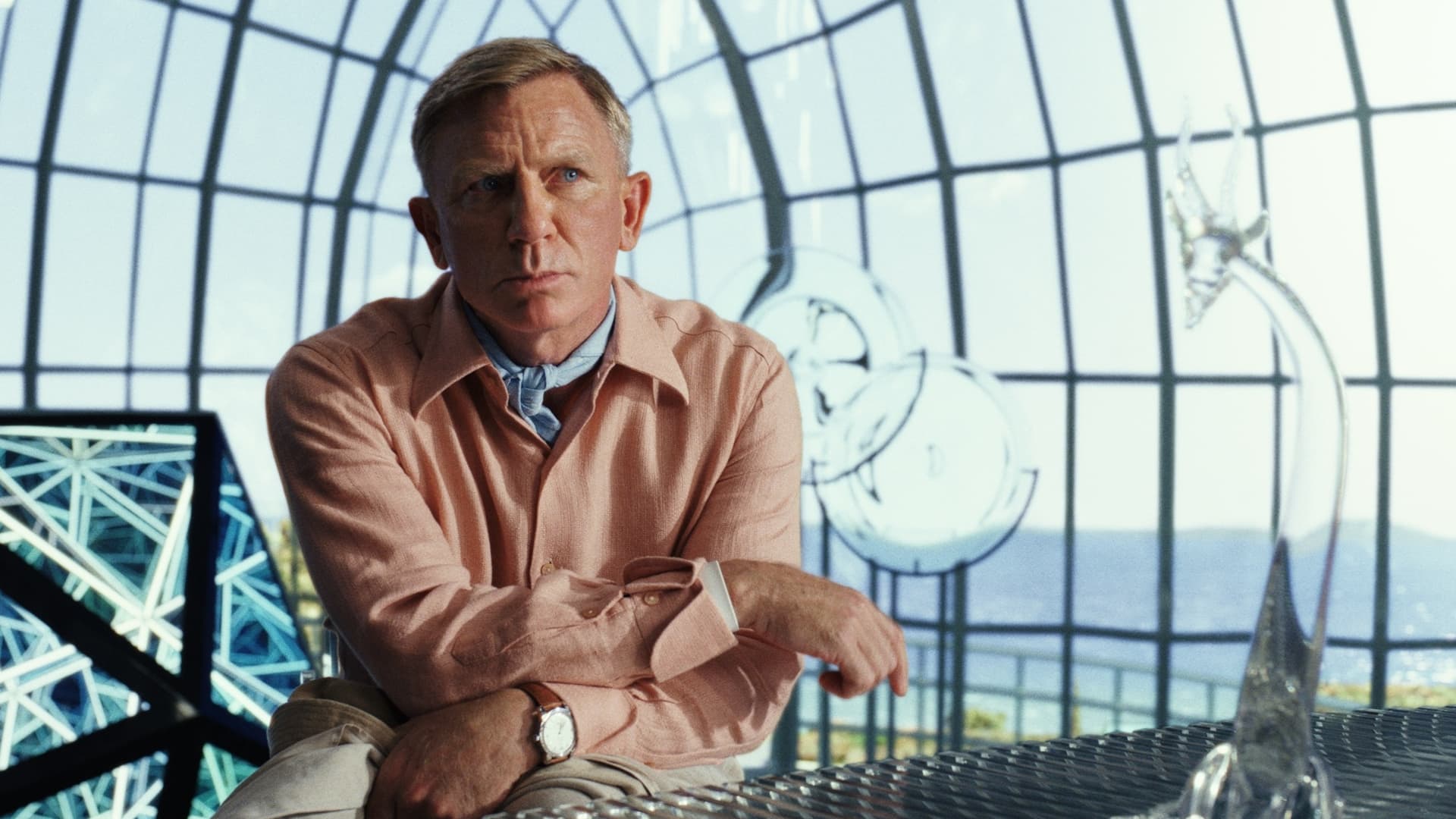
Daniel Craig returns as Benoit Blanc in “Glass Onion: A Knives Out Story.”
Netflix
Netflix backtracked on advertisements. Should theatrical releases be next?
Some theater owners and industry analysts are wondering whether the streaming giant will rethink its resistance to the traditional Hollywood movie release model as it looks for new ways to grow revenue.
This Thanksgiving, Netflix plans to release “Glass Onion: A Knives Out Story,” the sequel to the 2019 hit whodunnit “Knives Out,” in select theaters for a week before offering it to subscribers a month later.
The streamer reportedly shelled out $400 million for the rights to two sequels after the original “Knives Out” generated $312 million globally on a budget of just $40 million. The first film’s performance at the box office in turn provoked questions about why Netflix has limited the release of “Glass Onion” to just one week in only 600 theaters.
And with a thin pipeline of big movie releases this year, theater owners want more from Netflix.
“We are happy they are experimenting and giving us an exclusive time window,” said Brock Bagby, chief content and development officer for B&B Theatres, which has more than 50 locations in 14 states. “But we wish it was a longer run and we wish it was wider.”
Some executives within Netflix reportedly lobbied co-CEO Ted Sarandos earlier this year to consider longer stints in theaters and wider releases for some films, but Sarandos nixed the idea. Top brass at the company have said repeatedly that the future of entertainment is streaming.
Netflix could benefit with a more flexible approach to movie releases, according to some on Wall Street. That could help bring in more box office revenue and attract filmmakers with the prestige that can come with theatrical releases.
“If anything, this past year has shown that Netflix is open to and in need of new sources of revenue,” said Mike Proulx, vice president and research director at Forrester. “Incremental subscription revenue alone just isn’t going to cut it going forward.”
Read more: Netflix wants investors to focus on earnings, not subscriber numbers
That’s partially why Netflix is adding an advertising-supported tier to its service after so many years of resisting, he said.
Michael Pachter, analyst at Wedbush, said he understands Netflix doesn’t make films to profit from theatrical releases, and that the company’s priority is to satisfy its members. “But that ignores the fact that film creators strongly believe in theatrical exhibition as a measure of success,” Pachter said.
Netflix executives have stood firm by their decision to show “Glass Onion” in just 600 theaters for one week. The company’s strategy in the past with limited theatrical releases – such as with Martin Scorsese’s “The Irishman” – has been to build buzz for subscribers when the film arrives on its service. That’s the play here, too, the company said during Tuesday’s earnings video.
“We’re in the business of entertaining our members with Netflix movies on Netflix,” Sarandos said during the call.
He said that Netflix has brought films to festivals and gave them limited runs in theaters because filmmakers have demanded it.
“There [are] all kinds of debates all the time, back-and-forth, but there’s no question internally that we make our movies for our members and we really want them to watch them on Netflix,” he said.
Netflix declined to comment further.
Still tinkering
“One thing Netflix has been successful at historically is iterating, experimenting, and seeing what works best for its members and shareholders,” said Ralph Schackart, research analyst at William Blair. “It then leans into what’s successful and pulls away from what doesn’t work. We think part of Netflix’s historical success has been its willingness to be flexible and to try unconventional methods.”
He said Netflix isn’t likely to commit to a longer theatrical release window until it sees if that strategy can benefit its business.
Additionally, Dan Rayburn, a media and streaming analyst, said that there is no publicly available data that suggests Netflix would make more money from subscriptions, in the long run, if the company did place more of its film content in theaters.
Of course, theatrical releases come with marketing costs, and Netflix has been reluctant to spend on promoting features playing for limited engagements.
And while theatrical releases might open a new revenue stream for Netflix, Forrester’s Proulx noted that movie theaters might not be as relevant as they once were. According to Forrester’s Consumer Energy Index and Retail Pulse survey released in December 2021, 54% of U.S. adults who use a streaming service said they prefer to watch movie premieres on streaming.
Still, people are returning to cinemas after hunkering down early in the pandemic, particularly for action and horror films, as well as established franchises. “Halloween Ends” debuted to $41.25 million at the domestic box office over the weekend, despite also launching on Universal’s streaming service Peacock at the same time.
There’s also a argument to be made to make decisions on a case by case basis, particularly for a movie like “Glass Onion,” considering how well the first installment of the franchise performed in cinemas in late 2019 – especially considering there are so few big movies coming to theaters before the end of the year.
The original “Knives Out,” which carried a $40 million production budget, generated $26.7 million during its opening weekend and held audience attention for weeks, before seeing another boost in ticket sales for the holidays in December holidays. By the end of its theatrical run, it generated $165 million in domestic box office and $312 million worldwide.
“The pros of a longer theatrical run for Netflix would seem to outweigh any cons,” said Shawn Robbins, chief media analyst at BoxOffice.com. “This is not an unproven original film like the streamer has predominantly made for its platform in the past, but a sequel IP with star names and strong commercial potential.”
He also noted that Netflix put such a high value on filmmaker Rian Johnson’s sequels because of the success the original film enjoyed during a long and exclusive theatrical run under Lionsgate.
“Without that latter component, would Netflix have invested as much in ‘Glass Onion’ and its eventual follow-up, if at all?” Robbins said.
The deal for two sequels to “Knives Out” was announced in March 2021 and was said to be valued around $400 million. Johnson was to retain complete creative control and Daniel Craig, the star of the original film, would return for both films.
“Like the first film, the legs could be really strong,” B&B’s Bagby said of “Glass Onion.”
Disclosure: Comcast is the parent company of Universal, Peacock and CNBC.

