


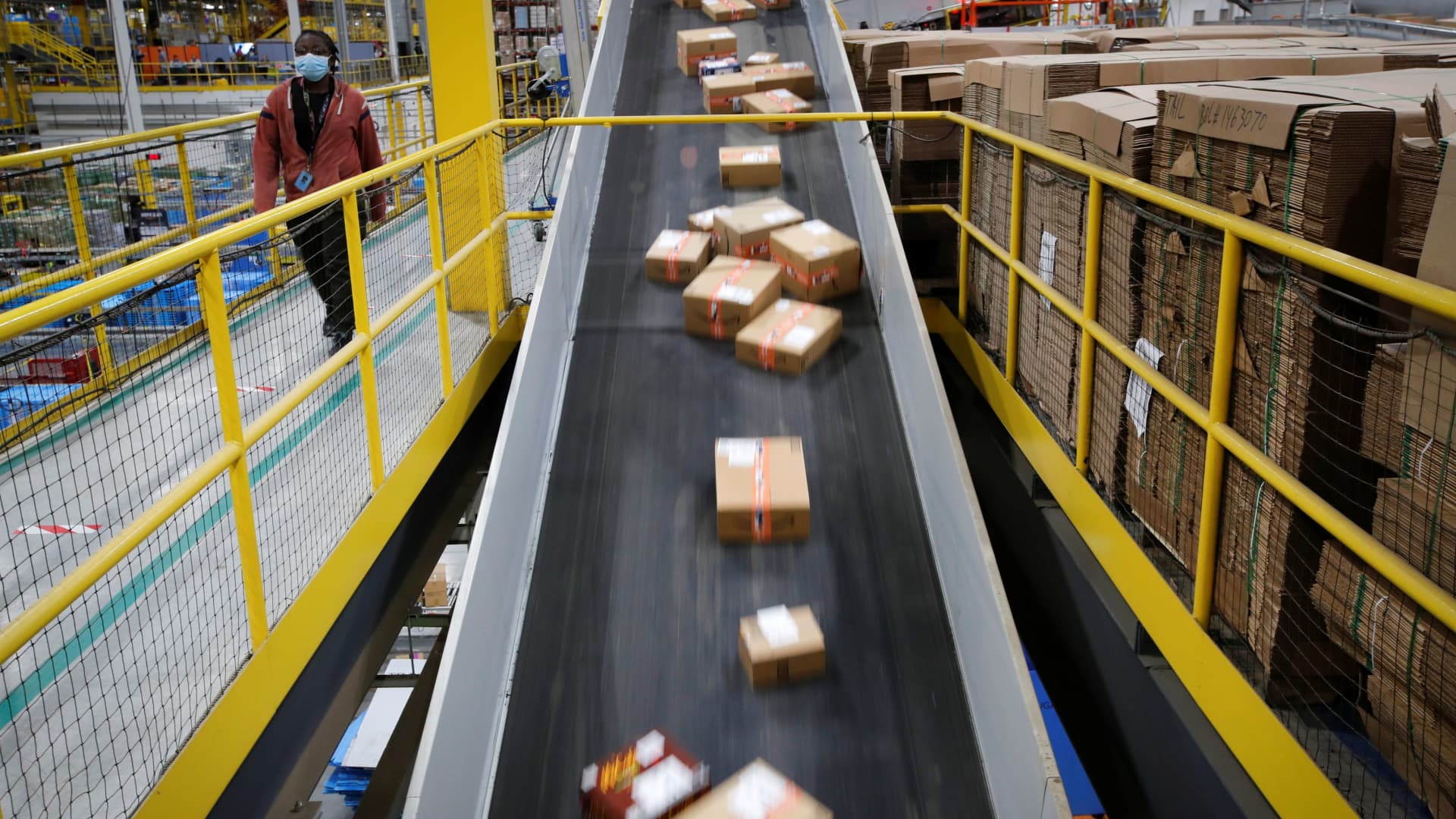
The big carriers such as FedEx, UPS and Amazon make lots of deliveries, and none of those packages are being shipped for “free.”
“People like free shipping because the word free is very powerful, even if people know that it’s not really free because someone is paying for it,” Kara Buntin, owner of the Etsy shop A Cake To Remember, told CNBC.
There were more than 131 billion parcels shipped worldwide in 2020, and parcel shipments are expected to double again in the next five years — possibly reaching 266 billion by 2026 — according to Pitney Bowes.
“When consumers click that ‘buy’ box, they often don’t see [the] labor that leads to a box on their doorstep,” Ellen Reese, a sociology professor at UC Riverside and co-editor of “The Cost of Free Shipping: Amazon in the Global Economy,” told CNBC.
And those shipping costs are ever-increasing.
“Anyone can offer an Amazon Prime two-day shipping. It’s just the cost that…might incur in providing that service,” Dhruv Saxena, co-founder of third-party logistics company ShipBob, told CNBC. He estimates it may cost a company anywhere from $25 to $35 for a typical two-day shipping rate.
Companies such as Amazon, Walmart, Target and even Etsy benefit from economies of scale because they generate mass online sales. This puts them at an advantage to achieve bulk discount rates, according to the U.S. Postal Service.
When CNBC asked the Postal Service for information about how much money Amazon, Walmart and Target pay the Service to ship packages, the department said no contracts exist, but “there may be possibly an agreement in place with negotiated rates to deliver packages. However, we cannot confirm nor deny an agreement exists.”
This is due to federal regulations dictating acknowledgment the existence of a specific national service agreement “would cause harm and is confidential commercial information that would not be disclosed under good business practice,” the Postal Service said.
Amazon, FedEx and UPS either declined or could not be reached for comment for this story.
“Many [small businesses] have been under pressure, shutting down and closing because they can’t compete, “Jake Alimahomed-Wilson, a sociology professor at California State University Long Beach and co-editor of “The Cost of Free Shipping: Amazon in the Global Economy,” told CNBC.
In a 2019 survey, three-quarters of independent retailers said Amazon’s dominance is a major threat to their survival, according to the Institute for Local Self-Reliance.
“You can’t really plan for how much [carriers] are going to charge or how much [packages] are going to cost when you ship them, and that makes it difficult to offer free shipping because a lot of times you end up with no profit if you’re not really careful,” Buntin said.
Watch the video above to learn why free shipping is a myth, what it really costs companies to send parcels around the country and how it impacts consumer sentiment.
