


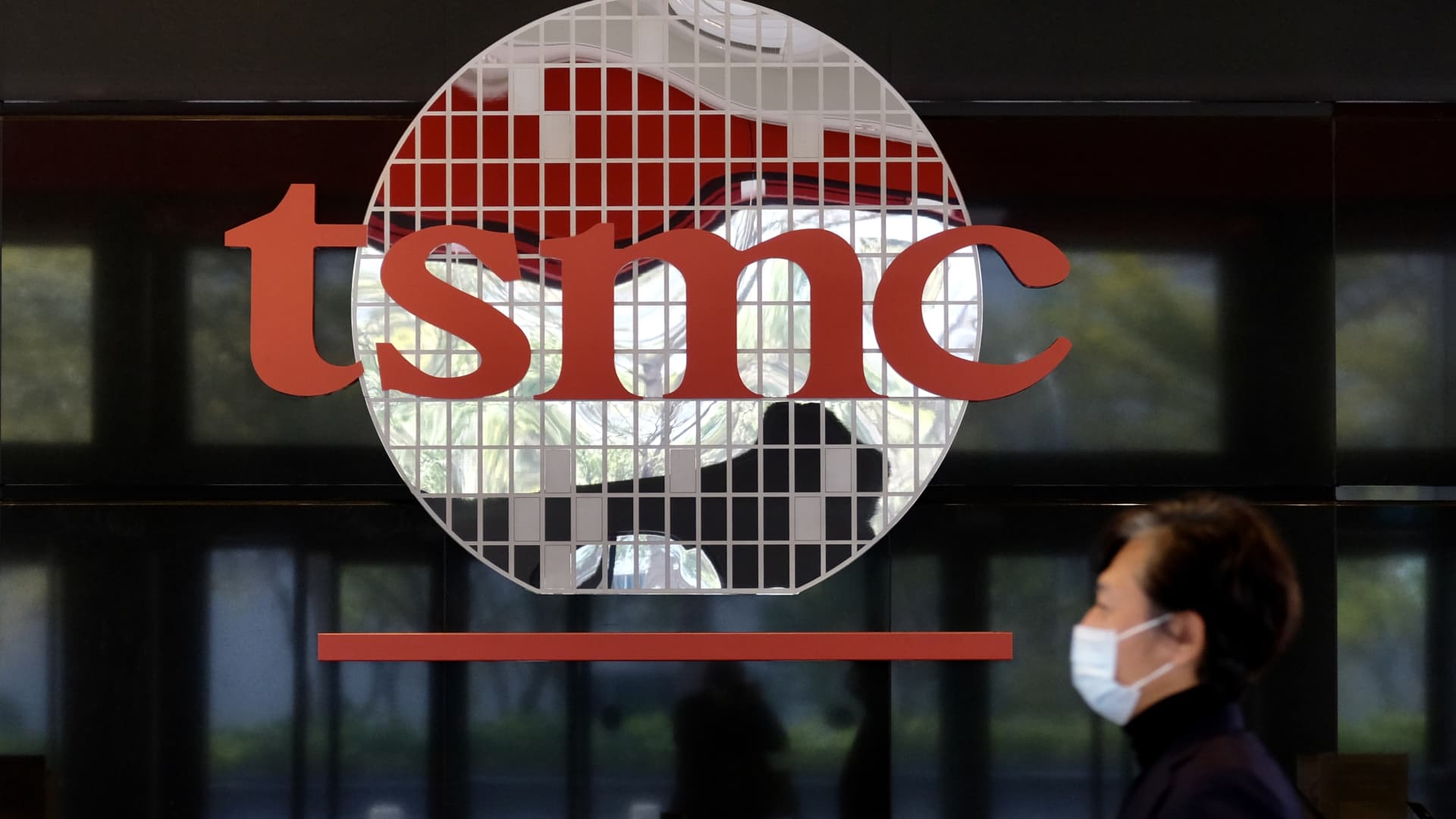
A man walks past TSMC’s logo at the company’s headquarters in Hsinchu, Taiwan.
Sam Yeh | AFP | Getty Images
If China were to invade Taiwan, the most-advanced chip factory in the world would be rendered “not operable,” TSMC Chair Mark Liu said in an English-language interview with CNN this week.
In the undated interview, Liu said that if Taiwan were invaded by China, the chipmaker’s plant would not be able to operate because it relies on global supply chains.
“Nobody can control TSMC by force. If you take a military force or invasion, you will render TSMC factory not operable,” Liu said. “Because this is such a sophisticated manufacturing facility, it depends on real-time connection with the outside world, with Europe, with Japan, with U.S., from materials to chemicals to spare parts to engineering software and diagnosis.”
TSMC, the world’s most advanced chip manufacturer, makes processors for American companies including Apple and Qualcomm. It manufactures Apple’s A-series and M-series chips and has over 50% of the world’s semiconductor foundry market.
The remarks were aired as tensions between China and Taiwan have escalated in recent days as House Speaker Nancy Pelosi visits the island.
“The war brings no winners, everybody’s losers,” Liu said.
Last week, the House of Representatives passed the Chips and Science Act, which sets aside billions of dollars in incentives to build chip factories on U.S. soil. President Biden is expected to sign the bill on Tuesday.
Backers of the legislation say it is critical for national security to secure the supply of efficient and modern chips for U.S. usage if China were to invade or otherwise make it more difficult to manufacture chips in Taiwan.
While much of the bill’s incentives will go to American companies like Intel, TSMC is building a $12 billion chip factory in Arizona that could benefit from the subsidies.
Liu compared a potential conflict in Taiwan to Russia’s invasion of Ukraine, saying that while the two conflicts are very different, the economic impact to other countries would be similar. He encouraged political leaders to try to avoid war.
“Ukraine war is not good for any of the sides, it’s lose-lose-lose scenarios,” Liu said.
Liu said an invasion of the territory would cause economic turmoil for China, Taiwan and Western countries. He said that TSMC sells chips to consumer-facing Chinese companies that need the company’s services and the supply of advanced computer chips.
“How can we avoid war? How can we ensure that the engine of the world economy continues humming, and let’s have a fair competition,” Liu said.

