


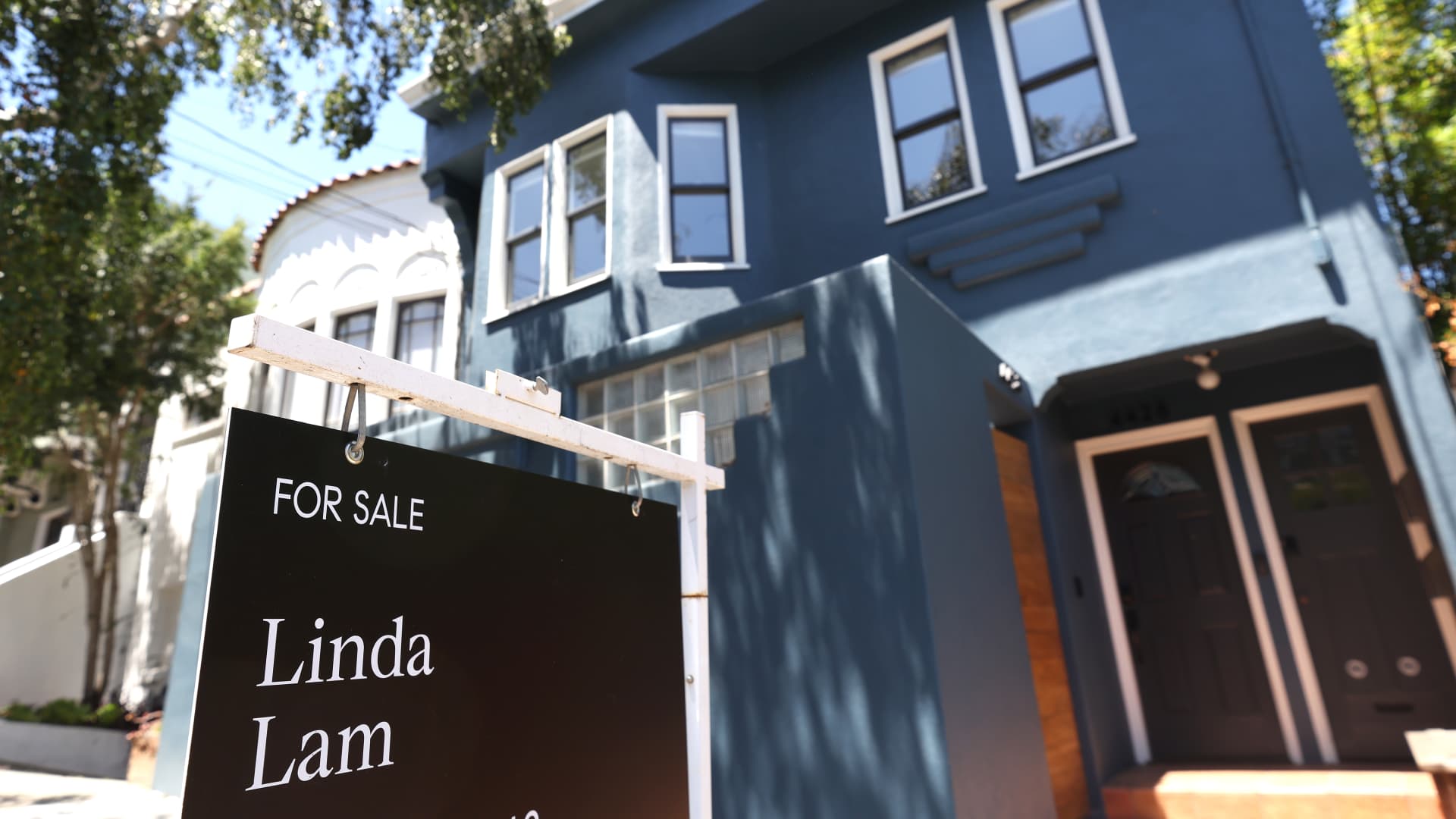
A sign is posted in front of a home for sale on July 14, 2022 in San Francisco, California. The number of homes for sale in the U.S. increased by 2 percent in June for the first time since 2019.
Justin Sullivan | Getty Images
Rising mortgage rates and inflation in the wider economy caused housing demand to drop sharply in June, forcing home prices to cool down.
Home prices are still higher than they were a year ago, but the gains slowed at the fastest pace on record in June, according to Black Knight, a mortgage software, data and analytics firm that began tracking this metric in the early 1970s. The annual rate of price appreciation fell two percentage points from 19.3% to 17.3%.
Price gains are still strong because of an imbalance between supply and demand. The housing market has had a severe shortage for years. Strong demand during the coronavirus pandemic exacerbated it.
Even when home prices crashed dramatically during the recession of 2007-09, the strongest single-month slowdown was 1.19 percentage points. Prices are not expected to fall nationally, given a stronger overall housing market, but higher mortgage rates are certainly taking their toll.
The average rate on the 30-year fixed mortgage crossed above 6% in June, according to Mortgage News Daily. It has since dropped back into the lower 5% range, but that is still significantly higher than the 3% range rates were in at the start of this year.
“The slowdown was broad-based among the top 50 markets at the metro level, with some areas experiencing even more pronounced cooling,” said Ben Graboske, president of Black Knight Data & Analytics. “In fact, 25% of major U.S. markets saw growth slow by three percentage points in June, with four decelerating by four or more points in that month alone.”
Still, while this was the sharpest cooling on record nationally, the market would have to see six more months of this kind of deceleration for price growth to return to long-run averages, according to Graboske. He calculates that it takes about five months for interest rate impacts to be fully reflected in home prices.
Markets seeing the sharpest drops are those that previously had the highest prices in the nation. Average home values in San Jose, California, have fallen 5.1% in the last two months, the biggest drop of any of the top markets. That chopped $75,000 off the price.
In Seattle, prices are down 3.8% in the past two months, or a $30,000 reduction. San Francisco, San Diego and Denver round out the top five markets with the biggest price reductions.
The cooling in prices coincides with a sharp jump in the supply of homes for sale, up 22% over the last two months, according to Black Knight. Inventory is still, however, 54% lower than 2017-19 levels.
“With a national shortage of more than 700,000 listings, it would take more than a year of such record increases for inventory levels to fully normalize,” said Graboske.
Price drops will not affect the average homeowner as much as they did during the Great Recession, because homeowners today have considerably more equity. Tight underwriting and several years of strong price appreciation caused home equity levels to hit record highs.
Despite that, the strong demand in the market recently could present a problem for some. About 10% of mortgaged properties were purchased in the last year, so price drops could cause some borrowers to edge much lower in their equity positions.

