


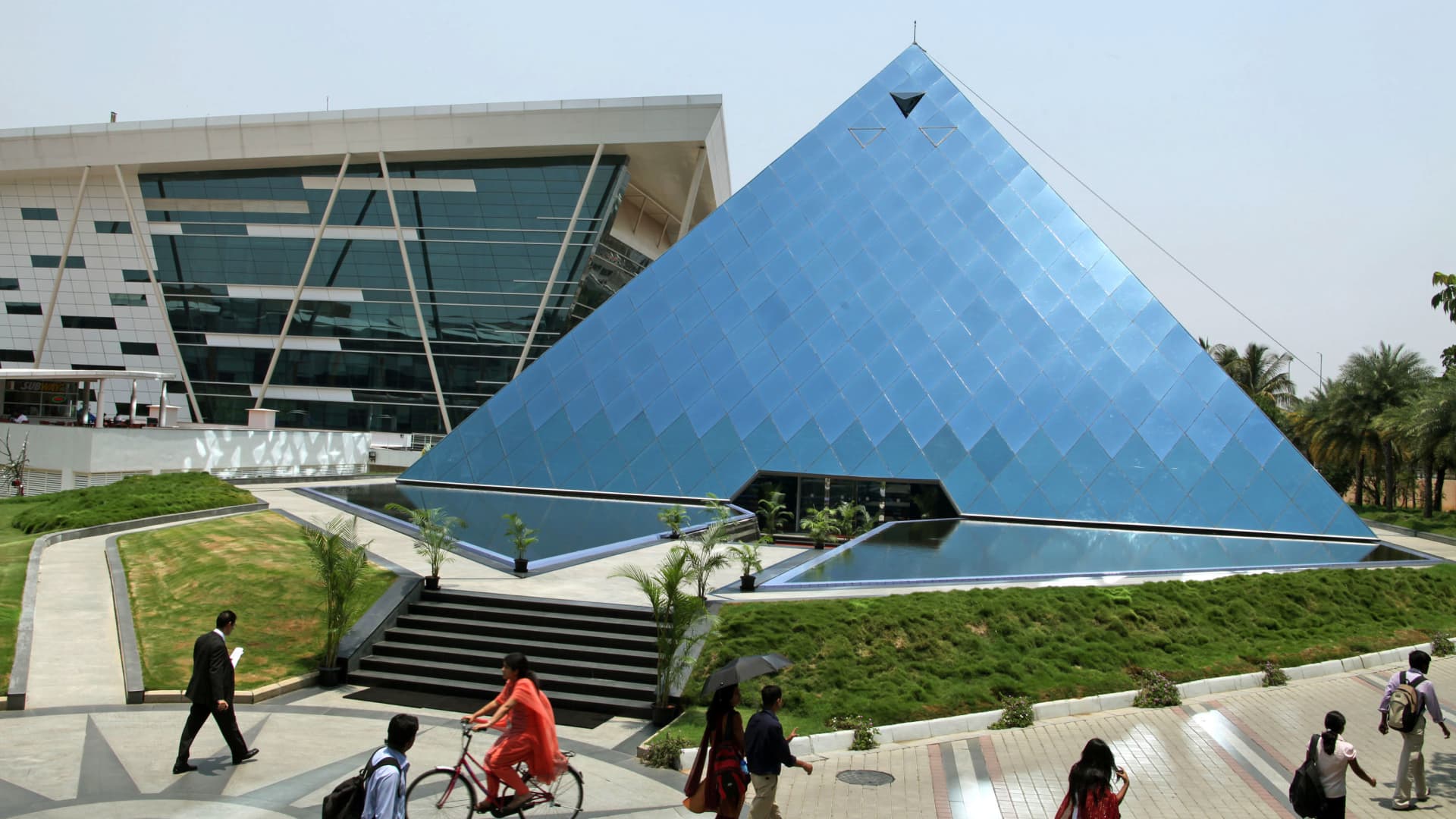
There is a wild mismatch between the salaries of the CEOs of Indian Information Technology companies and lower and mid-level employees, the latter seen here going about their business at the headquarters of India’s best-known technology company, Infosys Technologies Ltd. in Bangalore in a stock photo.
Bloomberg | Bloomberg | Getty Images
The chief executive officers of Indian information technology companies are being paid big bucks as attrition rates surge among employees.
IT major Wipro’s CEO Thierry Delaporte earned $10.5 million in the fiscal year ending March 31, 2022. Infosys CEO Salil Parekh began drawing $10.2 million this year under the terms of a new five-year contract, almost doubling his pay from 2021.
This means that Delaporte and Parekh will earn more in roughly three hours than the average employee would in an entire year, according to back-of-the-envelope calculations by Nascent Information Technology Employees Senate, an association of software employees in India.
NITES President Harpreet Singh Saluja told CNBC that Indian IT CEOs are taking home “obscenely high salaries” despite pandemic layoffs.
“Those that skirted layoffs did so by announcing pay cuts,” Saluja said.
The CEO of India’s largest software company Tata Consultancy Services Rajesh Gopinathan drew the lowest salary among his peers, with his pay totaling $3.2 million.
On Wednesday, Wipro reported quarterly revenue surged 17.9% from a year ago to $2.7 billion, while net income dropped 20.9% to $324.4 million.
Wipro also reported that 23.3% of its employees left in the three months ending June 30, a marginal drop from the 23.8% rate reported for the January-March quarter. During Wipro’s April earnings call, Delaporte said the company will “increase the frequency of promotion cycles for 70% of our colleagues in junior bands, to now a quarterly basis.”
Wipro did not respond to CNBC’s requests for comment.
Rising executive pay
Infosys, India’s second-largest IT company, reported an annualized attrition rate of 27.7%, according to its most recent quarterly results. It also raised its CEO’s compensation by 88%.
In its report, the company said “the overall wages at leadership levels remained constant during fiscal 2022. However … the higher remuneration [is] primarily on account of the increase in perquisite value of stock incentives granted in previous years but exercised during the year.”
The Infosys board said it aimed to make Parekh’s salary comparable to that of his peers at other global software companies such as Accenture, Cognizant and IBM. His salary is still lower than that of those companies’ CEOs. Accenture’s Julie Sweet earns over $23 million a year, Cognizant’s CEO Brian Humphries is paid over $19.6 million and IBM’s Arvind Krishna pockets just over $17.5 million.
Infosys did not comment when contacted by CNBC, citing its quiet period ahead of its upcoming earnings report, scheduled for July 24.
Mohandas Pai, who served on Infosys’ board in its early days as an outsourcing company, said the “absurdly high” CEO salaries showed the “Americanization” of the Indian software industry.
“These are offshore companies. They are not American companies. They grew, not because of a mercenary attitude towards people, but because of a people-centric attitude,” he said.
Pai said billable employee pay has remained almost flat since 2009, while that of senior executives has gone up many times over. Billable employees in the sector are typically those who write software code and whose time is directly billed to clients. They are generally programmers and software engineers who have up to five years experience in the industry.
Surging labor demand
Pai, who also previously served as Infosys’ CFO, said pay for new recruits in India is not keeping up with surging demand for software professionals globally.
Between 600,000 and 650,000 people were hired in India’s technology sector in 2021, according to Pai, who called it the largest hiring spree in the world. He estimated between 1.4 million and 1.5 million people will be hired “over the next two years in India across IT services and start-ups.”
Pai attributed climbing attrition rates to low pay in the industry despite many software companies reporting record revenue during the pandemic. He estimated attrition costs companies $5,000 per employee. Indian software companies can reduce attrition rates by 30% to 35% by paying fair wages, Pai said.
“Globally, India is the only country with surplus human capital in technology. There is a huge shortage in the United States, and an inadequate number of qualified people across Europe. And Southeast Asia does not have the kind of talent in place, making India the only country that serves global markets,” Pai said.


