


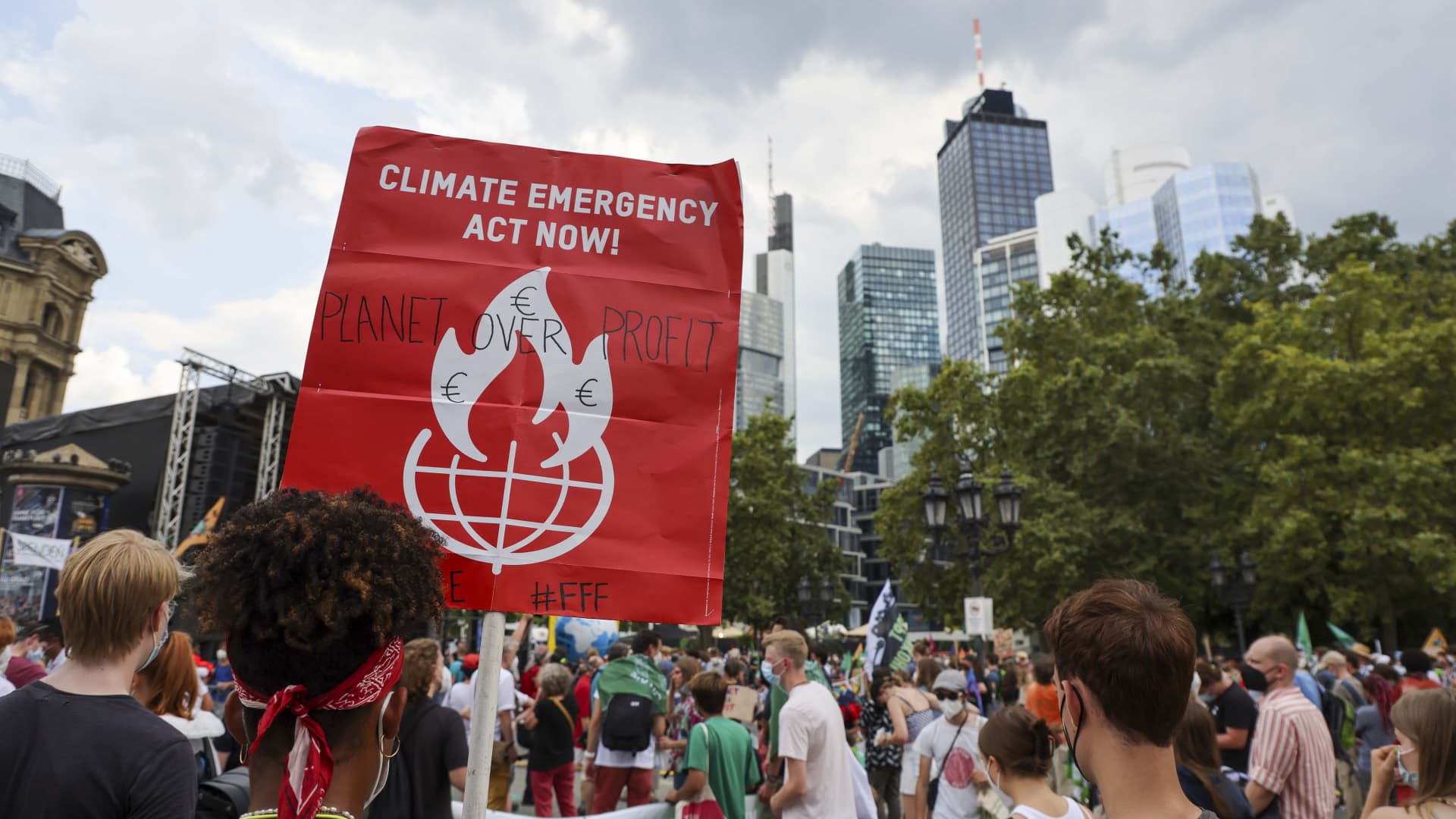
Environmental protesters take to the streets during a demonstration by Fridays for Future in the financial district of Frankfurt, Germany, in August last year.
Bloomberg | Bloomberg | Getty Images
The results of the European Central Bank’s first climate risk stress test show that most banks do not sufficiently incorporate climate risk into their stress-testing frameworks and internal models.
In a report published Friday, the ECB said the findings reaffirm the view that banks must sharpen their focus on climate risk.
“Euro area banks must urgently step up efforts to measure and manage climate risk, closing the current data gaps and adopting good practices that are already present in the sector,” Andrea Enria, chair of the ECB’s supervisory board, said in a statement.
A total of 104 banks participated in the test, which is the first of its kind, the ECB said, providing information over three modules, or categories. Those included their own climate stress-testing capabilities; their reliance on carbon-emitting sectors; and their performance under different scenarios over several time horizons.
The results of the first module found that roughly 60% of banks do not yet have a climate risk stress-testing framework.
Similarly, the ECB said most banks do not include climate risk in their credit risk models and just 20% consider climate risk as a variable when granting loans.
As for the reliance of banks on carbon-emitting sectors, the ECB said that on aggregate, almost two-thirds of banks’ income from non-financial corporate customers stems from greenhouse gas-intensive industries.
In many cases, the report found banks’ “financed emissions” come from a small number of large counterparties, which increases their exposure to emission-intensive sectors.
Within the third module, the results were limited to 41 directly supervised banks to ensure proportionality toward smaller banks. It required lenders to project losses in extreme weather events under different transition scenarios.
The results warned that credit and market losses could amount to around 70 billion euros ($70.6 billion) on aggregate this year for the 41 directly supervised banks.
The ECB noted, however, that this “significantly understates the actual climate-related risk” as it reflects only a fraction of the actual hazard. This was due, in part, to a scarcity of available data.
“This exercise is a crucial milestone on our path to make our financial system more resilient to climate risk,” said Frank Elderson, vice-chair of the ECB supervisory board. “We expect banks to take decisive action and develop robust climate stress-testing frameworks in the short to medium term.”
ECB President Christine Lagarde previously said the central bank was taking steps to incorporate climate change “into our monetary policy operations.”
Bloomberg | Bloomberg | Getty Images
The ECB said it collected both qualitative and quantitative information, with a view to assessing the sector’s climate risk preparedness and gathering best practices for dealing with climate-related risk.
The report concluded that most banks would need to work further on improving their stress test frameworks’ governance structure, data availability and modeling techniques.