


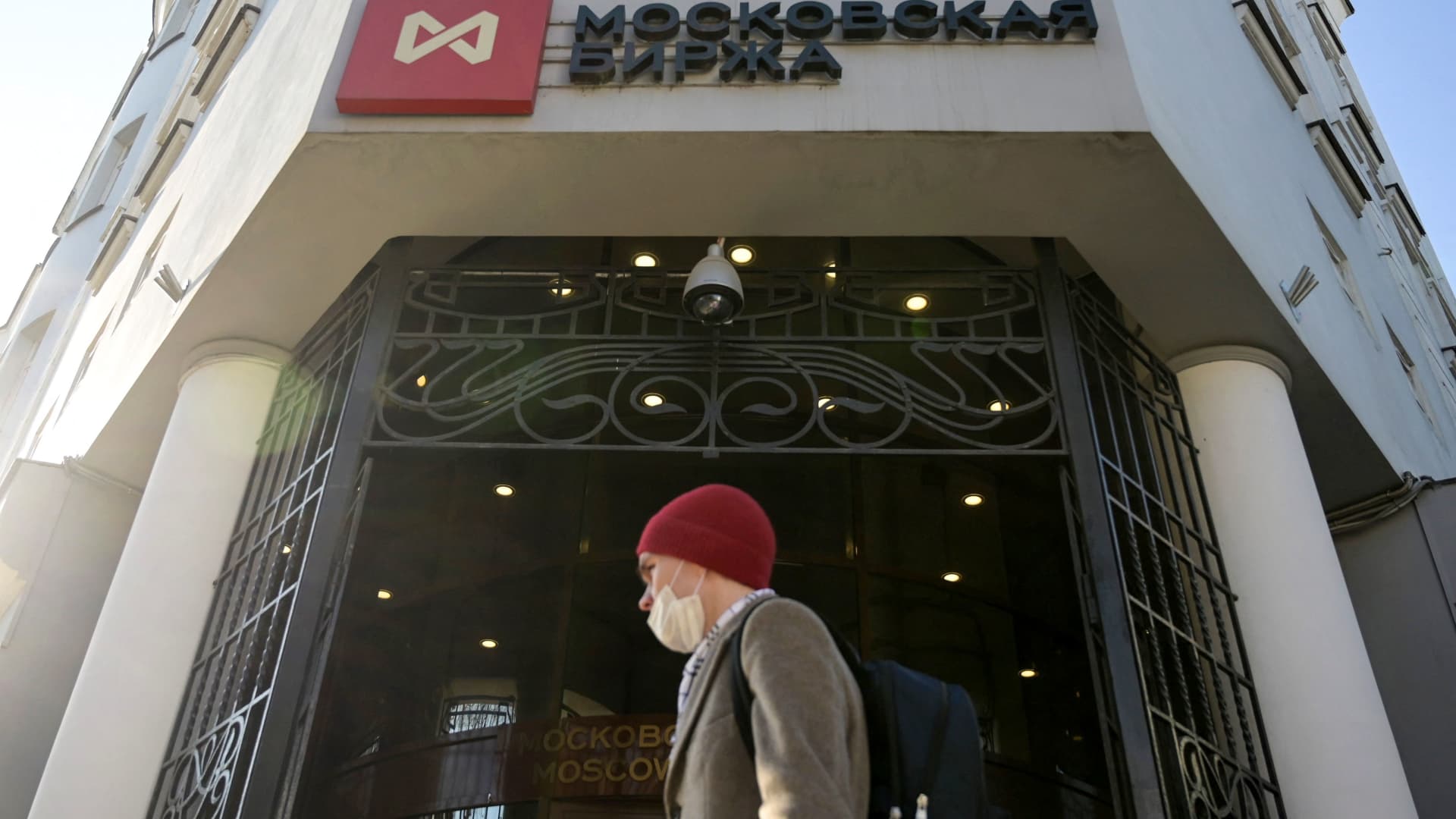
A man walks past Moscow’s stock market building in downtown Moscow on February 28, 2022.
Natalia Kolesnikova | Afp | Getty Images
Russia’s stocks moved sharply on Thursday, after the market partially reopened for limited trading after its longest shutdown since the fall of the Soviet Union.
The Moscow Exchange resumed trading in 33 Russian equities, including some of its biggest names like Gazprom and Sberbank, between 10 a.m. and 2 p.m. Moscow time (3 a.m. and 7 a.m. ET) following an announcement from the Central Bank of Russia on Wednesday.
Short-selling on stocks will be banned, however, and foreign investors will not be able to sell stocks or OFZ ruble bonds until April 1.
The MOEX Russia Index was up more than 5% by around 1 p.m. Moscow time, having pared earlier gains of more than 10%.
Oil giants Rosneft and Lukoil jumped more than 17% and 13%, respectively, while aluminum company Rusal climbed more than 13%. Norilsk Nickel gained more than 10%.
At the other end of the index, Shares of Russian airline Aeroflot initially plunged more than 20%, but soon pared losses to trade around 12% shortly after midday in Moscow.
The country’s stock exchange had been closed since Feb. 25 as Russian assets plunged across the board following the country’s invasion of Ukraine and in anticipation of the punishing international sanctions that followed.
Jeroen Blokland, founder and head of research at Dutch investment firm True Insights, said in a tweet Thursday that investors were going back into Russian stocks “perhaps based on the idea that valuations will revert to pre-war levels.”
“But this is unlikely to happen. It’s very difficult to assign fundamentals, but what we do know is that (self) sanctions will remain for a very long time,” Blokland added.
The Institute of International Finance on Wednesday projected that the Russian economy will contract by 15% in 2022 due to the war in Ukraine, in particular noting the “self-sanctioning” of foreign companies as a contributing factor.
The IIF said domestic demand in Russia will fall sharply, with a “collapse in imports” offsetting a decline in exports.
“Together with a decline of 3% in 2023, this will wipe out fifteen years of economic growth. However, the impact on medium- and long-term prospects is likely to be even more severe,” the D.C.-based international industry body said.
The report added that a “brain drain” and low investment will “weigh heavily” on already-subdued potential growth.